Jennie C. Jones and Fred Eversley at the Pulitzer, and the Perception of a Divided Life
By Noa Ablin
November 23, 2025
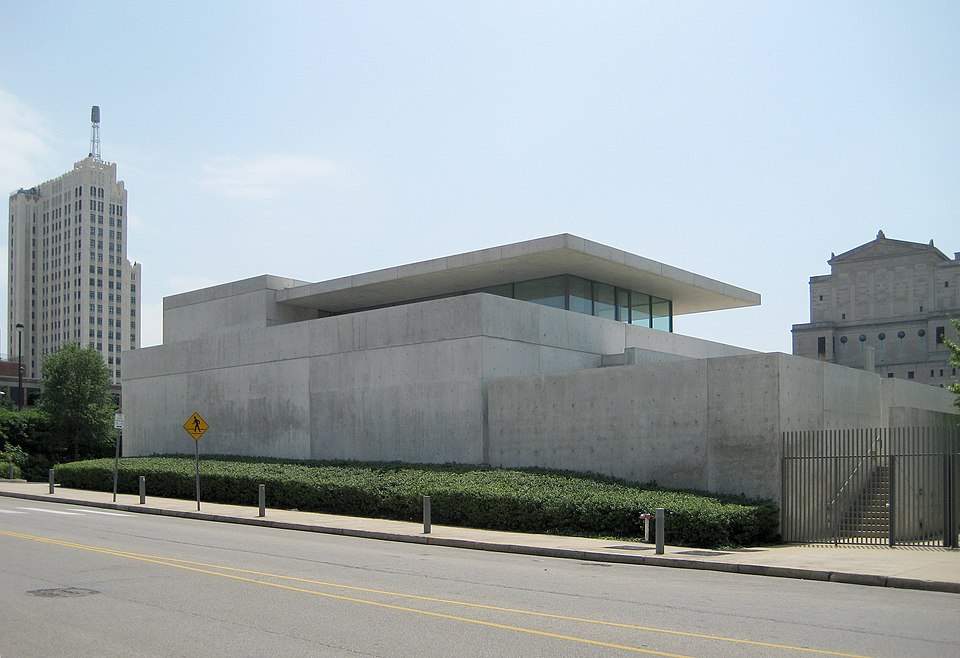
The Pulitzer is a quiet place. Silence fills the whiteness of every wall. The rooms are small and so square that you notice the sharp edges of each corner. When you walk through the galleries, your footsteps echo as you move from one painting to the next. From September to February, the Pulitzer is showing Jennie C. Jones: A Line When Broken Begins Again. Her paintings feel contemporary to me. Some are canvases filled with just one color. Others are small works on paper with one straight line through the center. A few sculptures stand in narrow rectangles, flooded with again just a single color. I do not really understand them, but I trust that they hold something, some intention I cannot see yet. Jones says she wanted her work to be “unrestricted” and free to go wherever she wanted it to.1 She did not want to carry the pressure of being a Black artist who must show her identity on the surface of every piece she creates. She wanted the freedom to meditate on form in any way she chose. When I look at her work, I can sense that freedom, even if I cannot translate it.
Downstairs, Jones curated another set of works, and the space feels even quieter. I moved from object to object without a clear plan until Fred Eversley’s parabolic lens stopped me. It looks almost like a contact lens—one huge, clear curve suspended in the air. It floats on its stand like a bowl taken apart and flipped inside out. As my friend and I walked around it, we noticed something strange. At a very specific angle, we could see each other but not ourselves. When I stood directly in front of the glass and she stood slightly to my left, her body appeared in the lens as if she were facing me. She told me she could see me, too. But neither of us could find our own reflection. It felt like the object erased us while keeping the other person intact. We kept creeping around the lens, watching the image warp. At one moment, we stood on opposite ends of the sculpture; she looked close enough to touch, while to her, I seemed far off in the distance. The perspectives shifted with every inch we moved, as if the lens kept rewriting the world around us.
Their hues announce themselves the moment you look at them. Color carries meaning whether you want it to or not.
To understand how Eversley created something like this lens, you need to know where he came from. He was not just an artist—he trained as an engineer, working for NASA. As a teenager, he tinkered in his dad’s workshop, spinning Jell-O on a turntable to make parabolic shapes. An almost fatal car accident made him switch careers in the late 1960s, and he devoted himself to resin sculpture. He figured out how to spin-cast resin into perfect curves, then sand and polish it into these flawless, glowing forms.2 These are not just beautiful objects; they are experiments in energy, perception, and how we relate to the world. His other sculptures are similar in form but filled with color, deep blues, and pale yellows; however, this one was completely clear. I wonder why Jones chose the transparent version instead of one of the brighter, more alive pieces.
The colored lenses feel confident. Their hues announce themselves the moment you look at them. Color carries meaning whether you want it to or not. Red pushes heat and intensity.
Yellow brings brightness and joy. Each color pins the sculpture to a certain mood before you even approach it. The clear lens does not do that. The clear lens is limitless in a way. It refuses those easy associations. When you look through it, you do not see yourself at all. You see whatever sits beyond it, and even that shifts as you move. The object does not tell you how to read it. It stays quiet. You pay less attention to the lens and more attention to the way your sight changes through it. Every step gives you a new angle, a new version of the world on the other side. The clear lens is aligned with the kind of freedom the Jones keeps circling.
The clear lens makes me think about what it means when artwork removes you from the frame entirely. In a museum, we often try to understand what a painting means and where it is coming from, placing ourselves at the center of the experience. This sculpture removed me completely. I was forced to look outward instead of inward, as if I were seeing a world that existed without me. I became an observer rather than a participant. It is an unsettling experience, not being the center of the universe. As humans, our default setting is to see ourselves as the axis of everything, and now, looking through this lens, I was not. Yet perhaps the very fact that I am reflecting on this moment—that I am writing about not being the center—means that in some ways, I still am. Standing there, I understood something about Jones’s work: she creates space for forms to exist freely, without demanding that the viewer assert control. Like the lens, her paintings invite you to step aside and experience the work on its own terms, free from definitions.
1 “Jennie C. Jones: A Line When Broken Begins Again,” Pulitzer Arts Foundation, accessed November 20, 2025, https://pulitzerarts.org/art/jennie-c-jones-a-line-when-broken-begins-again/
2 Stromberg, Matt. “How Artist Fred Eversley Went from Consulting for NASA to Creating Otherworldly Sculptures.” Artnet, April 30, 2019.