The Puppeteer and the Straight Shooter
A book about how the plain-talking Truman succeeded the smooth-talking Roosevelt
February 28, 2026
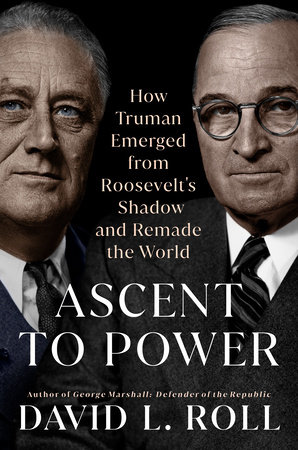
Ascent To Power: How Truman Emerged from Roosevelt’s Shadow and Remade the World
Less heralded than his iconic immediate predecessor, President Harry Truman nevertheless not only rose to the occasion but had a profound impact on American domestic and foreign policy in his own right.
When Franklin D. Roosevelt died less than three months into his fourth term, he bequeathed his successor what policy wonks might call a hot mess. Most countries were still deeply involved in World War II, and the United States was trying to figure out its place in the new geopolitical structure. At home, the nation faced an array of economic and social challenges.
While the transition between the two has been extensively chronicled, Ascent To Power: How Truman Emerged from Roosevelt’s Shadow and Remade the World, is the first book solely devoted to that topic. David L. Roll, who has written three other books on that era, is an engaging storyteller and avoids getting bogged down in minutia.
The relationship between Truman and Roosevelt was distant and somewhat frosty. Roosevelt did not keep his vice president informed about many key matters, and Truman was not a major player on any substantive issues. Their personalities could not have been more different.
Roosevelt was a Harvard-educated patrician who was quite aloof. He loved playing aides off against one another and manipulated people like a master puppeteer.
The relationship between Truman and Roosevelt was distant and somewhat frosty. Roosevelt did not keep his vice president informed about many key matters, and Truman was not a major player on any substantive issues. Their personalities could not have been more different.
Truman never went to college and was from a family that struggled financially. He loathed pretentious people and double-talk. While giving a speech criticizing Republicans, a supporter called out, “Give ’em hell, Harry!” Truman replied, “I don’t give them hell. I just tell the truth about them, and they think it’s hell.”
Roosevelt, who suffered from an array of illnesses including heart disease and polio, chose Truman when seeking his unprecedented fourth term in 1944 because he and many aides felt that the current vice president Henry Wallace, was too liberal and had excessive affection for the Soviets. Truman had distinguished himself as a senator by chairing a committee that investigated defense industry overcharging of the government during World War II, but was not widely known outside of Washington, DC, and his native Missouri.
While Roosevelt has been the subject of many outstanding biographies, due to the nature of the subject, he is not the major focus here.
Roll does cover key events toward the end of FDR’s tenure, such as the Tehran conference of world leaders in December 1943. He notes that despite the president’s diminished physical condition, he was actively engaged, and he, Winston Churchill, and Josef Stalin made progress on topics such as scheduling Operation Overlord (D-Day) and held preliminary discussions on the United Nations.
He quotes FDR as saying, “I think we have done some great work here.” And quotes Roosevelt aide Robert Sherwood describing it as the “supreme peak” of FDR’s career. (46)
Roll also discusses a little-reported plot by the Nazis to assassinate several Allied leaders that was stopped by Iranians. The details of that are worthy of a John Le Carre novel.
Roll, who has previously written biographies of General George Marshall and FDR aide Harry Hopkins, tells this story in an enjoyable yet occasionally overly detailed manner.
The next major summit for the Big Three leaders took place in Yalta in February 1945. FDR’s health had worsened and, according to many accounts, he was not as on top of events as previously. He later admits that he and Churchill had been overly optimistic about Stalin keeping his promises not to establish totalitarian satellite regimes in Poland and other countries.
But Roll gives FDR the benefit of the doubt, sort of.
“By most accounts, FDR’s health did not hamper his dealings with Stalin at Yalta. He sometimes rambled and was caught a few times staring into space. And he was occasionally forgetful,” he writes. (108)
Two months later, FDR was dead.
Shortly after Truman took office on April 12, 1945, he had to make several key decisions, the most important one of which was how and whether to use the atomic bomb. As vice president, he was aware of the bomb’s development but was not briefed about it regularly.
While dropping the bomb over Hiroshima and Nagasaki led to a Japanese surrender sooner than might otherwise have occurred, the morality of the decision is still debated today. Roll notes that Truman did not agonize too much about it. He notes that Truman wrote his sister while the bombing was occurring that: “Nearly every crisis seems to be the worst one but after it’s over it isn’t so bad.” (194)
Either Truman, an expert card player, had a poker face that extended to his writing, or he lacked empathy. This writer votes for the former.
While dropping the bomb over Hiroshima and Nagasaki led to a Japanese surrender sooner than might otherwise have occurred, the morality of the decision is still debated today. Roll notes that Truman did not agonize too much about it.
Many of Truman’s other initiatives were more clear-cut successes. These included the Marshall Plan and recognizing Israel.
Roll does not break much new ground on the Marshall Plan, which played a major role in the successful rebuilding of Western Europe. It hurt Truman domestically, but it was the ultimate example of a profile in courage. Those wanting to learn more should read Roll’s biography1 or the magisterial group biography of many post-WWII leaders by acclaimed journalists and authors Walter Isaacson and Evan Thomas.2
Truman’s recognition of Israel, despite the sharp opposition of some key advisers such as Marshall, laid the groundwork for a series of events that still resonate today. Roll tells the story with admiration but not hero worship. Truman changed his mind several times before making the decision and was guided both by practical politics and broader principles of right and wrong. But Roll disputes the analysis of some, such as University of Florida foreign policy scholar and Wall Street Journal columnist Walter Russell Mead, who wrote in his exemplary history of US-Israeli relations that the decision was “rooted in his [Truman’s] own settled convictions.”3
Roll contends that Truman’s record on that issue “indicates inconsistency and vacillation as if Truman did not know his own mind on what to do about Palestine.” (330)
On the home front, Truman took great risks by desegregating the armed forces and by embracing civil rights more boldly than his predecessors.
These efforts and a sagging economy hurt his popularity, and his approval ratings dropped to the 30s. He was considered so inept at one point that a Republican quipped that “to err is Truman.”
Some Democrats, including one of FDR’s sons, did not want Truman to seek a full term in 1948. Truman would not hear of it and ran the classic come-from-behind race, and ever since has been the patron saint of underdog candidates.
Truman had to fight challengers in his own party and, of course, the GOP. He was challenged from both the left and right in his party, including by Wallace and segregationist Senator Strom Thurmond of South Carolina. Truman won the nomination, but the other two ran on the tickets of other parties.
Truman’s recognition of Israel, despite the sharp opposition of some key advisers such as Secretary of State Marshall, laid the groundwork for a series of events that still resonate today. Roll tells the story with admiration but not hero worship.
Roll spends a great deal of time chronicling the Machiavellian maneuverings, and political junkies will especially enjoy this section.
The Republicans nominated New York Governor Thomas Dewey (the unsuccessful nominee against FDR in 1944), and he ran a lackluster campaign and fully expected to win, in part because of faulty polling techniques.
Roll does not spend a great deal of time on Truman’s full term because his focus is on the transition. But there are two outstanding biographies that fill the gap. A scholarly account by Alonzo Hamby4 and a popular account by David McCullough.5
A note about McCullough: He was a masterful storyteller and made the past appealing to general readers rather than just to history aficionados. His Pulitzer Prize-winning book is often credited with fueling Truman’s rise in the rankings of presidential performance.
Roll builds on these and other works and does not try to reinvent the proverbial wheel. He has found a new angle that should have a wide-ranging appeal.
1 David L. Roll, George Marshall: Defender of the Republic, (New York: Dutton Caliber, 2019).
2 Walter Isaacson and Evan Thomas, The Wise Men: Six Friends and the World They Made, (New York, Simon & Schuster, 1986).
3 Walter Russell Mead, The Arc of a Covenant: The United States, Israel, and the Fate of the Jewish People, (New York: Alfred A. Knopf, 2022).
4 Alonzo L. Hamby, Man of the People: A Life of Harry S Truman (New York: Oxford University Press, 1995).
5 David McCullough, Truman (New York: Simon & Schuster, 1992).