How a ’60s Sci-Fi Television Series Boldly Spawned the Mythology of Our Time
Ryan Britt’s franchise-spanning history of ‘Star Trek’ stays mostly on target.
January 30, 2026
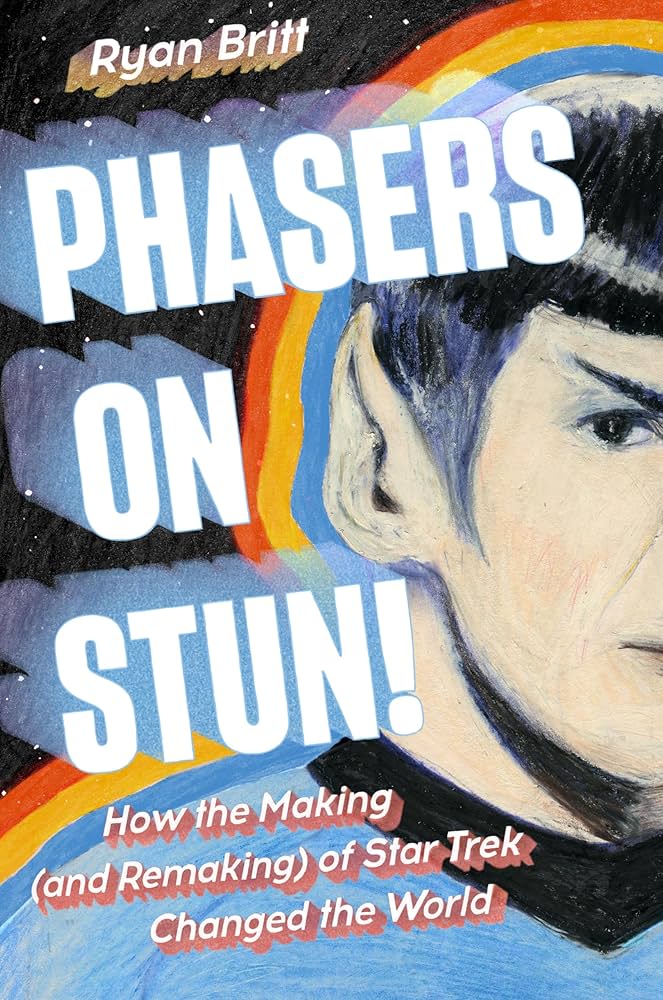
Phasers on Stun!: How the Making (and Remaking) of “Star Trek” Changed the World
1. Beaming in
According to a 17 September 2023 tabulation by Michael McCarrick (for the website Comic Book Resources), at least 837 hours of Star Trek—meaning the franchise that began on Thursday, September 8, 1966, when creator Gene Roddenberry’s Star Trek: The Original Series premiered at 8:30pm Eastern Standard Time on NBC—have been filmed.1
And more are on the way!
In layman’s terms, people wishing to watch every minute of Star Trek must clear at least 35 days from their calendars—and their lives—if they hope to accomplish this honorable goal, unless, that is, they wish to sleep, work, and spend time with friends and family. The figure of 35 days, after all, presumes anyone stout enough to undertake this project will watch Star Trek continuously, for 24 hours all day every day, in a mad dash to absorb Trek’s 50,220 minutes (and counting!) of available footage.2 Our intrepid Star Trek completists must take even longer if they wish to consume the novels, short stories, plays, poems, songs, rock operas (yes, really!), board games, video games, and seemingly endless streams of merchandise that Roddenberry’s franchise has produced in its 58 years (and going!) of cultural life.
Having seen every single minute, hour, episode, and movie in the Trek franchise (most more than once, and some—like the superlative Deep Space Nine [1993-1999]—more times than I dare count), I can confirm McCarrick’s math. Over the span of six decades, the various Trek film-and-television productions have debuted enough work to keep us all occupied—if we so wish—for weeks, months, even years.
Star Trek (or what Britt just calls Star Trek, without italics or quotation marks, to distinguish the franchise from its specific movie and TV productions) has been a fixture in my world for so long that thinking of life without it makes me shudder.
Yes, dear reader, I am a proud Trekkie, Trekker, or whatever label one wishes to invoke. Nerd, geek, addict, crazy man: I accept them all with the good humor in which (I hope) they are offered. Why? Since I cannot deny loving Star Trek beyond all reasonable expectations—yes, indeed, I am one of those nutcases who can name the title of most Trek episodes and films within 30 seconds of seeing them—why deny the obvious? To make matters better (or, perhaps, worse), I regularly listen to four different Trek podcasts when not re-reading teleplays and screenplays from across the franchise’s many iterations (for pleasure, to be sure, but also because I teach these scripts in my screenwriting, media, and literature courses).
In simpler language, Star Trek (or what Britt just calls Star Trek, without italics or quotation marks, to distinguish the franchise from its specific movie and TV productions) has been a fixture in my world for so long that thinking of life without it makes me shudder. Although I have written about Trek before, I have never finished (or even begun) a book about it even if this task seems inevitable. Yet I can delay that project a little longer since Ryan Britt, author of the compulsively readable Phasers on Stun!: How the Making (and Remaking) of “Star Trek” Changed the World, has performed more than yeoman’s work by putting his volume together. Phasers on Stun! may not make future efforts at assembling a franchise-spanning overview of Star Trek obsolete, but Britt’s comprehensive approach makes such labor redundant, at least for now. He analyzes, anatomizes, celebrates, and criticizes every extant Trek television series and film in sometimes granular detail, making Phasers on Stun!, despite its sloganeering subtitle, too accomplished to ignore. The thickets—indeed, the forests, jungles, and underbrush—of cultural criticism about Star Trek have grown so deep and so tangled that Britt’s valuable book, whatever its drawbacks, cannot be allowed to get lost in their wilds.
2. Beaming down
Writing about Trek has been a cottage industry for nearly as long as the franchise has existed, with Stephen E. Whitfield releasing The Making of “Star Trek”—one of the first behind-the-scenes accounts of producing a weekly American television drama ever published—in September 1968, to coincide with The Original Series’s Season 3 premiere episode, “Spock’s Brain” (one of the most embarrassing and regrettable Trek episodes ever broadcast).
Whitfield’s book is far, far better than “Spock’s Brain,” even if “Whitfield” itself is a fiction, being author Steven Edward Poe’s penname, borrowed from his stepfather to avoid conflicts with his (Poe’s) day job as an advertising-accounts manager (for a Phoenix, Arizona firm) who helped broker the deal for one of his clients, Aluminum Metal Toys (better known to Trek fans as AMT), to produce the first model kits based on the show’s starships. Co-credit and half the book’s royalties may have gone to Gene Roddenberry, but The Making of “Star Trek” is pathbreaking thanks to its thoroughness and its brio, with Poe/Whitfield interviewing nearly every person working on The Original Series before and behind the camera.
… the effort required to conceive, script, and then physically create strange new worlds on Trek’s $185,000-per-episode budget became so killing that nearly every member of TOS’s cast and crew checked into the hospital to recuperate from exhaustion before Season 1 was complete …
Whitfield’s friendly, garrulous, insider tone permits readers to believe that they walk the Trek soundstages as the author unveils the moviemaking secrets that Roddenberry, his cast, and his crew employed to pull off what was, at the time, one of the most ambitious network dramas ever attempted, forcing them to work insane hours to meet NBC’s immovable airdates even as they maintained, according to Whitfield, enviable senses of humor.
The Making of “Star Trek,” however, is not a backstage exposé in the Kitty Kelley or TMZ mode. Whitfield avoids the seedier—when not outright objectionable or even illegal—aspects of TOS’s production despite plenty of available material, including 1) Roddenberry’s incessant credit-hogging and shameless womanizing (Gene’s affairs with “Uhura” performer Nichelle Nichols and “Christine Chapel” actress Majel Barrett—Roddenberry’s eventual fiancée and wife—were open secrets on the Desilu Studios lot where Star Trek was filmed); 2) the fact that the effort required to conceive, script, and then physically create strange new worlds on Trek’s $185,000-per-episode budget became so killing that nearly every member of TOS’s cast and crew checked into the hospital to recuperate from exhaustion before Season 1 was complete; and, worst of all, 3) how “Yeoman Janice Rand” actress Grace Lee Whitney was, by her own account, sexually assaulted by an unnamed studio executive shortly before being fired fifteen episodes into TOS’s run (an allegation never confirmed, mostly due to Whitney, who died in 2015, never publicly identifying her attacker).
Ryan Britt’s Phasers on Stun! similarly resists dishing dirt on the franchise’s backstage fights and philanderings (for that, consult Edward Gross’s and Mark A. Altman’s massive, two-volume oral history titled The Fifty-Year Mission)3 even if Britt confronts uncomfortable truths about how Trek—in the hurly-burly of putting hour after hour of science fiction onto the shooting stage, into the can, and onto the big and small screens—has failed to honor its progressive ideals at least as often as it has upheld them, all in an effort to meet release dates that, if missed, could (and did) cost the affected studios and networks money, which, unsurprisingly, could (and did) cost the people responsible for these delays their careers.
Plus, in the 54 years between Whitfield and Britt publishing their books, so many scholarly studies examining the Star Trek franchise from every conceivable angle have appeared—to say nothing of the hundreds of cast and crew memoirs, production manuals, technical guides, short-story collections, authorized and unauthorized novels, fanzines, blogs, and Klingon translations of Shakespeare’s plays (yes, really!)—that Britt cannot cover every detail of the Star Trek universe on- or off-screen, so he wisely chooses not to try.
The best news is that Britt, having honed his writing for websites such as Den of Geek, Inverse, and Vulture, discusses the franchise’s episodes, programs, films, and trends not only with rigorous attention to detail but also in accessible prose that does not indulge what my Aunt Alice, an old writing teacher from way back, called “hundred-dollar words” when, as she lectured anyone who would listen, “ten-dollar words do fine, in fact better than fine, but too few writers take that lesson to heart.”
Although Aunt Alice joined the ancestors five years ago, she would be happy to know that Ryan Britt shares this outlook. He keeps his sentences moving at a steady clip, stumbling here and there over ungainly expressions and too-cool-by-half slang that, despite appearing more frequently than seems wise, never overwhelms his observations or his arguments.
Take this comment about Deep Space Nine: “While TNG (The Next Generation) mocked the idea of God, Deep Space Nine was more tender toward spiritualism, and presented characters in the twenty-fourth century as not only pro-science, but pluralistically, sometimes as people of faith, too. When the Bajorans learn their gods are, in fact, aliens, it doesn’t change their faith at all. In many ways, it reaffirms it.” (219)4 While not precisely accurate to suggest that the Bajoran religion remains static after Starfleet Commander Benjamin Sisko (Avery Brooks), in this series’s terrific pilot episode (“Emissary”), discovers a stable wormhole near the planet Bajor that its inhabitants call “the Celestial Temple” of their gods, Britt nonetheless captures with admirable energy and economy how DS9 entertainingly interrogates, from its inaugural to its final installments, significant issues revolving around politics, religion, war, peace, and civic and spiritual faith to become, for my money, the best American television series (of any kind) ever broadcast.
3. Beaming up
Even so, my admiration for Britt’s prose has limits, particularly his fondness for the word crap, which he deploys in many different contexts, none of them edifying. To my mind (and ear), crap’s attenuated profanity is much worse than simply calling something shit (for instance, “Spock’s Brain” is shit of the highest—or, perhaps, lowest—order despite its cast’s valiant efforts to salvage a hopeless script). Britt and/or his editors seem to think that, by avoiding on some pages openly foul-mouthed references to bad behavior, bad writing, and bad production choices, they preserve the frisson of invoking “filthy words” without printing them, thereby protecting their rebellious, cool-kid bona fides without violating too many taboos.
Cursing (or what Aunt Alice called “cussing”) may once have pushed the publishing industry’s boundaries of “good taste,” but that notion long ago collapsed thanks to the ever-wider social recognition that profanity is not merely a legitimate way to express one’s critical perceptions about art, culture, and politics but also—as critics, reviewers, and scholars who employ such language in their work know—great fun.
Britt’s great achievement in producing Phasers on Stun! is to affirm, again and again, how Star Trek has earned its place as a cultural institution, one whose lexicon has so fully mixed into the language of everyday life that Americans rarely realize how much or how naturally they employ Trek-speak.
Britt, it must be said, does not avoid profanity, as he demonstrates in Chapter 2 when he questions the oft-told tale that Gene Roddenberry pitched Star Trek to NBC as “Wagon Train to the stars” by writing, “I’ve been in a lot of rooms where people just kind of nod solemnly when this is mentioned, and I gotta say, I’m willing to bet a million bucks that most living TV watchers have never seen Wagon Train, nor do they give a warp-speed fuck what Wagon Train even is.” (37)5 Britt emphasizes his doubts about Roddenberry’s apocryphal anecdote here, but, as witty as Britt’s observation tries to be, it trips over the term “warp-speed fuck.” Coming too late in an overripe string of clauses, this sentence requires editorial tightening to land with the force that Britt desires. At least he avoids profane half-measures by refusing to employ execrable terms like frig or (switching SF franchises to Glen A. Larson’s Battlestar Galactica) frack, instead deciding that an expletive should be jarring and, mercifully, opting for the real article.
My comments might suggest that Britt writes a book hobbled by its author’s worst tendencies, but this impression is flat-out wrong. Britt’s great achievement in producing Phasers on Stun! is to affirm, again and again, how Star Trek has earned its place as a cultural institution, one whose lexicon has so fully mixed into the language of everyday life that Americans rarely realize how much or how naturally they employ Trek-speak (i.e, beam me up, make it so, mind meld, phasers on stun, photon torpedoes, prime directive, red alert, resistance is futile, warp speed, and where no man/no one has gone before). Even people who rarely (if ever) watch Star Trek know what these terms mean when they hear them, which, as Britt documents throughout Phasers on Stun!, applies to many other nations, with some of the franchise’s most passionate fans living in Germany, Japan, Kenya, Laos, Cuba, and, in two real-life examples illustrating the influence of Star Trek’s fictional optimism about science’s presence in our actual lives, research teams living in Antarctica and aboard the International Space Station.
Phasers on Stun! exhibits Britt’s access to so many cast and crew members from every phase of the Star Trek franchise (a terrible pun, I grant you) that I cannot help but be envious. His book reads like an update of Whitfield’s text that goes beyond The Making of “Star Trek” by analyzing the franchise’s characters, themes, symbols, settings, and philosophical underpinnings with the perspicacity of a talented graduate student who, knowing that loading his prose with academic jargon is the wrong way to go, settles upon an unfussy style that only sporadically interferes with clear expression.
Britt, for example, includes so many smart comments from The Original Series’s story editor Dorothy C. Fontana (shared with him during a 2016 conversation) that he cements Fontana’s reputation as one of Trek’s best-ever writers (and his talent as a scrupulous correspondent) when considering the narrative sophistication and brass-tacks production reasons that Fontana revealed Spock’s emotional needs and desires in one of TOS’s best episodes, Season 1’s “This Side of Paradise.”
Phasers on Stun! exhibits Britt’s access to so many cast and crew members from every phase of the Star Trek franchise (a terrible pun, I grant you) that I cannot help but be envious.
Britt talks confidently (and correctly) about Deep Space Nine’s remarkable seven-season run by citing remarks from performers Armin Shimerman and Chase Masterson, writers-producers Robert Hewitt Wolfe and Ronald D. Moore, and showrunner Ira Steven Behr that illustrate why, if a person were forced to choose the best Star Trek production ever committed to film, Deep Space Nine must be it. This pattern recurs throughout the book, with Britt talking about Star Trek by talking to Star Trek’s makers from the 1960s all the way to the 2020s. His illuminating chats with the people creating the current crop of shows known as New Trek (i.e., everything that has followed Star Trek: Discovery’s September 2017 launch on the CBS All Access—now Paramount+—streaming service), are, to repeat an oft-employed but accurate adage, worth the purchase price alone.
4. Beaming out
This access to Trek production personnel old and new, beyond making me jealous, enables Britt to move from episode-and-film analyses to hilarious anecdotes about Trek’s colorful on- and off-screen lives in the assured, even relaxed style of a practiced raconteur.
Britt, to state the matter plainly, is the right person to write Phasers on Stun! because he loves Star Trek as ardently as I do, indeed as much as any devotee does, from every era and iteration that the franchise has given us—from The Original Series’s earliest days to Discovery’s, Lower Decks’s, Picard’s, Prodigy’s, and Strange New Worlds’s latest forays into the final frontier—or, in simpler language, from the early 1960s to what seems like yesterday.
This ardor equips Britt to see Star Trek’s tremendous strengths and undeniable weaknesses because he knows that it is, at once, an absurd, goofy, and sometimes childish television franchise that is just as often a mature, thoughtful, and sophisticated edifice of American popular art. Despite Star Trek’s mind-stretching stories, emotionally resonant characters, and cosmopolitan (if not cosmic) perspective about that shaggiest and baggiest of all notions (the so-called “human condition”), the franchise can never quite escape its American worldviews and presumptions no matter how hard it tries—and Trek has tried, heroically and unashamedly, to do just that since its early days, with Deep Space Nine, Discovery, and Lower Decks achieving tremendous dramatic and comedic highs in the attempt.
More than anything, however, Britt stresses how much fun watching Star Trek is and how joyous debating (i.e., disagreeing, fighting, shouting, and laughing about) Star Trek can be. Its famously disputatious admirers (count me among them) can argue, in exhaustive detail, about anything and everything Trekian, into the wee hours and out again, but Britt’s book suggests that Star Trek fans, at our best, are a compassionate bunch who recognize that the franchise has never remained static or unchanged, having transformed itself—in fact, having renewed itself—again and again, as any storytelling enterprise told by thousands of human beings over the span of six decades must.
Britt’s book, in the end, shows us that his subtitle is not quite the selling point or slogan he thinks it is. Phasers on Stun! demonstrates that the world, in making and remaking itself again and again just within our lifetimes, has forced Star Trek to change to remain relevant to its audiences, creators, and corporate masters. More to the point, Britt’s enthusiastic appraisals and incisive takedowns of specific Trek productions illustrate that the franchise has been—and remains—a forum for some damned fine work, occasionally brilliant in its drama, sometimes shocking in its ability to shake our perceptions about the world around us, and more good than bad overall even if bad Star Trek is so ridiculously charming that some of us (by “us” I mean myself) love it even more than before.
Britt’s book suggests that Star Trek fans, at our best, are a compassionate bunch who recognize that the franchise has never remained static or unchanged, having transformed itself—in fact, having renewed itself—again and again, as any storytelling enterprise told by thousands of human beings over the span of six decades must.
And so it goes with Phasers on Stun!, an enjoyably intelligent examination of Star Trek that rarely falters on its way to making the case that an idea Gene Roddenberry had in the early 1960s has become a mainstay of American art and culture precisely because it takes intriguing concepts, fascinating characters, and memorable narratives seriously enough to have fun with them. “The Human Adventure Is Just Beginning” reads the tagline that appears at the conclusion of 1979’s Star Trek: The Motion Picture to suggest that, no matter how gloomy the present may seem, the future can be better if we are willing to work to create it for ourselves and for future generations, becoming in the process the captains of our own lives.
Never has this message been more urgent, so, as a longtime fan and a concerned citizen, I am glad that Star Trek is still with us and that someone as smart as Ryan Britt has written a book telling us how and why that is so. Phasers on Stun!: How the Making (and Remaking) of “Star Trek” Changed the World may just end up as a definitive text about its subject, so please read this book, but only while (re)visiting those 837 (and counting!) hours.
1. Michael McCarrick, “How Long Would It Take to Watch All of Star Trek (Yes, ALL of It),” 17 September 2023, Comic Book Resources, https://www.cbr.com/star-trek-every-tv-episode-movie/.
2. Onscreen Star Trek, at last count, comprises twelve television series (1966-1969’s The Original Series, 1973-1974’s The Animated Series, 1987-1994’s The Next Generation, 1993-1999’s Deep Space Nine, 1995-2001’s Voyager, 2001-2005’s Enterprise, 2017-2024’s Discovery, 2018-2020’s Short Treks, 2020-2023’s Picard, 2020-2024’s animated Lower Decks, 2021-Present’s animated Prodigy, and 2022-Present’s Strange New Worlds), two of them ongoing, with Number 13 (tentatively titled Starfleet Academy) in pre-production; thirteen theatrical motion pictures (1979’s The Motion Picture, 1982’s The Wrath of Khan, 1984’s The Search for Spock, 1986’s The Voyage Home, 1989’s The Final Frontier; 1991’s The Undiscovered Country, 1994’s Generations, 1996’s First Contact, 1998’s Insurrection, 2002’s Nemesis, 2009’s Star Trek, 2013’s Star Trek Into Darkness, and 2016’s Star Trek Beyond), and one television movie starring Academy Award-winner Michelle Yeoh—tentatively titled Star Trek: Section 31—officially announced by Paramout+ on 18 April 2023 and which, on 21 March 2024, wrapped principal filming in Toronto, Ontario, Canada.
Wrath of Khan and Undiscovered Country writer-director Nicholas Meyer revealed on Star Trek Day 2022 (held on 8 September of that year) that his long-gestating three-episode television miniseries Star Trek: Khan—Ceti Alpha V, set to dramatize what happened to Ricardo Montalban’s Khan Noonien Singh in the 15 years between this character’s first appearance in the 1967 Original Series episode “Space Seed” and his spectacular return in 1982’s Wrath of Khan, was being retooled into a scripted, audio-drama podcast for Paramount+.
This project, if it ever comes to fruition, will be the first of its kind for the Trek franchise, although hundreds of audiobook cassettes (remember them?) of Trek’s novels have been released since The Voyage Home’s audio version—narrated by Leonard “Spock” Nimoy and George “Sulu” Takei—was released by Simon and Schuster in January 1986.
3. Edward Gross and Mark A. Altman, The Fifty-Year Mission: The Complete, Uncensored, Unauthorized Oral History of “Star Trek”: The First 25 Years and The Fifty-Year Mission: The Complete, Uncensored, Unauthorized Oral History of “Star Trek”: The Next 25 Years: From “The Next Generation” to J.J. Abrams, both Thomas Dunne Books, 2016.
4. Ryan Britt, Phasers on Stun!: How the Making (and Remaking) of “Star Trek” Changed the World, Plume Books, 2022, pg. 219.
5. Ibid., pg. 37.