Gunn Control
A native St. Louisan brings the big blue Boy Scout back to the big screen.
August 31, 2025
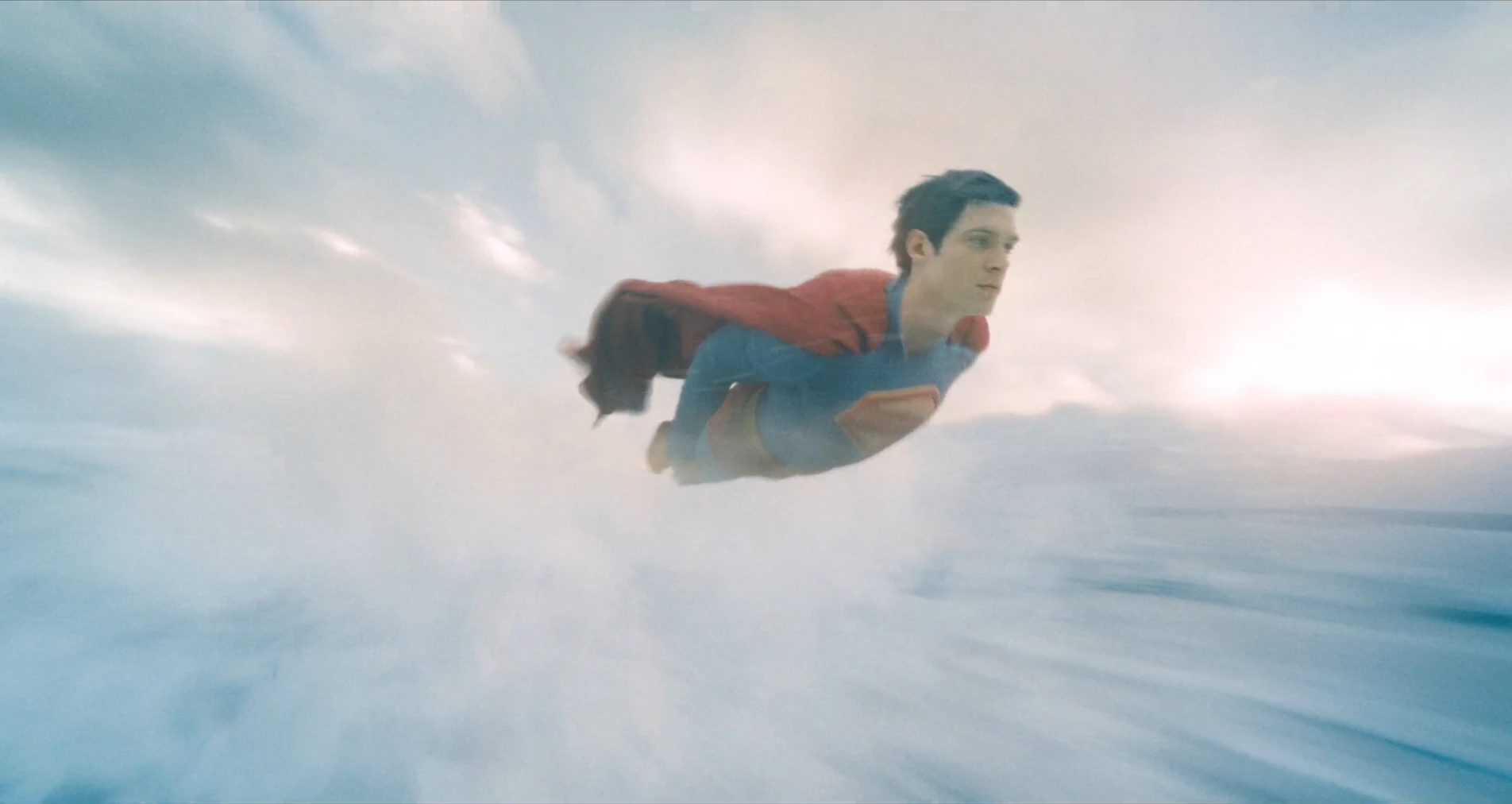
1. Up!
When, in 1978, at age six, I sat in a Sioux City, Iowa, movie theatre watching Richard Donner’s Superman: The Movie, the first theatrical (read: live-action) film devoted to the Man of Steel since 1951’s Superman and the Mole-Men used its 58-minute running time to demonstrate what a weekly early television series about this character might be like, I experienced all the feelings that people who saw Donner’s movie on the big screen always mention when discussing its powerful effect upon them: intense fascination, earnest optimism, and, especially, buoyant joy.
Why? Well, Donner, his remarkably talented creative team, and his superb cast managed, just as their movie’s one-sheet poster promised, to make us believe that a man can fly.
Every person who participated in that production deserves praise, none more so than Donner? Who would now deny that John Williams’s stunning score, especially its brassy main-title theme—that three-note fanfare that, as Donner always observes when discussing Superman: The Movie, speaks the protagonist’s name —lifts the entire film’s mythic retelling of Superman’s origin (as the last son of the doomed planet Krypton) to the same heights that Christopher Reeve achieves in playing the dual role of Superman and his alter-ego, Daily Planet newspaper reporter Clark Kent?
Reeve is so good in Superman: The Movie that every actor who has essayed the role since Reeve’s departure in 1987 has remained indebted to him. Whether on television or in cinema, whether in animation or live-action, Reeve’s imprint on Superman remains so strong that Bryan Singer, when making 2006’s better-than-you-remember Superman Returns, evidently instructed his leading man, Brandon Routh, to mimic Reeve at every turn, resulting in a good—if schizophrenic—performance that is most successful when Routh forgets Reeve and, instead, plays the character as Routh sees it: earnest, yes, but less the dewy-eyed farm-boy that Reeve embodies and more the cosmopolitan man-about-town.
Some moviegoers, I hear, have flocked to Gunn’s film three or four times, which is what I would have done in 1978 were I persuasive enough to convince my parents to take me again and again.
Now, nineteen years after Singer’s attempt to recapture the magic of Superman: The Movie (itself hitting multiplexes nineteen years after Reeves’s last effort, Superman IV, plunged the franchise into ignominy), James Gunn’s Superman so clearly wishes to recapture the magic of both Richard Donner’s masterpiece and the comic books/strips that Superman’s creators, Jerry Siegel and Joe Shuster, cranked out (starting in 1938) that I can only admire Gunn’s moxie in making this newest movie a bright and bouncy barrel of fun.
Gunn seems to have fulfilled his desire for his film to be the true heir to Donner’s Superman: The Movie and its well-regarded sequel, Superman II (1980). Superman 2025 has generated, in the current generation of moviegoers, the same joy-bordering-on-rapture that I felt in 1978. Some of them, I hear, have flocked to Gunn’s film three or four times, which is what I would have done in 1978 were I persuasive enough to convince my parents to take me again and again.
Yet, while I long to share these new fans’ love of Gunn’s movie, whose moments of brilliance are as dazzling as one could hope, Superman 2025, while good, is never great despite its cast and crew elevating the film to pinnacles that Gunn’s hit-or-miss screenplay cannot sustain, meaning that Gunn’s script does not match Tom Mankiewicz’s peerless writing for Superman: The Movie.
2. Down!
Even so, this pronouncement cannot dismiss the many pleasures of Superman 2025. Chief among them is David Corenswet’s wonderfully awkward Superman and Clark Kent, Rachel Brosnahan’s gritty-yet-empathetic portrayal of Lois Lane, Nicholas Hoult’s deranged take on Lex Luthor, and Edi Gathegi’s, well, terrific work as Mr. Terrific. The entire cast is excellent, including day players who appear in only one scene, testifying to how good a director James Gunn can be when he concentrates on human relationships rather than worldbuilding the newly revamped DC Cinematic Universe (or DCU) that he, as co-chairman and co-CEO of DC Studios (alongside Peter Safran), now controls.
How I wish Gunn had paced his film better by reducing the cameo appearances of characters slated to appear in future DCU projects, to improve Superman’s narrative tempo. Shedding the interminable stretches of what movie critic Mark Kermode calls “the smashy-crashy bits” (i.e., scene after scene of property destruction that quickly lose their novelty) would also help. The two “Justice Gang” colleagues that assist Mr. Terrific—Nathan Fillion’s Hal Jordan (member of the Green Lantern Corps) and Isabela Merced’s Hawkgirl—are barely presences, much less personalities. Despite Fillion’s and Merced’s efforts to make their roles more intriguing, they are poorly served by the arid characterizations Gunn’s screenplay gives them.
Gunn also misplays a supposedly astounding revelation about Superman’s parents, Jor-El (Bradley Cooper) and Lara (Angela Sarafyan), whose charge to their son was not to serve mankind but to rule. This fundamentally undermines Superman’s role as humanity’s protector, and that turns the American public against him. This is Gunn’s repurposing of the Superman-as-false-god plotline suggested by Zack Snyder’s serviceable Man of Steel (2013)—and affirmed by Snyder’s dreary Batman v Superman: Dawn of Justice (2016). David Corenswet’s Superman realizes that his choices define his identity as much as his heritage, a lesson given voice by his adoptive human father, Jonathan “Pa” Kent, who is so skillfully played by Pruitt Taylor Vince that we might miss how trite this narrative turn and how stereotypical Jonathan’s down-home, aw-shucks persona are. Once again, Gunn should have more closely studied Tom Mankiewicz’s characterization of Jonathan, brilliantly realized by Glenn Ford in Superman: The Movie, to learn how to write the Kent patriarch with authenticity and grace.
How I wish Gunn had paced his film better by reducing the cameo appearances of characters slated to appear in future DCU projects, to improve Superman’s narrative tempo. Shedding the interminable stretches of what movie critic Mark Kermode calls “the smashy-crashy bits” (i.e., scene after scene of property destruction that quickly lose their novelty) would also help.
Gunn’s Superman fumbles such character beats and plot twists too frequently for me to give it a full-throated endorsement, so the best news I can offer is that, despite these challenges, the good outpaces the bad well enough for me to recommend seeing Superman 2025 on the big screen while you still can.
3. And away!
Maybe the best aspect of Gunn’s movie is how it tells a political story—about Superman’s life as an immigrant to Earth undergirding and enhancing his compassion for all human beings, regardless of their circumstances—in the guise of a summer blockbuster. Before the film begins, Superman prevents the nation of Boravia from invading its neighbor, Jarhanpur, by threatening the safety of Boravia’s leader, the odious president Vasil Ghurkos, played with Snidely Whiplash glee by Zlatko Buric.
Whether you read the Boravia-Jarhanpur dynamic as representing Israel-Palestine, Russia-Ukraine, or one of a dozen other geopolitical flashpoints, Superman 2025 opens spaces for probing conversations about current events that, as Stephen Robinson notes in his perceptive essay “Superman Doesn’t Hate Israel. He Just Doesn’t Like Bullies,” demonstrate how political concerns have been part of Superman’s cultural DNA from the moment Jerry Siegel and Joe Shuster published their first Superman story in June 1938’s Action Comics No. 1. Two years later, they wrote a comic strip titled “How Superman Would End the War” especially for Look Magazine’s 27 February 1940 issue, in which Superman flies Adolph Hiter and Joseph Stalin—not fictionalized versions of these world leaders, but the men themselves—to the League of Nations to be judged for their crimes, doing so after Superman tells Hitler, in what must be among the greatest anti-Nazi sentences ever uttered, in fiction or in real life, “I’d like to land a strictly non-Aryan sock on your jaw.”1
Maybe the best aspect of Gunn’s movie is how it tells a political story—about Superman’s life as an immigrant to Earth undergirding and enhancing his compassion for all human beings, regardless of their circumstances—in the guise of a summer blockbuster.
Gunn’s Superman continues this noble tradition by giving his film’s Man of Tomorrow three notable speeches—one about kindness, one about respect, and one about honor—that, in any normal year, would make every eyeball in the theatre roll back into its socket, but our current political landscape is so regressive that hearing these platitudes spoken aloud (Corenswet makes them work better than they have any right to) softens even my hardened cynic’s heart to the point that I commend Gunn for taking a route—i.e., the obviously expositional.
Perhaps you have heard that Hoult’s Luthor is an insecure prick and pathetic manchild whose narcissism drips from every pore? All true, although saying, as some observers have, that Hoult’s performance evokes Elon Musk’s public breakdowns, outbursts, and idiocies is only half-correct in that Hoult’s scarily competent character figures a way to access a pocket universe with technology that does not detonate when activated, meaning this Lex can never be mistaken for Musk, the man who—when his rockets are not exploding—still thinks the Cybertruck was a good idea.
Gunn’s narrative reach exceeds his storytelling grasp, but I prefer Gunn’s everything-and-the-kitchen-sink ambition to the middle-of-the-road, playing-it-safe, milquetoast tendencies that typify too many summer blockbusters.
Gunn packs many allusions to the entire history of Superman comics: to Grant Morrison’s and Frank Quitely’s 2005-2008 All-Star Superman run, as well as to all four Christopher Reeve films including Superman IV’s so-dumb-it-might-be-brilliant plot point of Lex Luthor harvesting Superman’s DNA from a single strand of his hair and engineering a clone more powerful than the Man of Steel—known as Nuclear Man in Superman IV and as Ultraman in Superman 2025—to make Corenswet’s hero fight a double of himself, just as Reeve’s Superman does in Superman III’s best sequence. Counting them all in a single viewing is impossible, which may explain why some fans keep returning to watch Gunn’s movie over and over.
Another reason may be that Superman 2025 does for them what Superman: The Movie did for me all those decades ago: offer hope and clarity in a world so unpredictable that it seems to have gone mad. From this vantage point, Gunn’s narrative reach exceeds his storytelling grasp, but I prefer Gunn’s everything-and-the-kitchen-sink ambition to the middle-of-the-road, playing-it-safe, milquetoast tendencies that typify too many summer blockbusters.
Plus, I cannot dislike too much any Superman movie that includes Krypto the Superdog, especially an entry that makes what should be the most absurd character in the film franchise’s history—yes, the superstrong Krypto not only flies but wears a red cape while doing so!—who starts as overly playful and disobedient into a touching and sympathetic character with a better narrative arc than either Hal Jordan or Hawkgirl.
And so, after all these ruminations about James Gunn’s entry in Superman’s cinematic sweepstakes, what is the bottom line?
Well, I liked it.
Maybe not a lot, and maybe not as much as others, but, in the end, I liked it fine, yes, just fine indeed.
1 Jerry Siegel and Joe Shuster, “How Superman Would End the War,” Look Magazine, 27 February 1940, magazine insert with no page numbers.