Ancient Splendor (and the Ambivalence of Its Ethics)
March 27, 2026
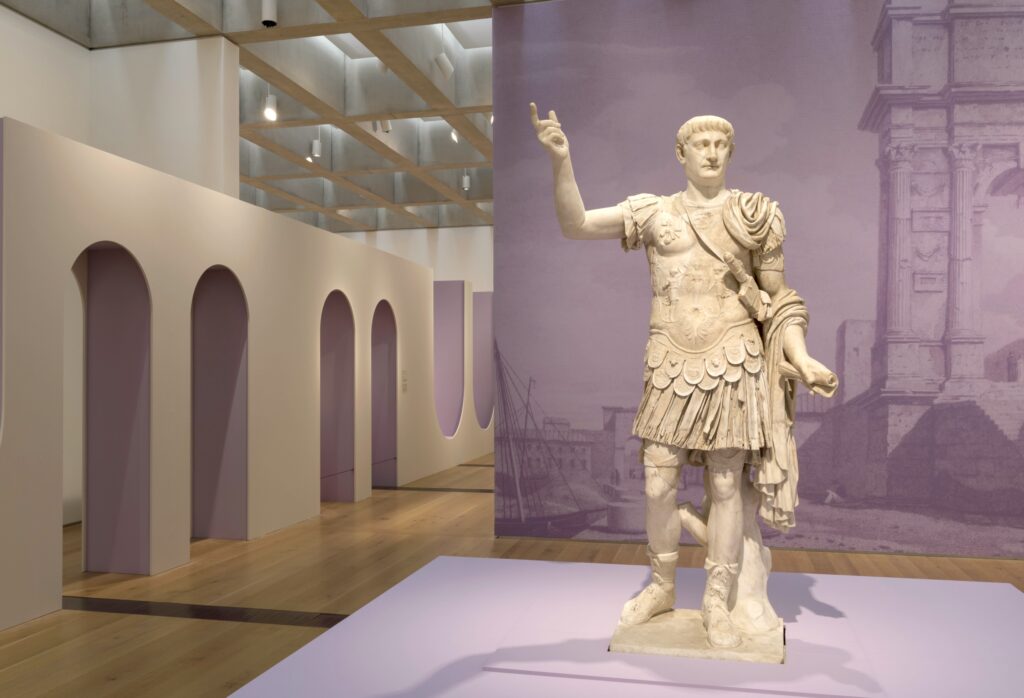
When you walk into the Saint Louis Art Museum’s new exhibit—Ancient Splendor: Rome in the Time of Trajan—the emperor himself greets you. His right hand is raised, index finger lifted: he is about to speak. The commanding air comes naturally to him; he rose through the army, suffering hardship alongside his men.
In statue form, Trajan stands nearly seven feet tall. His garb is military in tone, though not battle-ready, and Minerva graces the center of his cuirass (anatomical breastplate). In his left hand, he holds a scroll, showing his respect for legislation and the Senate.
This role is not his bloodright. His predecessor, Nerva, had no children, so adopted Trajan to consolidate power—then died unexpectedly soon after, having reigned only fifteen months. Trajan ascended to the throne in 98 CE. By all accounts, he is popular, even though he is the first Roman emperor to have been born outside Italy (in what is now Andalusia, Spain). Julius Caesar is his model, with his deep pietas, devotion to the gods, homeland, and family—and with his many conquests, which Trajan wants to surpass.
Later emperors will take Trajan as a model, and the conventional wish for each successor will be “May you be luckier than Augustus and better than Trajan.”
“He made the Empire the biggest it had ever been or would be,” remarks Claire Lyman, a curatorial research assistant who is finishing her Ph.D. at WashU. He granted citizenship to those conquered, changing what it meant to be a Roman. “And in contrast to previous emperors, he ingratiated himself with the people,” handing out free grain, lowering taxes, building roads and aqueducts and baths, boosting trade. “He was a man of the people, to the extent an emperor can be.”
Lyman is co-teaching a course centered on this exhibit with Dr. Nate Jones, associate professor of art history and archaeology. He wants students to learn that, “though we shouldn’t expect that we can just transfer our values on them,” the ancients are far from inaccessible. First-century Rome was “a multicultural world with internal conflict about its role in the world as a political and cultural entity”—sounds familiar, no? “It’s said that Roman art is the first modern art,” he adds, “in that it is eclectic and self-aware in its historicism.”
Hannah Segrave, the museum’s associate curator of European art to 1800, oversaw the presentation of the exhibit. “‘First among equals’—Trajan embodied that idea,” she remarks. “He wasn’t just in it for himself.” She acknowledges the tension, though, in admiring works “paid for by the spoils of war and subjugation of other peoples to the empire.”
Though Trajan was harsh in conquest, he was benevolent at home. Segrave points to busts of the women Trajan listened to: stern-faced Marciana, his beloved elder sister, and graceful Plotina, his wife, who, like him, grew up in Hispania. When she climbed the stairs to the imperial palace after her husband was made emperor, she vowed not to let glory change her: “I enter here the kind of woman I would like to be when I depart.”
Compassionate toward the poor and the orphaned, Plotina made it her mission to advocate for them, expand the gifts of grain, and curb the excesses of the procurators (tax collectors). Avoiding the drama of past divas (we stole the word, honorific for a deified empress), she was known for her simplicity, virtue, dignity, and love of philosophy.
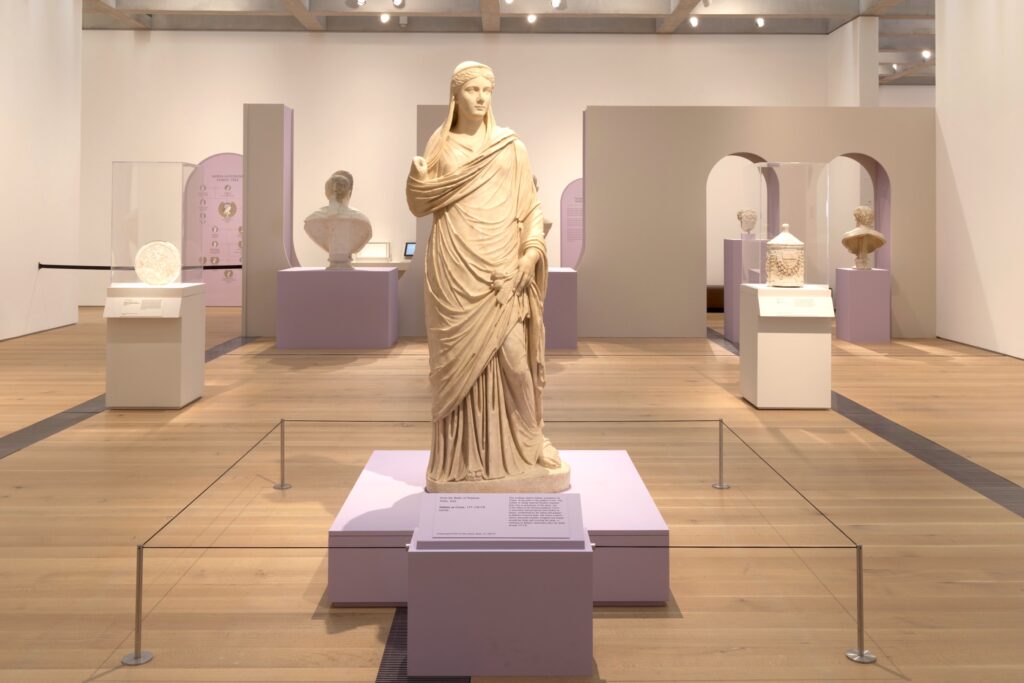
The lovely Sabina, Trajan’s grandniece, appears several times; she will marry Hadrian, the next emperor, whom childless Trajan will have adopted. We see Hadrian here, too; he wears a beard, because he was fascinated by Greek culture. Since Rome had no Hollywood stars to ape, imperial grooming and couture set the trends: Trajan had been cleanshaven, but beards would now come into vogue.
Before we leave the imperial statuary, duck into an alcove and imagine, with the text’s help, what these creamy marbles might have looked like in the first century, painted in bright colors. On one wall is a scent station: bend close and let the honeyed scent of old roses fill your nose. The Romans anointed their statues with such scents.
Other scent stations, developed at the Institute for Digital Archaeology, include garum, a fermented fish sauce made from salted intestines. You can recover with the help of a light, soothing soundscape composed by musician Chris Cundy, who mixed in recordings taken at the Roman Baths in England.
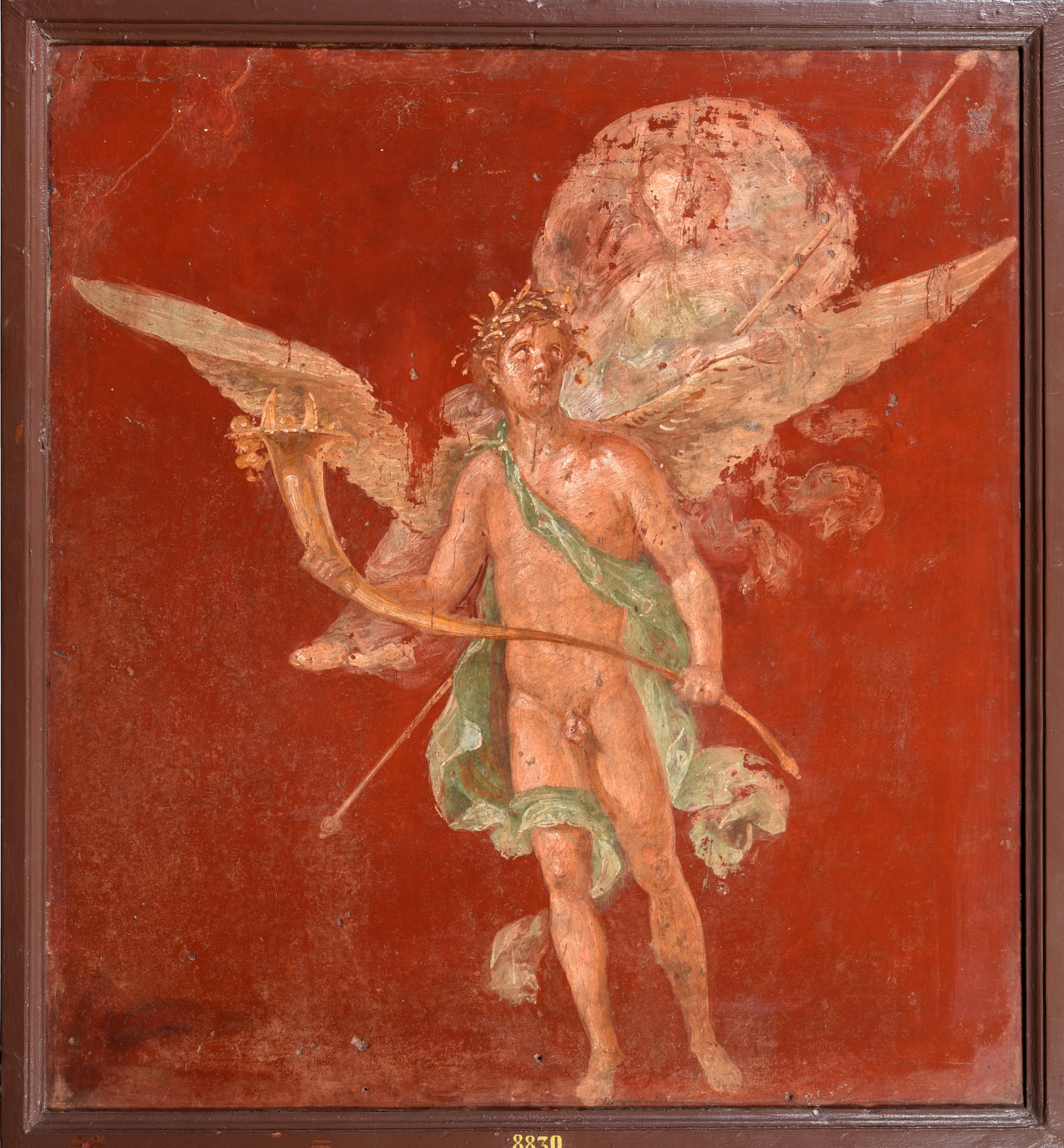
You are now in the domus part of the exhibit, devoted to the domestic and private lives of upper-class Romans. Why so snobbish? Because theirs was the material culture that survived. Rooms are lit with frescoes, still beautiful, rescued from Pompeii and Herculaneum. Decorative bits of art and craft that covered every surface.
Imagine redoing your home with this lavish attention. A bronze fulcrum cast as a duck might stabilize the bottom of your bed, while a satyr and donkey hold up the top and a griffin anchors your table legs. Your sauté pan’s handle might be a finely wrought panther. We do not even know what techniques allowed some of this beauty; how did they manage the glow of that pearlescent bluish-green glass amphora? And who had the patience to create that big, tessellated mosaic, the Egyptian colored stones so small that their darks and lights define the musculature on the tiniest figures?
Everything was decorative. Even the strigils, curved bronze scrapers used to remove oil, dirt, and sweat from the skin, are lovely. Ancient Romans banqueted on peacock, jellyfish, flamingo, and dormouse, and they got drunk often enough that a warning figure, drunk and slumped, is painted into one of the frescoes. Satyrs grin knowingly, and pre-Christian images of magic, superstition, and mythology mingle on plaster and enamelled metal. Also, because the empire was at its biggest and most diverse, luxurious imports carried the mystique of faraway cultures. Not that Rome thought those cultures equal to its own, mind you. But once the line of Roman or non-Roman was drawn, hierarchy was set by class, not race.
If you feel relaxed in these rooms, it is because wealthy Romans practically invented work-life balance. Their concept of ostium, or leisure, was an equal counterweight to negotium, or business. When the chores or trade were done, Romans took refuge in their gardens, music, wine, and baths. SLAM has cleverly raised the shades to show off its own garden—and the main museum building whose Sculpture Hall was modeled on the Baths of Caracalla.
When you reach the room devoted to the dead, you will finally see preservation from other classes: as Segrave notes, “Everybody cares for their dead.” A heavy, elaborately wrought cremation urn from SLAM’s own collection sits near the columbarium of a group of liberati, formerly enslaved. Far plainer, it is decorated with a scattering of small images: men bent over outdoor work, a basket of figs, a chicken pecking the ground.
Do not miss the bread and circuses. When Juvenal, a satirist, invented the phrase, it was very much a dig at the common folk for being so easily placated. And the circuses still distract. A parade helmet of a murmillo, a heavily armed gladiator, is decorated with images of music and the arts. A funerary relief of the Circus Maximus shows a charioteer with four horses rampant, perfectly in sync. At the left stands the deceased—“He may have worked for one of the racing teams,” Segrave explains—with his wife, who obviously died before him, as she is standing on a pier.
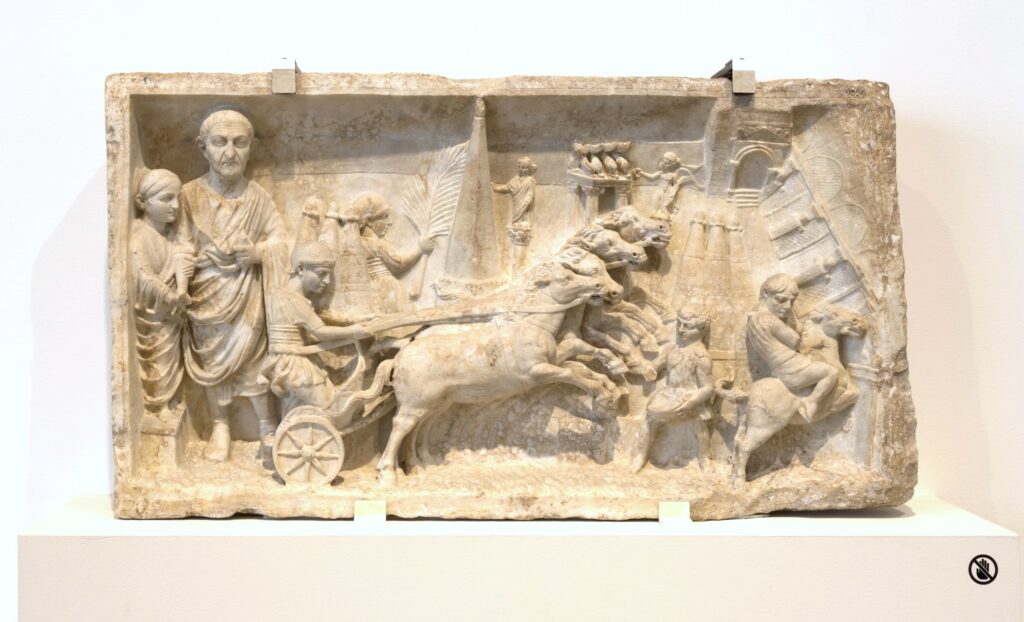
“They appear to be holding hands,” Jones notes, though the hands are broken off. “This is common in funerary reliefs because it’s an important moment in marriage, the joining of the right hands. It’s a tender moment.” He points out other details, especially the lap-counting device, with mechanical dolphins moving at each completion. “This is one of two objects you’ll see in every textbook of Roman art. It was lent by the Vatican.”
The other object? Another relief, “a piece of a larger tomb that belonged to the Haterii family. It shows buildings—one of them the Coliseum—that the family was perhaps involved in constructing. Common in the Roman world though not in other ancient cultures, this is a public demonstration of pride in your work and your profession. The glory formally goes to the person who paid for the edifice, so we don’t get written sources naming architects, artisans, and laborers.”
Nearing the end of the exhibit, you wind up where Rome connects with the rest of the world: terra cotta vessels carrying oils up the Tiber into the natural port of Ostia or the artificial harbor Portus; a gleaming black lion on an oarlock, ring in his mouth; images of ships and finally, a life-sized, 3-D printed scene from Trajan’s Column, painted bronze as it might have been originally, with sheets of real bronze placed where there was armor. You may touch it! The column itself stayed home, intact. “Made for the gods,” Segrave murmurs. “We like to call it the first film in history.” The narrative spirals up one hundred Roman feet; this frame shows the Roman army invading Dacia, now Romania, with Trajan as the calm statesman in charge.
Ancient Splendor was curated by Lucrezia Ungaro, archaeological curator of the city of Rome, former director of its Imperial Forums Museum, and a respected Trajan scholar. She had pull; many of these sculptures and paintings have never been seen outside Rome, but she persuaded the Vatican, Ostia Antica, the National Roman Museum, and the Naples National Archaeological Museum to let them travel. First to Houston’s Museum of Fine Arts, and then to SLAM. When Ancient Splendor leaves St. Louis in August, it will come apart, each artifact carefully dispatched to its home.
The exhibit is free on Fridays. You might want to get there while you can.