America’s Culinary Icon Is Not Done With Us Yet
By Ben Fulton
March 7, 2026
Scrolling engages. Social media enrages. Before either of those, nothing defined American childhood like gorging a hamburger, backed up by salt-laden French fries, and then staring out of your parents’ backseat in a silent coma of oleaginous indigestion in search of something interesting to stare at.
I know because, as a grown latchkey kid of a single mother who either worked or studied nights, this ritual was aided and abetted by—who else?—none other than the Golden Arches. The “billions and billions served” corporate behemoth, and fortune behind my generation’s grandparents—were they lucky enough to purchase McDonald’s stock early in the days of that franchise’s ascendency—was the gateway drug to U.S. culinary convenience. Who will deny that American food culture has been hooked ever since?
Even if you exchanged McDonald’s decades ago for the nascent promise of better health by spending your hard-won food budget instead at Whole Foods, the yellow-on-red marquee will always hang above our heads. Like the piñata at a birthday party, we can whack it in blindfolded blame for so many of our nation’s health problems. If eating the chain’s food was not so much damned fun for kids in search of savory when they (finally) tire of sugar, we might get somewhere in the endless goal of improving our country’s nutritional profile. Were that even possible, we would still have to maneuver around the glass of whole milk and the condiment of beef tallow recommended by our current Health and Human Services Secretary.
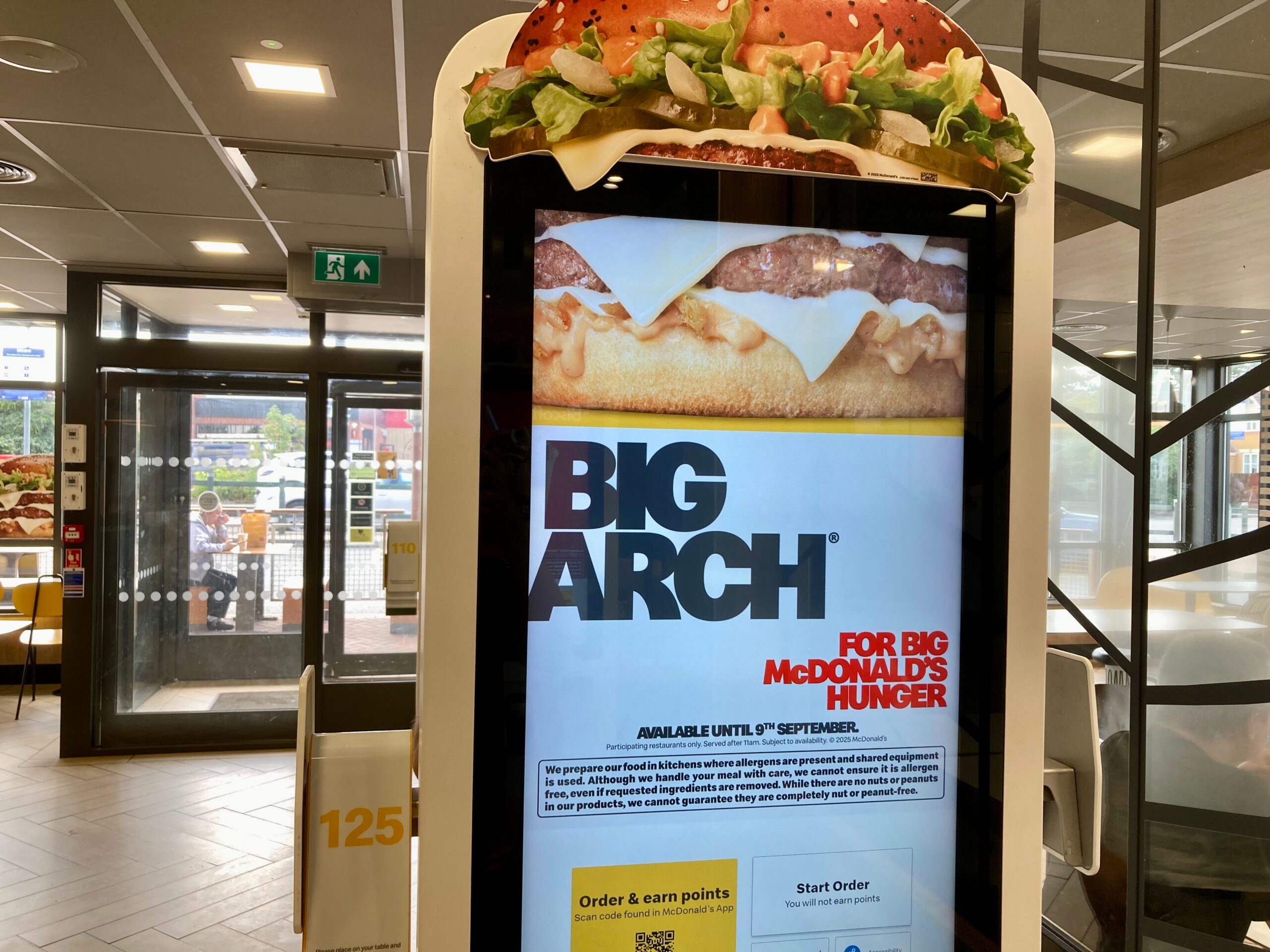
McDonald’s latest entry in the battle to bulge American bellies is the Big Arch. Fans of the franchise’s assembly-line kitchens will hone in on the sandwich’s ingredients, of which the real game-changer is fried onions and perhaps a tweak of the sauce. Kill-joy nutritionists will leap to warn of its eye-popping nutrition facts. The Big Mac loaded up 7.4 ounces and 580 calories of 11 grams of saturated fat, 1,060 mg of sodium, 7 grams of sugar, and 85 mg of cholesterol, with 3 grams of fiber to snake its way through our bowels. The Big Arch, by contrast, more or less doubles these horrendous numbers, but with not one gram of fiber beyond the Big Mac to speed its digestion. Like the unemployed, alcoholic uncle who moves in with you until he finds “the right situation,” the Big Arch has its own schedule, timed to a slow-ticking bomb of sodium and saturated fat.
You may have read that McDonald’s CEO Chris Kempczinski made a pleasant fool of himself taking a too-dainty bite of the Big Arch in a corporate Instagram video that provoked more manly, aggressive bites from competitors. But what was most curious was not Kempczinski’s small mouthful of the featured “product,” but how he seemingly could not stop talking about the virtues of the Big Arch. Granted, this is his job as CEO. But has no one ever told the poor man that no one stops to talk about fast food? Has no one told Kempczinski that people just eat the stuff, then get on with their day? This is what fast food is. That is what fast food does. It inoculates our taste buds to more nuanced culinary experiences. It embalms the possibilities of what any alternative meal could be.
Americans returning home after a month or two in France or Spain sometimes speak in wondrous words about the beguiling ways folks in those countries take a lunch or simple meal. A table is set. A spread of meats, fresh-sliced bread, cheeses, and condiments is unveiled. A bottle of wine might be uncorked. And all this can take place at home, perhaps among the potted plants of a sun-lit patio, during a 90-minute break away from the office. All of this offends the American sense of time, utility, and eating meals from the passenger seat of a car. There is no lament or critique in this description, because we Americans clearly like it this way. It makes perfect sense, too, that McDonald’s used Canada as part of its test market for the Big Arch, and has already ensconced it in the markets of Ireland and Britain, the two countries across the Atlantic most similar to our own.
Foodies scoff. Nutritionists shake their heads. But the American hamburger marches on. Maybe it does not conquer everything in its path the way it once did, but it beats its own path nonetheless. No one in their right mind will deny that Jules, played by Samuel L. Jackson, channeled the hamburger’s mercurial mix of the trivial and the brutal to perfection in the 1994 film Pulp Fiction. There is nothing subtle about the hamburger. From the day it was mass-marketed, it strove to outdo itself, to promise a lifestyle in flavor. Plant-based burger substitutes tried to replace the beef-based original, but to no appreciable avail. Like war in the Middle East, military-grade weaponry, partisan enmity in politics, and utility trucks and RVs, the hamburger endures because it delivers recombinant flavors in huge doses of fat and salt that land in the stomach like a firm, reliable handshake.