A Real Knowhere Man, Part Two
Working as an extra on “The Biggest Movie in the Whole World”
August 31, 2025

The following are further scenes from my life as Knowhere Citizen #65, a “humanoid” extra on the set of Guardians of the Galaxy Vol. 3, south of Atlanta, Georgia, in 2022.
Monday, January 31, was a satisfying first day on set, which you can read about here.
Tuesday I was not chosen to work, so I did not get paid. I spent the day writing in a crappy motel a few miles from the studio. Transience, not Georgia, was on my mind.
Wednesday I was back on the lot and finally warm in the frigid holding tent, where the army of extras ate and waited to be called to the set, but only because I brought my winter coat and wore it over my costume. After a free buffet breakfast I sat in a plastic chair at a long plastic table with three others. A smaller group of extras was called to the set, but most of us sat in the tent all day.
My new friend Tom, his head like blue driftwood in full prosthesis, had been asked to come in Tuesday, several hours before dawn. His makeup artist had wanted his prosthetic perfect because she believed everyone got a close-up eventually—or at least it kept her from getting lazy, she told him. Tom never got used that day.
It was funny that a sci-fi movie returned us to an older, slower time by locking up our phones and prohibiting other tech. People admired each other’s costumes, read, played cards, strummed a guitar, sang, talked, danced, played a cup-and-ball game like kids, worked out with stretch bands, and napped. A little White girl with a shock of red hair spent all day, every day, with her arm in the air, spinning her fist, and popping her hips. When asked why, she said it was her signature move.
In two weeks, intermittently, in the holding tent, I would get through Zbigniew Herbert’s 700-page The Collected Prose, 1948-1998, and re-read Robert Hass’ The Essential Haiku: Versions of Basho, Buson, and Issa. It was not possible to read on set; there was nowhere to put personal items during filming, and production assistants worked hard to keep water bottles and eyeglasses, let alone post-war Polish poets, out of frame.
It was funny that a sci-fi movie returned us to an older, slower time by locking up our phones and prohibiting other tech. People admired each other’s costumes, read, played cards, strummed a guitar, sang, talked, danced, played a cup-and-ball game like kids, worked out with stretch bands, and napped.
Maureen, a local, sat behind me reading Fires of Heaven, a novel. She lived near Trilith Studios, in a house she and her late husband had bought twenty-three years earlier. She said she was getting “ridiculous offers” for her house and two acres due to the studio’s prosperity. The house had undeveloped acres behind it and a five-acre neighbor, and Maureen’s daughter lived a mile away, so she was not inclined to sell. Still, she had looked at an 1800-square-foot stone cottage in the community of Trilith, adjacent to the studio, listed at $600,000. She said the neighborhood had an automated grocery store with robots that delivered to homes.
(“The residential neighborhoods at Trilith comprise the largest geothermal community in the United States,” their website says, “with 51 percent of the development dedicated to green space, and is currently home to more than 1,000 trees. Residents have access to 15 miles of nature trails, 54 acres of forest, 19 superbly landscaped parks, and one of the most sophisticated and welcoming dog parks in the world.”)
Maureen said there were many production studios in Georgia, so she worked often. She had been on a shoot for the series Stranger Things at the Georgia Renaissance Festival, southwest of Atlanta. The scene portrayed events in July but was shot in October, including Halloween. Extras were costumed in sundresses and short sleeves, and their cars were icy after a 2 a.m. wrap.
She pointed around the enormous tent and said there were fewer of us today, because some extras “got a look at the stars on day one, got cold, and don’t want to do the work.”
The casting agency had wanted veterans. Evidently many had had enough of hurry up and wait in their lives and had not returned. I spotted a former Marine pilot up the aisle by his kit bag. A 300-lb. bald guy painted yellow had a backpack suggesting he had been a Marine grunt. Brandon (also a Marine) sat at our table and asked if he could borrow my prop bag, a fake duffel held together with sharp wires, then fell asleep with it as his pillow on the cold asphalt.
My tablemate Tom was an Air Force NCO. He told me about being in Syria and Afghanistan when each American president at the time said we were out of those places. “Bitches, I must have missed the helicopter. Get my fat ass over the River Jordan,” he said and laughed his Georgia laugh inside the alien head, which had little raptor feathers on top.
Jeanine, the fourth at our table, taught in a Florida community college theater department. Midmorning, she became one of the first extras called out of the tent to have her photo(s) taken, in what she described to me as a 3D scanner “so weird” it would give anyone seizures.
This turned out to be one of Clear Angle Studio’s “full body photogrammetry systems,” which had cute names such as Scanny DeVito and Jean-Claude Van Scan. When it was my turn, I saw the scanner was a stand-alone metal booth, staffed by a technician, with 204 digital cameras and 32 lights inside to “capture geometry, textures and look dev reference in just 1.2 seconds….”
Before I drove to Georgia, I had told my actor friend Larry I hoped the production would not ask me to do anything embarrassing on camera. Now I could not say who even owned my likeness.
The technician asked me to put my feet on outlines on the floor at shoulder width, squat slightly, and keep my hands at waist level, fingers apart, palms backward. He said to lean back. The uncomfortable, ape-like pose was hard to maintain even during the brief, intense sequential firing of strobes and SLR shutters.
With my captured images, visual effects artists could digitally make me do or wear anything, put my head on other bodies, and manipulate my expressions. I could become a character, put to any purpose. The technician thought the system had been used for a scene in the second Guardians movie, in which dozens of bad-guy bodies fall from catwalks, and a lank-haired, over-excited freak played by musician Jimmy Urine gets his in spectacular slow-motion.
A backlash had already begun to the use of the technology, as the 3D scans raised union concerns over compensation and terms for use. Before I drove to Georgia, I had told my actor friend Larry I hoped the production would not ask me to do anything embarrassing on camera. Now I could not say who even owned my likeness.
Hours passed. PAs (production assistants) told us not to walk outside the tent to stretch or get sun, because paparazzi might use drones and telephoto lenses to leak pictures of our costumes. About 4 p.m., the extras who had been on set came back to the tent and said Nebula (Karen Gillan) had been carrying Quill (Chris Pratt) through town because he was passed-out drunk. The plot of the third movie was also a tight secret.
Pez, the 30-ish, second assistant director in charge of the 170 extras, told us there would be sixteen more shots tonight and sixteen tomorrow. He began to choose the extras who would be in them, and I focused my eyes on his face so he would know to pick me. The scene, he said, was the character Kraglin (Sean Gunn, the director’s brother) practicing with a telepathically-controlled arrow and accidentally shooting Nebula in the chest, played for laughs. Then Cosmo the Spacedog would maneuver the arrow through an obstacle course perfectly with her mind.
“I don’t get it,” Pez said, “but whatever. Thanks for your patience, guys.”
Of course he did get it. He was very good at his job, like a funny but no-nonsense NCO, manipulative but in service to the organization.
“You look 100,” he told an extra as he walked through.
“All my friends over here,” he said, motioning to my side of the tent, “you’ll be used tomorrow, since you didn’t get used today. We like to give everybody a chance to get some time on set. Thanks so much for your patience!”
I was released at 7:30 p.m. Larry called and asked if I was broken yet from the waiting, cold, and boredom. I admitted I might be and that I might not make it through the week, let alone the rest of the shoot. He sounded disappointed. Though he was an actual actor and pretended to disdain “background work,” I knew he was invested.
Thursday
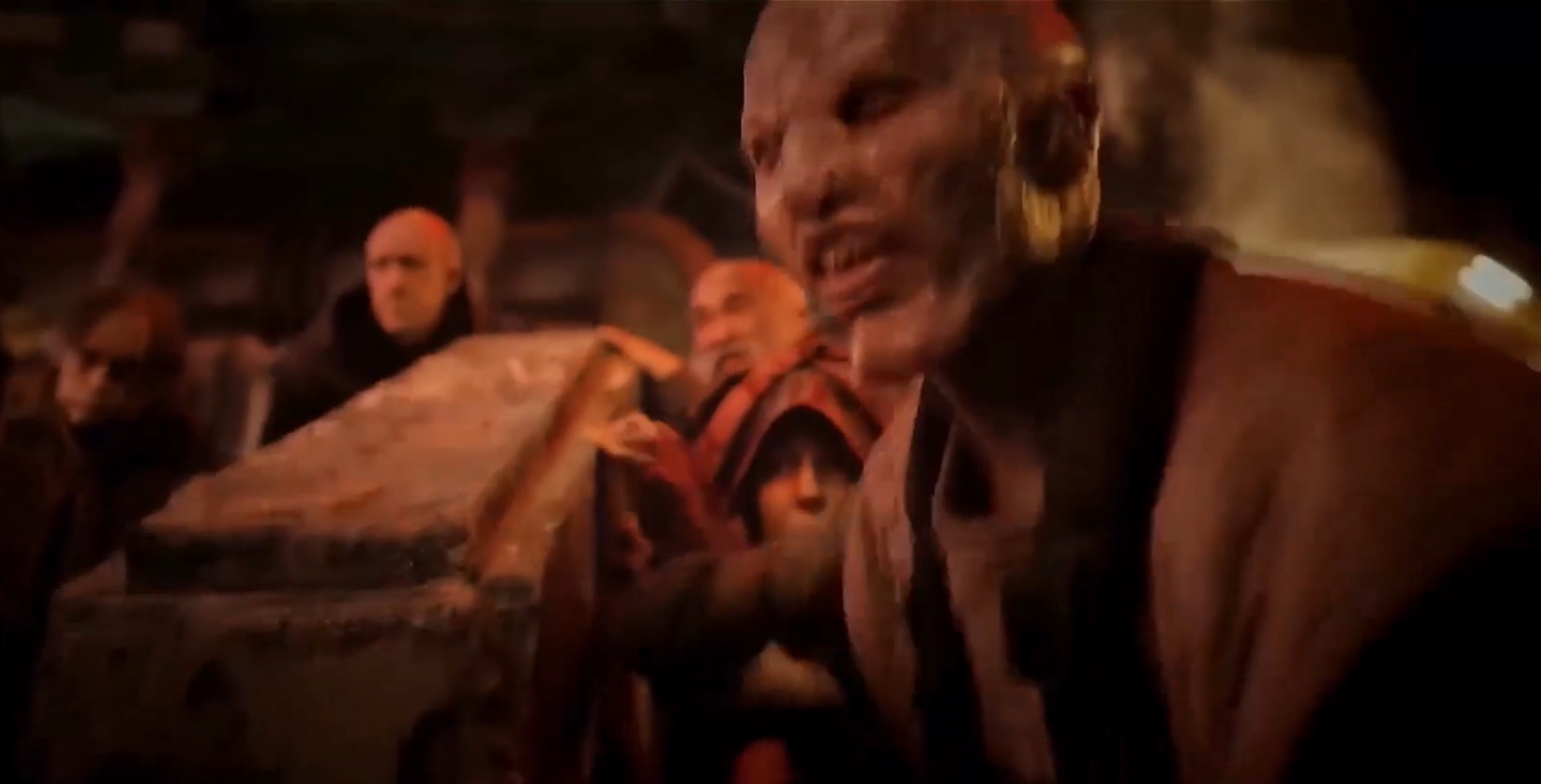
It was depressing driving to the lot through the pre-dawn piney woods, but in “Planet Pez”—the staging tent where we got changed, went through makeup, were tested for COVID, and gave up our phones—there was camaraderie and applause as Pez gave instructions for the day. He said it would start with two scenes that involved special effects and stunts, so we would be sitting around at first.
On the bus to the holding tent, someone asked about his name, and he said his real surname started with “Pez,” and that if he got called “Pez” because he loved Pez it would be stupid. He said so many people gave him Iron Man Pez toys on the set of one of those movies that he learned to say, “Oh, what an original gift!” and throw them on the pile.
He said, “It’s no secret, it’s in the trades—Knowhere will be destroyed again by a certain villain who was hinted at, at the end of Guardians Vol. 2.”
Other extras gasped, but I did not remember who that was.
“Is he here?” someone asked.
“Everyone’s here,” Pez said.
On the bus Pez responded to a girl’s playful request for a line to speak. “A guy asked me six times yesterday to talk to the stunt coordinator [for stunt work] and asked someone else for an autograph. He’s gone. We’re all here to have fun, and to see and do, and this isn’t a threat, but seriously don’t do that shit.”
Everyone sat in the holding tent until noon. A few extras basked like the rich in a little oasis around the one heat tube, while the rest of us huddled miserably and quietly in our chairs. I figured I was in character.
Jeanine and I were talking when a young Asian guy, costumed like a Mongol blacksmith but carrying an inner tube on his arm as his prop, stopped by the table and humble-bragged about his agent. We asked him to tell us more, and he said he made a living at background work and had been in 250-plus productions. He lived in Lawrenceville, more than an hour’s drive from Trilith. He had been a nursing major in college, switched to young childhood education, then exercise science, then he quit college. Snoop Dogg’s production team had paid him $500 a day during the pandemic, plus home-quarantine pay, plus Covid-testing pay, for being in a video. He made more than he did at a former warehouse job.
A few extras basked like the rich in a little oasis around the one heat tube, while the rest of us huddled miserably and quietly in our chairs. I figured I was in character.
He assumed Jeanine and I wanted to be professional extras and helpfully told us to get to know PAs on the set; to be on time; to do what we were told; and to join Facebook groups for extras to get more tips. He named Atlanta casting agencies. I asked if he had arranged his life to be gone from home 10, 12, 14 hours a day.
“Oh yeah,” he said matter-of-factly. He loved it. I guessed that he had no partner or kids.
Tom told me he did background work “to get away from reality now and then, ‘cause, phew.” He had been in a TV series called Valor but was deployed overseas when it came out; his kids saw him in it.
A trash can blew over as we talked, and someone yelled. Tom scanned the tent. “I don’t do loud noises, man,” he said. “I was fixin’ to jump this table and get out of here and get small.” He chuckled in his fearsome mask. “It’s the only time my PTSD kicks in; I don’t do loud noises.”
He was working on a laptop for his day job as an Air Force civilian. A young blue woman came over and took my chair. She had a laptop too, for some reason, and wanted to use Tom’s hotspot. She thanked him, then stayed to thank him again. She chatted him up about his prosthetic head, and he told her it was in eight pieces, which allowed him to express emotions. She leaned in and said her mottled skin was in one piece, so she could only go, “Grrrr.” He laughed, and his raptor eyes glanced over at me.
I had decided I liked my assigned costume—tanker boots, overalls, cable knit sweater, hoodie and leather hood, notebook holsters—and was thinking about the character. Knowhere Citizen #65 might as well be, I decided (taking a cue from Jules Verne), “A man of action as well as of thought, [who] moved through the world effortlessly, impelled by a great vitality, with a kind of persistence that defies every threat of failure. Very learned, very practical, very débrouillard as French soldiers say in speaking of an unusually resourceful person, he was also a man of superb temperament; whatever the circumstances, he never failed to retain mastery over himself…”
“You self-aggrandize,” Larry told me later. He said another friend who did background work compensated by telling people in bars he got more screen time than others with speaking roles.
“There’s a reason they call it background work,” Larry said. “You’re like a shrub, best not seen at all. The studio must regret having to feed you.”
I sat around all morning. A pink extra who had been on set told me that the passed-out Quill who Nebula was carrying around Knowhere was a photorealistic dummy that weighed 30 pounds. When Gillan went to put it down, a prop guy dove to get his hands under it: “I’ll do it!” he yelled.
A group of ten extras was sent in, then eighteen more, and finally I was on set again. Endless takes were shot of the main actors ordering Orloni rats on skewers at a takeout, and extras were told to busy themselves walking across the square or looking at junk sold on the street. It got boring quickly, and our sinuses were already black with fog machine residue.
The crowd of extras began to mill around, and several of us chose to end at a food cart that had Asian tea cups and plastic slugs on a fake brazier. One of the Marine vets had decided to act as its proprietor, and the others sniffed the props and pretended to ask him questions. After ten takes I thought I would see who else had been in the military.
“They told me you guys were over here sniffin’ a cup,” I said when I reached the cart.
The Marine nodded enthusiastically and offered me a cup. The others watched.
“Mmm,” I said, sniffing it. “That smells good. Like your mother.” The men I thought were vets laughed so hard I was afraid we would get in trouble.
And that is how one itinerate writer became an actor. In another take, I pointed to the prop duffel that I had to carry everywhere and was already the bane of my set life.
“You’ve heard of 10 pounds of shit in a five-pound bag?” I said. “This is that bag.”
On the first day I had met a six-and-a-half-foot guy with shoulder-length hair, costumed like a Viking. He and his buddy, who had a huge nose and bowl-cut mullet, had been in the first two Guardians movies. I asked if they could be seen onscreen, and he hesitated. “For a split-second, as the camera whirls,” he said. They had been Ravagers. The Viking was blue then, and his buddy had worn a prosthetic head. His buddy was killed by actor Michael Rooker in an episode of The Walking Dead, a great honor.
“There’s a reason they call it background work,” Larry said. “You’re like a shrub, best not seen at all. The studio must regret having to feed you.”
Now, as we did take after repetitive take in the dust and glycol fog, I saw the Viking selling piles of blankets and coils of ropes from a stand in the street. I made it my signature move to walk over and silently haggle with him. He was paired now with another extra who had facial hair exactly like Chris Pratt’s but was a lot heavier than Pratt, bald, and painted yellow. I tried to guess if the makeup department was clowning Pratt or the extra.
On about the fifteenth take, I walked to them, hit my self-assigned mark, and said, “A guy told me to come talk to Tweedle Dumb and Tweedle Dumber. Am I in the right place?”
The Viking’s eyes flared a little like a berserker’s, and I thought, Uh oh. Then he laughed, and I laughed, and bald yellow Chris Pratt stood there dully.
The Viking was Zane, a smart young guy from Michigan who worked for the state of Georgia. We became set friends. He told me he had failed out of an engineering program in college and became an urban planner instead. The three-ring binder I had seen him reading from in the holding tent was for his national certified planner exam. During COVID he had been working remotely, and he took time to do certain extra gigs. With this movie, he was a Guardians completist.
The day ended at 7 p.m.
Friday was a 9:30 a.m. start, for a change. Tom was gone now. As we lined up in the holding tent for our first makeup check, Pez shouted that the head of Marvel security was going to talk to us later, that things were going nuts, and that we should not bring phones, laptops, or iPads to the set. Pez said he loved us all and was happy we were there, but the security chief was “pissed.”
A small group was chosen to stand around on a restaurant deck in Knowhere, emoting a good time, as a camera flew over them repeatedly on wires. About noon Pez brought them back in and shouted down the holding tent: “This is Barry, Director of Global Security for the Marvel Universe, and he’s here to scare the shit out of you!”
Barry looked like he had come up through the Agency or Delta, but he spoke well and politely: “For the fans, please please please don’t bring devices.” Two extras had been fired, and Barry said he had worked with the entire crew for fifteen years, and they would tell him if extras were seen again with technology. It was a mark of Pez’s likeability and control that the extras applauded him at the end of the dressing-down.
Late in the afternoon Pez said he did not want us “sitting in the fucking tent all day,” so we would all go on set. He gave credit for that small mercy to his PA, Adam. When the extras applauded Adam, Pez pretended to be Adam walking around basking in the applause. Pez’s job seemed impossibly big and important, except that extras would hardly be seen in the movie.
About noon Pez brought them back in and shouted down the holding tent: “This is Barry, Director of Global Security for the Marvel Universe, and he’s here to scare the shit out of you!”
On set we reacted to Karen Gillan floating up on wires and acting out shooting hand rays to knock a stuntman for Will Poulter (Adam Warlock) through a wall. Rehearsals and portions of takes took more than an hour, then there were only two full takes, and Gunn yelled over the speakers, “That was fan-fucking-tabulous!”
Back in the holding tent, Pez lined us up and picked every other person to stay even later. O! the wild, working-class exuberance of mostly young people who have not worked all that hard and have been set free! They performed cheers, laughter, singing, and shouts of, Have a good weekend!
The second Monday was a 6:15 a.m. call. (A COVID test, and sometimes two, had to be done each day before call time.) Brandon was back after doing a commercial for a school-bus company. In the morning lineup, Pez said he would use everyone, eventually, in a long day of shooting, which turned out to be 13.5 hours. I napped after breakfast and again after lunch. Brandon slept for four hours on my prop bag. A young pink woman, face as vibrant as a TV screen, took what looked to be a depression nap on a folding cot and Polartec blanket she had brought in.
Dozens of us sat in the cold until 4 p.m. then were taken on set. Nebula had the bad guy down in a fight. Earlier in the day an air cannon had blown fake debris around in an explosion, and the remains of plaster craters were being taken outside.
In the first shot we were meant to react to Adam Warlock picking up Nebula and throwing her sideways into the fried-Orloni stand—all done with harnesses, technical rigging, and stunt people. In the second shot, the window of the stand was exploded by being pulled violently from the inside. (A blurry split-second of me gaping at all this is in the final cut.)
There were also several takes by a perilous-looking Steadicam, rigged on cables, that dropped from the rafters and stopped just short of Will Poulter’s head, as he looked up into the lens. The camera was a stand-in for the sentient tree Groot, who would be added with CGI. Poulter walked heroically in his cape, but his stuntman looked more confident and physical.
Several of us were placed on stairs around the town square. I stood next to Troy, a 74-year old little person from Alabama, who started doing background work in 2013. He said he had worked 33 years for AT&T, which took him to all but eight or ten states, mostly on military bases. But his wife spent his 401(k), he said, and he took Social Security early at 62, so the amount was too small to live on.
He had made a “whole new career” in the movies and had been in so many things he had lost count. He said he had something coming out with Sylvester Stallone. His twin, Roy, also acted. Pez and the PAs deferred to him out of respect—standing on set was uncomfortable, and he sometimes walked away during delays and sat down—and other extras came to talk to him in tribute. He was generous with them, which overrode a gruff exterior.
On the shuttle to our cars, after 8 p.m., Tempest, whom I had met on my first day, plopped down, threw her weight against me, and asked how my day had been. She was from Los Angeles but said she left due to the homeless that blocked intersections, and COVID. She lived now in a room in a house in Atlanta for $1,000 a month. She had played a detective in a police procedural series and was stunt-trained to fall 15 feet. I asked if she got to beat people up, and she said yes and picked at my civilian clothes. She asked where my glasses were, which I had stopped wearing after the first day. It gave a citizen an odd, happy feeling to be seen for his true self.
Tuesday
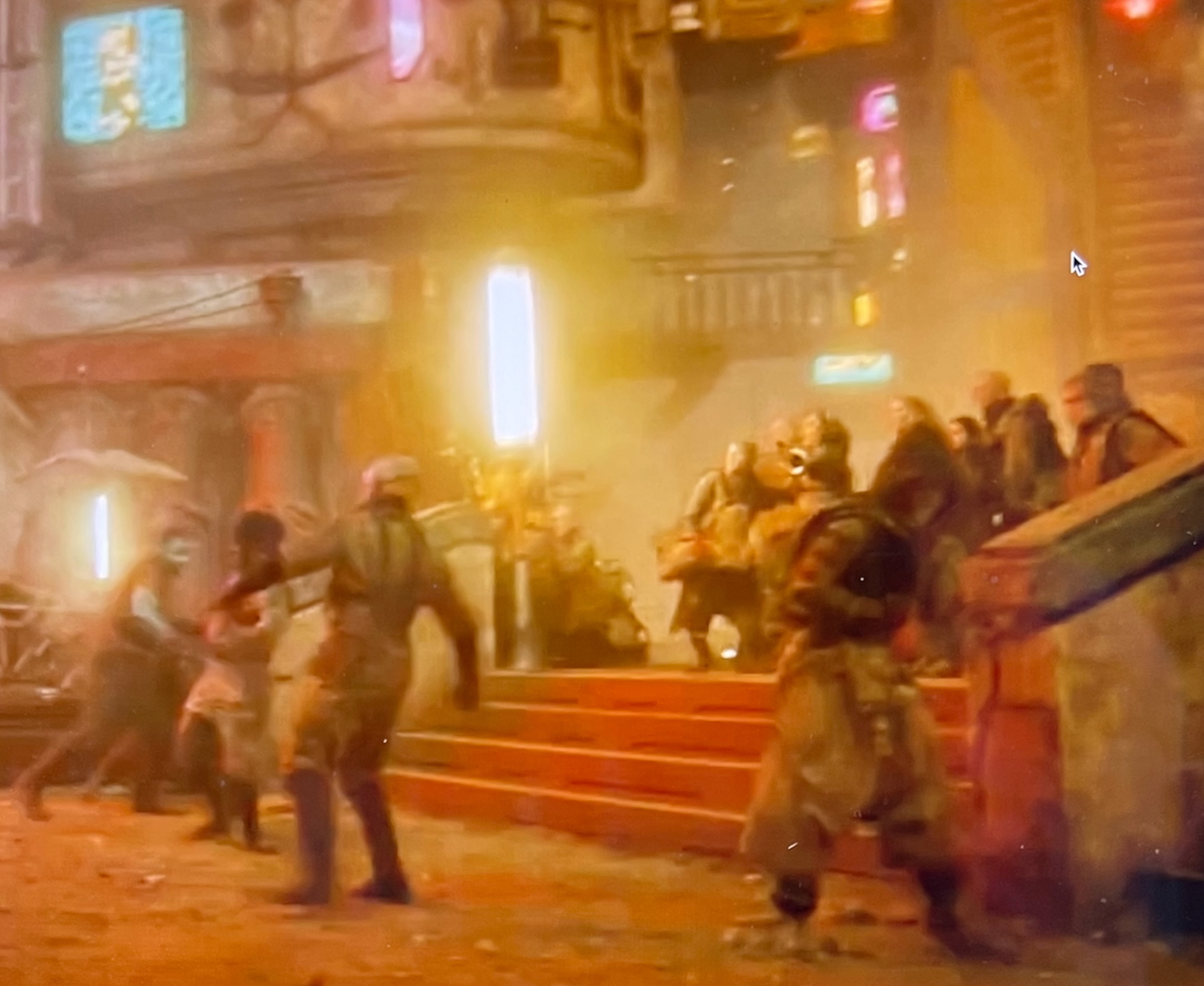
After a 7 a.m. call, we spent the day on-set. Adam Warlock would be walking, in the scene, to the Knowhere armory for the big fight that was key to the movie. (For fans: We thought at the time that Rocket died for good.)
Though none of us would be visible in the final cut, Pez gave us acting notes, such as, “Don’t stand like a statue.” He moved around in a crouch, showing us how to be animated: “You’re looking in, what the hell is that? Oh, shit, I need to run away!” He dodged back. “You’re looking, and this gold guy and a tree blast off!” he said.
There were two dozen shots to be completed, each with multiple takes—some with stunt doubles, some with principals Pratt, Gillan, and Bautista, some with other camera angles, some reversed with extras reacting to events. Warlock/Poulter held Nebula/Gillan up by her forearm, but someone positioned her in a way that no weight ever hangs, and Gunn came in to correct it. At one point, a 30-pound sandbag accidentally fell from a great height, narrowly missing Gunn, the First AD, and a star. Even with pretend violence, people could die.
Between takes I gazed too long at some fake gold bars used as props on a table. They would have been perfect for my kids as mementos, but I knew I no longer had it in me to be interrogated in the Fayetteville jail by Disney GSOC agents demanding to know why I hated their shareholders. I went and sat down. Two minutes later a strange man came out to count the bars, almost as if everything we did was being watched.
At one point, a 30-pound sandbag accidentally fell from a great height, narrowly missing James Gunn, the First AD, and a star. Even with pretend violence, people could die.
Everybody was there, just as Pez had said. Chris Pratt brushed past me. James Gunn walked up and accidentally locked eyes with me, no doubt seeing my resemblance to his brother and considering whether to give me lines. Between takes, Pratt and Bautista played around in front of me. Bautista acted like he wanted to gunfight in the dirt. Pratt did a childlike little pew-pew, pew-pew with both hands. Bautista/Drax bent forward and wiggled like a burlesque dancer, and Pratt gave a delighted little-boy laugh and copied him.
Two young extras canoodled on set. He hugged her from behind as they sat together and put his leg around the front of her leg. She got mad: “Do you know what that looks like?” She got up and walked away. She came back; they resumed.
It was 7:30 p.m. I was tired.
Wednesday
“He’s a real nowhere man,” a makeup artist sang prettily during another early start.
I was used to my makeup and costume, but the one-inch heels, painful toes, and tight uppers of my tanker boots made me walk suspiciously, like a poor guy with a belly full of free eggs and a heart filled with larceny. My overall straps hung down in back like I had forgotten to fasten them after a trip to the outhouse. Yet the staff treated me and everyone else with cheerful professionalism. They knew how to handle an army of amateurs and loose cannons and get the job done.
The canoodling couple was gone, and I wondered if they had been canned. It made me realize there were entire categories of things from the real world not represented in background work. There would be no PDAs by Knowhere citizens—no kissing, no handholding, no hugging. No laughter. No tears. No routines of personal hygiene. What else was there none of? No looking up in wonder, looking around lost, pausing as if something had been forgotten. There were no pets. No books. And almost no wheels, strangely.
An extra named Mike was with me on deep background (ie, hidden) in a scene near Quill’s apartment. He worked at Sam’s Club nights and did background part-time until COVID. When he got laid off, he became an extra full-time. He worked about twelve days a month and bought health insurance off the marketplace. He said he was satisfied, though he had been on a July shoot for Hunger Games that portrayed winter and had to wear a coat in the Georgia heat. He said he tended to be cast as bikers and thugs. On Hawkman he was given a temporary tattoo. Studios did not like real tattoos, because they could cause licensing issues with the artists, he said.
During lunch in the holding tent, Troy saw me writing in a composition journal and stopped twice to ask if I was writing a book. He stopped a third time and asked if I was writing a movie, and I said yes, and that he would star in it. The joke made him randy, and he told me to look for “Pretty Ricky Mulatto” on YouTube. He said not to watch the video with my kids or wife around. He said it was not porn, then he hesitated.
“It’s a contest, I can tell you that,” he said and winked at me over his COVID mask.
Pez kept saying that in the story line we would be in hiding, so we would not get used much, but we spent a long midday on set. Bautista rehearsed throwing Warlock into a neon sign. There were sixteen stunt people, their rigging, a rail system built for the Steadicam, groomed dirt, and a mountain of stunt pads to contend with. Crew spirits were high, and even Gunn sounded giddy as word was passed around that the two weeks had gone well, and that segment of the film was captured.
After lunch Gunn emerged in a T-shirt that read, Guardian of the Bakery. He and the First AD, in a goofy mood, set up a scene they thought might be used as a trailer. Little scraps of plastic on boxes and wires were placed on the stairs and courtyard and put in motion by a PA shooting them with compressed air. (First AD: “Are they going to add the sound, Boi-oy-oy-oy-oing?”) I assumed they were markers for CGI creatures to be added in post-production.
During lunch in the holding tent, Troy saw me writing in a composition journal and stopped twice to ask if I was writing a book. He stopped a third time and asked if I was writing a movie, and I said yes, and that he would star in it.
A dozen extras were told to react to them moving, with no further explanation. A group of women chose to laugh at the scraps and bobs, as others of us pretended to talk companionably. Pez had asked for Troy’s involvement in the scene the night before—“I need you, buddy”—and now Troy improvised putting his hands up, as if there had been a touchdown, still holding his assigned prop, a roll of flex pipe. The First AD strode off the stairs, laughing, and said, “This guy thinks it’s a field goal—he does this,” miming Troy.
About that time, Pez was deep in conversation with someone by the Orloni stand. An extra had done something, and I thought I heard “mentally ill.”
“Get rid of her,” Pez said several times over five minutes. “Don’t ruin any lives. Mine is ruined enough for everybody.” He imitated a rough voice, comically: “Give her my best. Welcome to Hollywood, kid!”
On the next break, Pez had everyone sing “Happy Birthday” to Heidi, a stunt coordinator, and danced for her as a gift.
Later an outraged extra complained to anyone who would listen that the production got rid of two people because they had nose rings. Hers, she said, was gold and diamonds, and they were not going to cut it out. If she needed to, she would go to a tattoo parlor and have a body-modification specialist take it out and put in a retainer, and the studio would pay for it.
Drax threw Warlock through the afternoon and into the evening, a few feet at a time. The sequence ended with a single take in which a stuntman flew into a neon sign that exploded with pyrotechnics. Everyone applauded the stuntman, who was older than Will Poulter and humorless, but a total professional and an athlete. Later he showed Poulter how to throw a punch, so he could hit Drax and not look ineffective. A bunch of us were in deep background for that beating until 7 p.m.
Thursday
A 7:30 a.m. start. Pez: “Your motivation is, I can’t see you.” The action was taking place in the armory; Rocket the Raccoon was shot, and his friends rushed around trying to save his life.
The canoodling couple was back in the holding tent, he smothering her from behind, looking like two people jealously guarding the mouth of a tiny cave they had taken shelter in.
I napped, read, and talked with Jeanine, an all-day study hall that did not end until 4:30 p.m., when I went on set. Pez had said for two weeks that we had been shooting around a shot not yet shot; we would be doing that now.
Adam Warlock was to fly up in the air with Groot, crash-land near the bar, then walk to the armory. We were to creep out of our hiding places, react in fear, and retreat as he walked up the dirt lane. He would get hit by something, which would not hurt him. Gunn did many takes, including Poulter lying head-down on the dirt; Poulter being pissed; being fucking pissed; wanting to kill somebody; saying, “Who threw that?”; and saying, “Who threw this item at me? Grow up.” Extras laughed at that one, which Poulter liked, but Pez told them to be quiet. Finally, Poulter said something I could not hear, and Gunn said over the intercom that he loved it.
One extra at the front of the crowd was picked to sprint back alone when he caught sight of Warlock. He had to run across the courtyard, through the extras, past me, and up a short flight of steps. He was an emaciated-looking kid with long, lank hair, who made a joke about getting his cardio, but after about fifteen takes, he stopped laughing.
Friday
On the last morning of the Knowhere sequence, wardrobe stylists in Planet Pez began fitting everyone for Christmas outfits, in case we were chosen to work on the Guardians Holiday Special due to be filmed in the next week or two. Long tables were filled with shiny necklaces, head bands, hats, pins, bracelets, and battery-powered lights.
Ira, the first person I worked with on the production, and who created my costume, was there. I told him I wanted to thank him for his kindness then, and he was amused. He put me in a kitschy holiday tie and green stocking cap, on top of my dirty face and Knowhere outfit. Someone took continuity photos. Maureen asked if we were being dressed as if we did not understand Christmas, and a PA said, “You got it on the first try.”
Pez, as we waited for the shuttle to the holding tent: “A good day, a good scene to end on—promotional.” He raised his fist in victory and bowed his head.
“Nothing says Christmas like a dirty refugee camp,” a young guy on bus said a few minutes later.
“And for the main characters to impose their colonizer religion on a camp filled with dirty war refugees,” another added. I had already decided to skip it and go home.
We took our places on the set, where the Props Department was creating a debris field in the town plaza: big chunks of Styrofoam with fake dirt on them from the previous crater scene; pieces of indiscriminate plastic and metal junk; a real wing flap from an aircraft, labeled “No step.” A woman used a garden sprayer to paint more things brown. A guy shoveled dirt over stuff. A guy came around with a box of candy glass and artfully tossed it down. More everything, more fussing. By the end, crew had achieved a genuine look of littered chaos.
Pez said everything we had done in two weeks might end up being four minutes of screentime. This was scene 20. At the end of the next week, after we had left, they would be halfway done with filming the movie.
I talked to an extra named Molly, who said she was Cambodian and asked if I had been to Cambodia. I said I had been to Vietnam but not Cambodia, and she said she told people, You’re in Vietnam, in Thailand, just step over the line to Cambodia.
I asked her favorite Cambodian food. She said she did not like to eat and weighed 80 pounds. She hated the smell of food and the sound of people eating. Her mom always tried to trick her into eating, as a kid, by giving her fruit and vegetables, but she hated them too.
“Do you know what I’d do in a desert?” she asked.
“Die?” I said. She laughed and said she meant she would not miss food.
Molly did martial arts for films and told me to look one of them up on YouTube but had the name wrong. She told me she was 47, but people thought she was in her late 20s. I told her I was in my late 20s, but people thought I was 58, and she laughed and cracked me in the knee with the roll of metal hose she carried as a prop and hurt me real bad.
It was fascinating to watch James Gunn use process to cover himself and be sure he had a “vengeance porn” shot that audiences would love.
Her voice was a mix of Georgian and Cambodian accents. She was married to a local, and they had raised five kids who were now all grown and out of the house. She said she told them to choose: “Job, military, or college.” She gave each one $5,000 and said, “Don’t come back.” Three had gone into the army, navy, or Marines.
To me, she said, “Why would they need to come back if they have $5,000?”
In the scene being shot, Nebula was to get up from the savage beating that had broken all her limbs into pretzels, walk to where Warlock was beating Drax to death, and stab him in the back. Gunn told Karen Gillan over the intercom to get there faster.
Gillan: “But I’m limpin’.”
After many closeup takes of Warlock being stabbed (Will Poulter’s line: “That hurts”), there were takes to try to get Warlock going down convincingly in the dirt. Gunn on the intercom: “I want my Brando.”
It was fascinating to watch Gunn use process to cover himself and be sure he had a “vengeance porn” shot that audiences would love. He seemed to settle on Will Poulter jerking suddenly as he beat Drax; the tip of a blade emerging from his chest; him saying, “That hurts”; him falling to the ground; and then we would see that Nebula had stabbed him.
Over the intercom, Gunn pimped Henry Braham, the movie’s English Director of Photography, who often ran a Steadicam himself. Braham was using some sort of “angle” shot, Gunn said, which started low and snapped to a higher view. Gunn said, “If you watch Thor 1, like, 90 percent of shots are that.”
The last thing we would do as extras was to react, in a reverse shot, to Drax being beaten by Warlock. Gunn arranged us in clusters, like a tableau, and after some rehearsals decided to focus on my little group on the stairs. Emoting to the now-ended action of what Gunn shouted to us on the intercom—“Your guy you love is being beaten up in front of you in the street!”—was the closest thing to acting I had to do on set. I pulled some faces and moved my body, even leaning forward as if I almost had the courage to intervene, but after several takes I was losing heart. That all went out the window when Gunn shouted that we should be flinching to the beats of the (non-existent) punches.
“Bam! Bam! Bam! Bam!” he shouted, like a demented metronome, to give us the beats, and we flinched on cue.
Another extra in my group stole my idea of straining forward, and Gunn told the other extras around him to restrain him. Oh, I was sour. In the final cut, almost none of this is shown, though I am visible, for a microsecond, in a whirling blur like the one my young friend Zane got in the earlier movies.
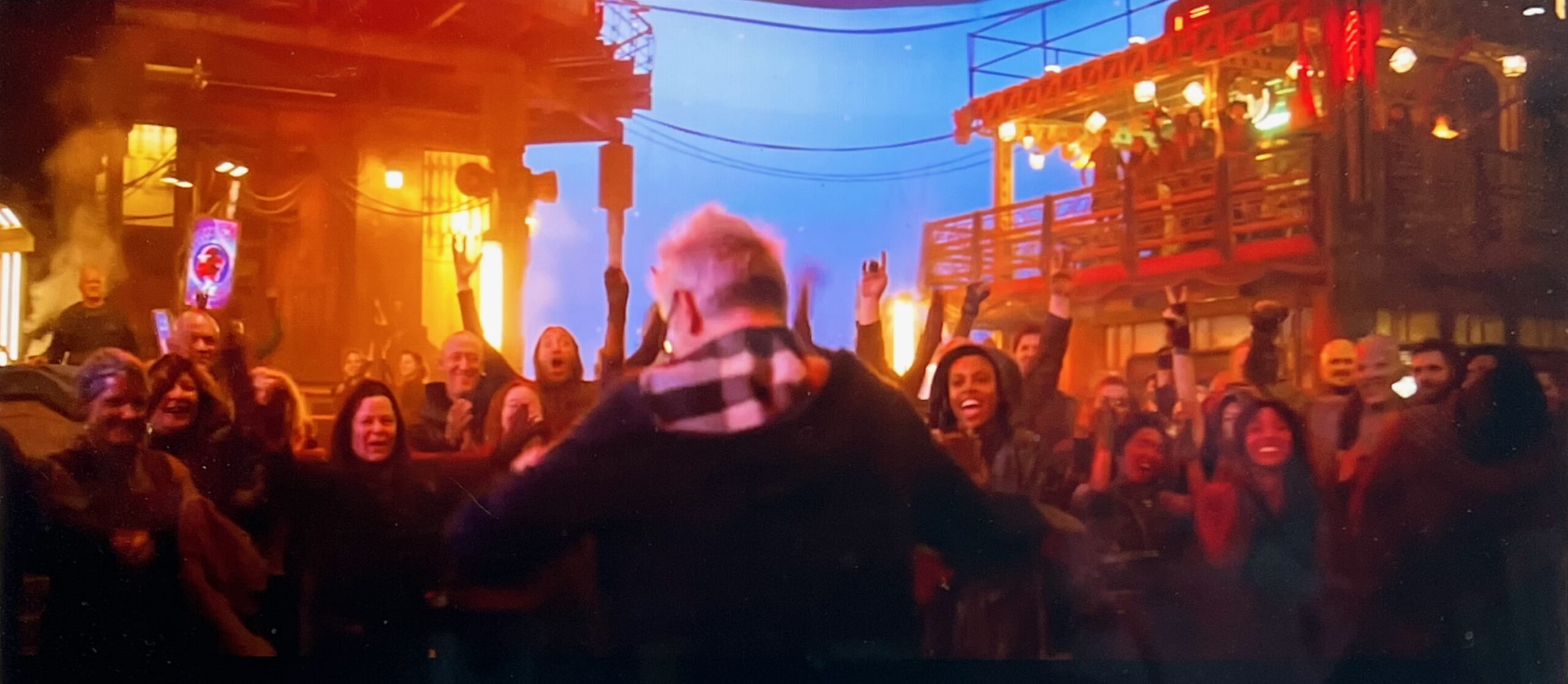
Then shooting wrapped, and we were invited down to where several Steadicams were running, to shout something into their lenses to a Fred and Tonya. I had no idea, but the others were really into it, as if we were one big family. Then we were encouraged to celebrate, dance, cheer, and clap. Gunn came out from his directorial hidey-hole in one of the false buildings, and the extras chanted, “James James James James” (seen here, at about 05:32, where I am in the crowd). Gunn shouted, “Live from Knowhere, the greatest citizens in the universe!” More cheers and panning cameras.
Then we were invited to go home, which was great because it was early, but the crew celebration had already started with a raffle-draw from a bucket. Some extras tried to hang back to watch, as cartoonish flames appeared on the blue screens all over the top half of the set, but were herded out by PAs impatient to get to the party. On the short walk to the holding tent, young extras of many colors cheered in imitation of the crew, who could still be heard distinctly back on set: “We did it!”
• • •
The almost startling end to the popcorny, blockbuster Guardians series is its psychotherapy-based human understanding. The characters’ fates in the third and final movie seem to be based on whether they have been able to actualize or individuate. All the women go their own ways, for instance, unencumbered by men’s needs or fantasies. This makes some of the men sad.
Peter Quill, who suffered the massive psychic wound, as a boy, of watching his mother die, has been sleeping his entire adult life with anything that walks, crawls and has not been dead too long. By the end he thinks he really needs a relationship with Gamora (Zoë Saldaña ) but is sent back instead to eat cereal in his boyhood home, which he had not been to since his mother’s death.
The almost startling end to the popcorny, blockbuster Guardians series is its psychotherapy-based human understanding. The characters’ fates in the third and final movie seem to be based on whether they have been able to actualize or individuate.
In the “behind the scenes” video about the third movie, Quill is shown walking down a subdivision street toward that house, backpack over one shoulder, like a schoolboy. Chris Pratt says in voiceover, “The Guardians themselves each need to fulfill their own lives in a way that requires them to be separate from one another. So the third movie is Quill learning to be okay on his own.”
James Gunn says in the same video that the goal of the movie was “allowing the emotion to really play out, and not to be afraid of it, not be ashamed of that emotion.”
• • •
I said goodbye to Maureen, Jeanine, Troy, Molly, Tempest, and Zane, and missed being able to say goodbye to Tom. I blinked in the sunlight on the shuttle to my car. It was usually pitch black at this point. I drove my car out of the studio gate and wondered what I was feeling. I would miss this strange world, even though the actual work was mildly uncomfortable, and I was not really part of it.
No longer a character in a major motion picture, I found myself just a guy with sturdy boots, a warm sweater, and a bag filled with papers, headed out for somewhere, all on his own.