The Restorative Noise of Doing It Yourself at The Sinkhole
Community, hope, and the annals of analog in St. Louis’s underground music scene.
October 16, 2026
Guitars growl, bass notes boom, and bodies begin to pulse. Your bones rebound against the flurry of rimshots and the wash of crash cymbals. The sweating crowd begins to swell as you brace for what seems to be the first wave of seasickness. You feel the floorboards sink. The room is small; the amplifiers loud. Neon manes and mops bob and surge and shimmer under the heat of stage lights. Mohawks, mullets, stratospheric spikes. A vortex opens up. Studded body moshes against studded body. It seems violent, but also intimate. And above the maelstrom, mounted to a wall plastered in a hodgepodge of band fliers and stickered affrontery, a sign illuminates the disclaimer: “This ain’t no disco. Ain’t no country club either!”
Suffice it to say, The Sinkhole is not your typical music venue. As owner-operator Matt Stuttler says, “I’m not trying to make money.”
That is an audacious strategy in a time of ticket oligopolies, the corporate consolidation of live events, and the Spottification of our daily listening into an algorithmic curation of more-of-the-same. Contemporary music culture often falls flat.
There is no tap-to-pay; no e-ticket to scan. Just cold, hard cash and even harder decibels.
Not at The Sinkhole. Conceived in 2016 with two others, today ownership and operations have been solely taken up by Matt. His responsibilities do not end with just booking shows and recording bands, but include, as he enumerates them, “beer ordering, bartending, janitorial stuff, you know, I’m taking out the trash and ordering more trash bags.” A one-man show that ensures the shows go on. “We’re doing everything from international bands to somebody’s first show,” Matt tells me about the venue’s diverse, wide-ranging roster of acts over the years.
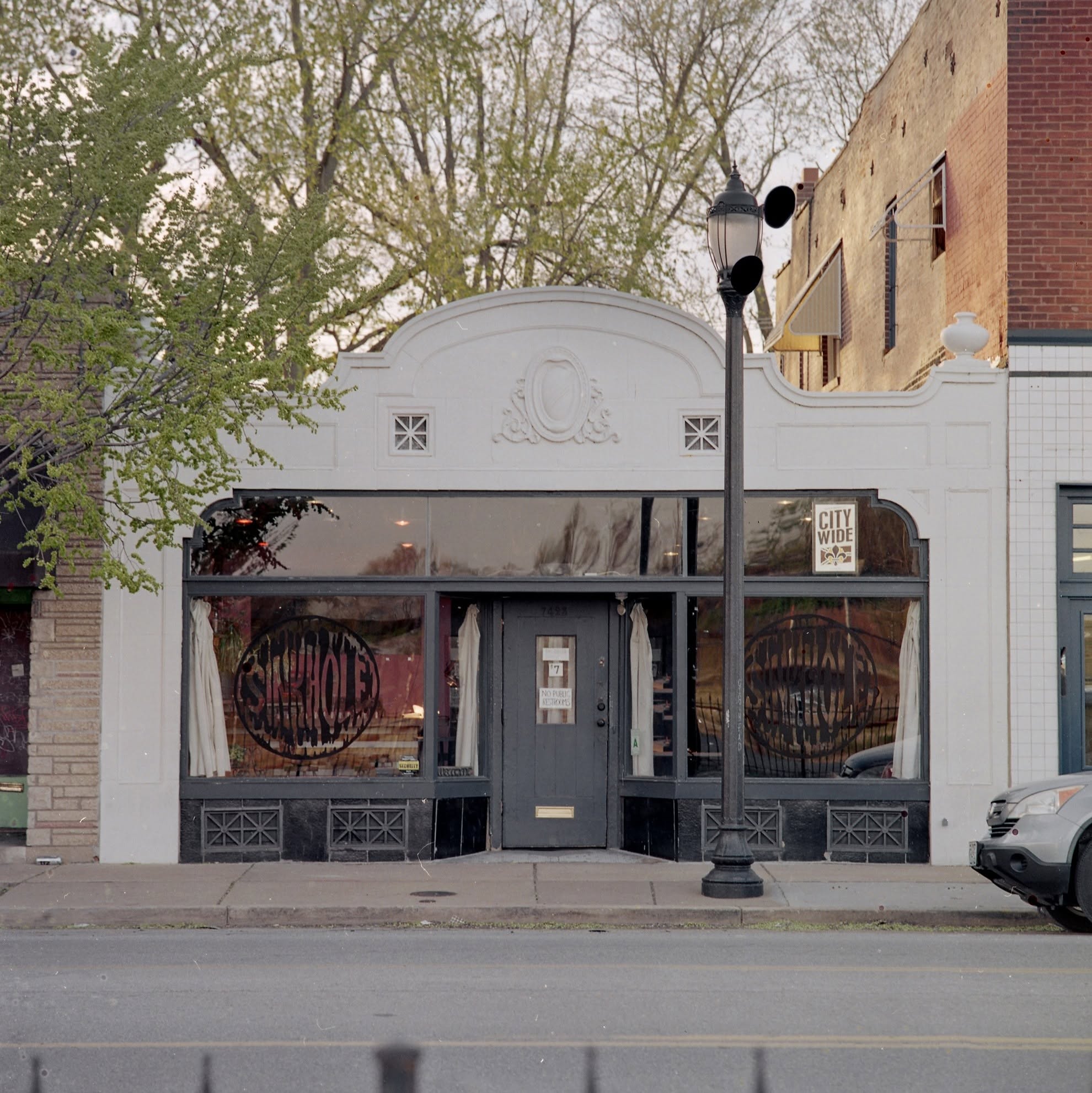
As Matt describes it, The Sinkhole is “an all ages DIY space. A venue for the working band and a venue for the local community.” Located on Broadway in St. Louis’s historic Carondelet neighborhood, the venue has become something of a billowing steam vent in the city’s punk, hardcore, and metal scenes. A bastion to the do-it-yourself ethos long embraced by the subcultures of underground music, The Sinkhole boasts a single room, one bar, and a ceiling as low as its overhead. As Matt states approvingly, “there’s no separation between the audience and the performance. It’s not cavernous. It’s close up in your face. The bar is there to serve the needs of the show, but it’s not a focus, you know? It’s meant for people to mosh around and spill beer and shit.” But do not let its modest proportions or its lack of a proper stage fool you. The space also features a recording studio from which it operates its own label. As Matt puts it, “my intention is to foster the St. Louis community as much as I can intentionally and be able to help bands out that might not have had the tools had The Sinkhole not existed.” For a decade now, The Sinkhole has diligently pursued that mission, providing local musicians with a professional space to perform and record, while offering live performances almost every night of the week. There is no tap-to-pay; no e-ticket to scan. Just cold, hard cash and even harder decibels.
“DIY is a lifestyle,” Matt says. And The Sinkhole wears its unembellished do-it-yourself philosophy proudly on its tatted sleeve. But if DIY means more than finally fixing that leaky faucet, what exactly is it? “You can’t fully pull it out of the air and be like, this is what it is,” says Matt. “It’s a discussion every time.” It’s an appropriately DIY answer to the question of definition. You cannot standardize this. Like The Sinkhole, doing something yourself means meeting a problem on its own terms, in its own moment in time and space. Consequently, meeting that challenge also means identifying the structural disparities that prevent lives from fully flourishing—the systemic neglect where on-the-ground efforts of local reparative politics can offer a megaphone, or a microphone, to express the outrage of the forgotten. In a word, it is punk. Indeed, drawing on his time touring in a punk band for almost twenty years, Matt taps into those past experiences as a resource to help local musicians have a chance at being heard. “It doesn’t matter what you do for a living,” Matt tells me, “it’s like, if you have the DIY ethos, you’re trying to give back because you understand that you were given opportunities as well. Or, you want those to have opportunities you didn’t have.”
On that note, The Sinkhole asks its patrons to consider what it means to be a part of a community organized around an ethic of repair in a dominant culture of replacement—single-use, disposable slop whose inevitable obsolescence comes pre-installed. And what stimulant might remedy this culture of impermanence and digital fatigue? “The younger generation,” Matt states, “thankfully are returning to analog.” And if you attend a show, you will be met with merch tables offering The Sinkhole’s preferred formats: cassettes and vinyls, formats that The Sinkhole as studio and label records on.
If this struck a certain distorted, power chord with me, it is because The Sinkhole conjures memories of my youth spent playing in hardcore bands in rural Missouri. With limited funds and even more limited opportunities, we often rehearsed in my father’s garage, a working-class guy who was rarely not in the garage fixing something. Although my father’s greased tools and half-finished projects frequently warred for turf against my band’s grungy guitars and blown amplifiers, we both at least shared a DIY orientation to the sense of forgottenness that fueled us: to repair a world that we found broken.
I cannot help but reflect on this each time I drive through Carondelet on the way to The Sinkhole. On that drive, I am immediately confronted with the remnants of another broken world. That world was Carondelet’s former economic glory as an industrial ganglia of factories seated on the Mississippi. The sooty spires of ashen smokestacks and the graffitied facades of crumbling manufacturing plants bespeak the halcyon days that once thronged with industry, swept off to distant shores during the waves of deindustrialization in the 1970s and ‘80s.
The industrial area of Carondelet remains a rusted husk of that past. Underserved and divested from, certain areas of Carondelet continue to struggle with an unhoused population and the inequities of urban decay. Nevertheless, community spaces persevere and thrive. The same stretch of Broadway also features the LGBTQ+ inclusive BarPM and, next door to The Sinkhole, Opaque, an artists collective of designers and screen printers. Reflecting on The Sinkhole’s embeddedness in the Carondelet neighborhood, Matt says that “the community around us has really embraced us. There’s a lot of stuff that goes on around here, you know, like a large unhoused population. Everybody struggles in their own ways.” However, in providing an all-ages space that attracts a diverse and eager crowd to the streets of Carondelet, The Sinkhole symbolizes a pocket of hope for an area both historically important to St. Louis and yet long neglected. “We’re the only nighttime business on our block. So we really can stretch out a bit.” In fact, if you pull up to The Sinkhole on any given night you will typically witness that stretching—mingling bodies on the curb, clad in studded-leather and Sharpied chucks, as if you drove into the waste world of Mad Max (and the roar of revving motors up the street at the Offtrack Saloon biker bar does not help to dispel the sense of rockabilly Armageddon).“But the neighborhood supported us,” says Matt. “We’ve received grants for our studio and for our historical facade on the front.” Both of those grants were awarded by the neighborhood association. The sounds of steel and iron of Carondelet’s past may have faded, but The Sinkhole recaptures the spirit of that ghost world in the hardcore and metal that blasts like a furnace roaring to reforge a forgotten community.
The Sinkhole asks its patrons to consider what it means to be a part of a community organized around an ethic of repair in a dominant culture of replacement—single-use, disposable slop whose inevitable obsolescence comes pre-installed. And what stimulant might remedy this culture of impermanence and digital fatigue?
And yet, underground spaces like The Sinkhole face their own trials as they compete to survive in a post-Covid landscape of shuttered venues and a digital ecosystem made up of algorithmic bubbles. What is more, concert-going today looks very different than it did even ten years ago as business models adapt to demographic shift. “It’s going to be interesting to see how shows change as alcohol is not a driving factor for younger generations, which is awesome,” says Matt. “But that means that venues that rely on a bar to stay afloat are going to have to restructure. Or these spaces are just going to become completely underground again, which is also rad.” The Sinkhole seems well ahead of the curve, if not already carving out a vital role to play somewhere in the subterranean layers under that bend. Putting community first and profit last, The Sinkhole is filled with an inclusive, intergenerational mix of old punks and new who have found there, as Matt tells me, “a space where they can actually express themselves.”
Of course, that expression gets inflected with regional cultures and identity. “It gets weirder here,” says Matt when I ask him about how DIY subcultures survive and thrive in a region like the Midwest. As with many other genres, like hip-hop, the historical narrative around punk and hardcore has long been framed as a rivalry between East and West. High-profile, coastal acts like Black Flag and Minor Threat, or The Dead Kennedys and Circle Jerks tend to overshadow the noisy interior exemplified in acts like Chicago’s Naked Raygun and Minnesota’s Hüsker Dü. Although forgotten, the Heartland has long pulsated to the beat of raging tempos. Like Carondelet, and St. Louis more broadly, this general atmosphere of forgottenness can be both a curse and a blessing. “Here, weirdness can thrive a little bit better,” Matt explains, “because no actual music industry exists in the Midwest. So, once you realize that there’s no label to strive for and you’re just doing it for yourself, then you could be as weird as you want.”
At The Sinkhole, doing it yourself is never a solitary endeavor. Doing it yourself, and doing it for yourself, also means cobbling together a community in a time when collective action and intergenerational solidarity feel broken. There is a togetherness in putting our world back together. In an anecdote that resonated with my own youth, Matt gives me a sense of how formative The Sinkhole can be to those who call it home. “There was a kid that started coming to shows when he was twelve at The Sinkhole. I served him his first beer last year,” Matt reminisces. “He started a band in his teens, and he’s still in a band now. You know, and his band’s starting to play outside of St. Louis more. It’s like, it’s cool to actually see that manifest. It’s crazy to think that that’s been ten years.” Every angsty chord that shakes the windows, every guttural scream etched into hot vinyl, shows that we might repair this world in common, one punk at a time. The Sinkhole captures a community’s desire for creative expression in a time when creativity itself is under threat. In a time of streams and algorithms, The Sinkhole reminds us that the bumps along the way might be the rhythm of our own, unique music. A resounding snare hit, an amplifier wailing with feedback, the swirling entropy of the mosh pit. No one ever said that repair would be a quiet affair.