Remembering the Publisher of “The Riverfront Times” and “St. Louis Magazine”
By Chris King
April 27, 2026
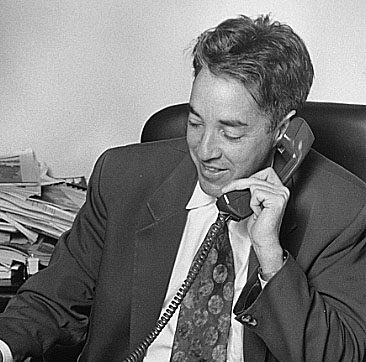
Ray Hartmann, who died in a car crash on April 23 at age 73, launched the careers of many journalists and scribes who got their first byline in The Riverfront Times or St. Louis Magazine when Ray owned those publications. They will mourn him and tell their stories. This is mine. I make no pretense of writing a news obituary of this complicated and provocative man. Rather, this is a memoir of his impact on my life, which endures in every word I write for publication.
The end of a life puts into perspective every element of that life you have shared. I once tried to tell Ray how important he was to my development when he had no idea who I even was, but only now that I think back on Ray after he was taken from us so tragically do I reflect on how profoundly I was shaped by the opportunities Ray provided.
Years before Ray published my first piece of paid journalism, I sang his name many times in a rock song that was pivotal for the rock band that was itself responsible for my first story in The Riverfront Times. The very first concert performed by my band Enormous Richard was attended by the music critic for the daily newspaper, the St. Louis Post-Dispatch, a kind, witty, and very tall man named Steve Pick, who was dragged there by one of my graduate school friends who knew him from growing up in the local music scene. Steve Pick liked our band Enormous Richard so much that he sat down to do a proper interview with us a few days after he saw us perform at our first-ever gig.
Inevitably, this story will have other things in it that are gone, the way Ray is now (unbelievably) gone, but Steve Pick interviewed our band upstairs at the original Cicero’s in that small front space adjacent to the stairs down to the basement bar where post-punk rock in St. Louis was created by Uncle Tupelo (and a few other bands). Steve liked the lyrics to a song we had performed at our debut show, “Tribal Rachel,” a portrait song about a young woman named Rachel Leibowitz, who was a friend of the band at Washington University in St. Louis and a superfan of cool music.
Rachel was a photography major who devoted her senior portfolio to portraits of her friends. I was a transfer student and a Navy ROTC refugee who had gone AWOL, and I felt like I had absolutely no friends on campus, so I was incredibly honored that Rachel thought I was her friend and wanted to take my picture. So, I wrote a song for her in return. When Steve praised our portrait song of Rachel, we told him we would write a song about anybody upon request, at which point Steve requested that we write a song for him. So, we did just that—we wrote a song called “Steve Pick, Music Critic.”
Inevitably, this story will have other things in it that are gone, the way Ray is now (unbelievably) gone.
I did not have much to go on besides his quite striking looks, which the lyric compares to Ichabod Crane and includes the phrase “hunched over and strummed,” as, like some very tall people, life has encouraged Steve to slump. He also told us that, though he was reporting on us for the Post-Dispatch, he previously had written for a newspaper that we all read much more closely, the alternative weekly paper, The Riverfront Times. At that time, in the early 1990s, Ray Hartmann’s RFT was quite the gadfly, fearless to lay into anyone or any institution in town. However, Steve informed us that it had not always been the case.
In the paper’s earliest days, when Steve was its first-ever intern, Ray wanted the paper to be a booster of all things St. Louis, including its music scene. Steve was a hipster and a very candid human being assigned to report on a mainstream local band (Mama’s Pride) that he did not like, and his piece reflected his low opinion of the band. In response, as I (mis) remembered the story, Ray fired him. Ray did not actually fire him. Nevertheless, the lyric states:
Ray HartMANN
gave him the can
for a grave journalistic crime.
He gave a poor review to a local band.
Well, after he hears this song,
he ought to give us a hand.
This factually challenged song, with Ray Hartmann’s name mispronounced by emphasis, played a pivotal role in the evolution of our band. In turn, thanks to Ray, it led to my profession in journalism.
Enormous Richard was formed as a campus band, a temporary lark, not for any future beyond our time as students at the university. When the band members graduated, most of them planned to leave St. Louis, so we got together in my sister’s basement across the river in Granite City, Illinois, to record the 30 songs we had written over a year of local gigs. We had no sense of how we sounded because we had never played a venue with adequate stage monitors; we had been projecting our music, unheard by us, into the void of small clubs packed with drunk college students.
We recorded our songs live to a two-track cassette, so the recording was mixed live as we went along, and, given that the medium was cassette, to hear ourselves, all we had to do was pop the cassette out of the recording machine and take it out to a car. It just so happened that the song cued up on the first cassette we took out for a car jam was “Steve Pick, Music Critic.” Only a few seconds into the recording, we all looked at each other in amazement. We, surprisingly, sounded good. Listening to the recording of our song, where I sang Ray Hartmann’s name, we decided to keep going after our bandmates left town.
To the surprise of many, Enormous Richard shaped up from a goofy, satirical, unserious campus band into an indie rock touring machine that played venues such as the fabled CBGB in New York. We even opened for the legendary (even then, legendary almost from their inception) Uncle Tupelo at the Blue Note in Columbia, Missouri, the place where they drew their biggest crowds. Though we had become more viable than anyone would have predicted, we were still pretty goofy, and Uncle Tupelo was somewhat dour and dead serious, so we decided to tone down our act and play a set of our least goofy songs. This became particularly amazing when Jeff Tweedy of Uncle Tupelo took me into their dressing room to show me the cheesy tuxedos the band had rented for the occasion. Tweedy said they had to outgoof us.
That was such a unique and cool experience that I wrote a story about it and shared it with Uncle Tupelo’s manager, Tony Margherita. When Tony asked what I was going to do with my story, I said I would give it to Bob Putnam to publish in his free ’zine. Tony’s response was: “Why don’t you send it to The Riverfront Times? They broke our band and consider us sort of continuing coverage.”
I did not at that time know exactly what it meant to break news or what continuing coverage was, and I doubted that the extremely popular newspaper that everyone I knew read every week would publish my story about my band opening for Uncle Tupelo. But I sent them a typed copy of my story, as Tony had suggested.
Not Ray Hartmann, but his features editor, Cliff Froehlich (who would go on to lead Cinema St. Louis for many years), called the phone number I included at the top of my story. Cliff asked me if someone had edited my story. I said no, not unless you count me. Cliff said he was always looking for writers who were easy edits, and I had sent him a story that was publishable as written. They published my story as written, I was paid $150 (10 cents a word), Cliff asked if I had any other ideas—of course, I had many other ideas—and I have been paid to write ever since.
I kept my first paystub from The New York Times, for whom I later covered Connecticut for a few years, and from Wenner Publishing, for my one Rolling Stone story about Chad Channing, Nirvana’s former drummer, but I did not think to save my first paystub from Hartmann Publishing, for the story that would make all the other stories possible and lead to the rest of my professional life.
Ray Hartmann’s newspaper led to my being plagiarized in National Geographic. My first cover story for the RFT was about East Wind Community, a hippie commune in the Missouri Ozarks. One day, I received a phone call from a fact checker at National Geographic who asked me a litany of questions about my East Wind story. I figured I must have been used as a source for a story in National Geographic, which seemed really flattering to me. When I eventually saw their story about East Wind, it was completely ripped off from my RFT feature, but nowhere was my reporting credited.
Ray Hartmann’s newspaper almost got me killed in Nigeria. One of my subsequent cover stories for the RFT was a news feature about a dozen political refugees from the Movement for the Survival of the Ogoni People who had fled a manhunt for them in Nigeria and been resettled in St. Louis through the United Nations High Commission on Refugees. That cover story led to my producing rebel radio for the Ogoni refugees, along with Adam Long. Without ever leaving St. Louis, we contributed to Radio Kudirat, a clandestine Nigerian radio station started by Nobel Laureate Wole Soyinka, the only voice of democracy penetrating the media blackout ordered by the military dictator, General Sani Abacha.
We would record the Ogoni refugees in St. Louis declaiming in their language and then overnight the digital audiotape to Soyinka’s son Ola in London. Ola would relay the tapes to West Africa where the recordings were broadcast all over Nigeria. Our first Ogoni broadcast was so successful that on the second broadcast our Ogoni friends praised Adam Long and me by name.
Ray Hartmann’s newspaper landed me a regular freelance book critic gig at The Nation, a historic left-wing magazine in New York that I idolized. Cliff was incredibly indulgent in letting me write long reviews of books no one else in St. Louis probably ever read, the kind of obscure, left-leaning literature that caught the eye of John Leonard, then the book editor of The Nation. John was amused that I sent him this enormous pile of clippings from my local weekly paper with a handwritten cover letter that began, “O mighty Nation.”
Ray Hartmann’s newspaper almost got me killed in Nigeria. One of my subsequent cover stories for the RFT was a news feature about a dozen political refugees from the Movement for the Survival of the Ogoni People who had fled a manhunt for them in Nigeria and been resettled in St. Louis through the United Nations High Commission on Refugees.
I scarcely ever met Ray Hartmann while I was writing for his newspaper. As a freelancer, I was not expected to attend editorial meetings and certainly would never volunteer for any meeting. Ray was preoccupied with local politics, which did not interest me—St. Louis elected its first Black mayor, Freeman Bosley Jr. (1993-1997), in the years I was writing for the RFT, and that fact did not even register on me. Neither did Ray show any avid interest in the kind of eccentric feature writing and obscure book and record reviews that I enjoyed. I remember one time riding alone with Ray in an elevator at the Shell Building when the newspaper’s offices were downtown. When the publisher did not recognize me, as I certainly did not expect him to do, I did not take the trouble to introduce myself.
Ray decided to sell The Riverfront Times to a publishing entity then known as the New Times. Cliff assured me that no good would come from the sale and the newspaper would soon have less need for freelancers and publish less of the oddball stuff that appealed to me. That change played a critical role in my deciding to leave St. Louis for New York, where I had The Nation gig and other anchors.
When I soon realized I would need a full-time job to survive in New York, I had nothing but clippings from Ray Hartmann’s newspaper to sell myself, and that is how Ray helped get me a job as travel editor for Car & Travel, the AAA magazine in New York, one of maybe the five most influential travel editorial positions in the world. In that way, Ray paved the way for my getting paid to travel. (I never offered any plum travel assignments to Ray, who still would not have known who I was, though I did hook up Cliff Froehlich with a paid trip to Tasmania.)
The RFT helping me become a travel editor was ironic, because the only story I ever wrote for the newspaper that they refused to publish was a travel story, and Ray played a role in my story being killed. It was not killed at Ray’s direction, but rather, in part, out of sensitivity to (keeping it real, here) Ray’s personal vanity. Of course, like any self-respecting newsweekly publisher who writes an editorial column, Ray placed his column at the front of the newspaper with his headshot. I could not have known that Ray was fussy about how he looked in his headshots. Unfortunately, my travel story included an insulting comment about his current mug.
In the story, I kept gloating to my travel companion (my high school sweetheart, a woman nicknamed Monkey), that “this day is on Ray.” I had been told to keep my receipts to be reimbursed for every dime I spent researching my travel story, which seemed indistinguishable from taking a vacation. At one point, Monkey asked who this Ray guy was. I explained it was Ray Hartmann, the publisher of The Riverfront Times, who was publishing my travel story. Monkey then said, “The man with the sad, long face on the first page of the newspaper?”
My copy also included sarcastic references to things like the dead flies in the water glass in our room at the lodge where we stayed. I had not yet learned that travel stories are supposed to paint the destination in a positive light to make readers want to visit there, and tourism vendors advertise in the publication. The disparaging reference to Ray’s face likely caused my one kill fee from Ray’s newspaper.
It was Ray’s newspaper that got me the journalism job that moved me back home from New York. Donald M. Suggs, the publisher of St. Louis’s historic Black newsweekly The St. Louis American, knew my work only from The Riverfront Times, and it was on the strength of work published by Ray that Suggs recruited me to edit his newspaper. More than 16 years spent in the trenches of Black political journalism in St. Louis would make me acutely aware of the kinds of local issues that obsessed Ray Hartmann, which he had made the subject of his artfully written and persuasive editorial columns. That intense political exposure, in turn, led to my first real job outside of journalism, which was managing media for Wesley Bell, the first Black St. Louis County prosecuting attorney. I had covered Wesley’s campaign for the American and drafted the newspaper’s endorsement of his candidacy.
Oddly, it was only after I left journalism and went to work for Wesley Bell that I finally got to know Ray Hartmann. Ray was a big supporter of Wesley’s and a friend. By then, Ray was no longer a newspaper or magazine publisher, but he did host a radio show and would occasionally call me to book Wesley for a segment. I took one such opportunity to tell Ray that I got my start writing for his newspaper, and he was happy to hear that he had helped me without even knowing it.
In that context, I was only talking to Ray so that Ray could talk to Wesley, so we only exchanged brief remarks about our shared history, which was news to Ray 30 years after that professional relationship had ended. I later bumped into Ray at a holiday party hosted by another mutual friend, retired Missouri Supreme Court Judge Mike Wolff. (I knew judges because I had edited The St. Louis American. I edited the American because I had been published in The Riverfront Times. Again, it goes back to Ray.) This being a cocktail party, there was opportunity for small talk, so I tried to tell Ray some of the stories I have been telling you.
I was not particularly successful. Anybody who knew Ray knew that Ray liked to do most of the talking. I could never get very far into any of these stories before the conversation turned to something that Ray was more interested in than his influence on me (which, indeed, there was no reason why he should care about this stuff nearly as much as I do). Ray may not have been the best listener, but he always had a lot to say, and what he said made an enormously positive difference in St. Louis. He sustained journalism platforms where so many of us found a voice. Mine is one. Thank you, Ray Hartmann. My life would have been so much less interesting and rewarding had you not lived. I am so very sorry you are gone.