Catch Us If You Can
A new book about Whitey Herzog’s Hi-Flying Birds who nearly won it all in 1987.
By Gerald Early
April 1, 2026
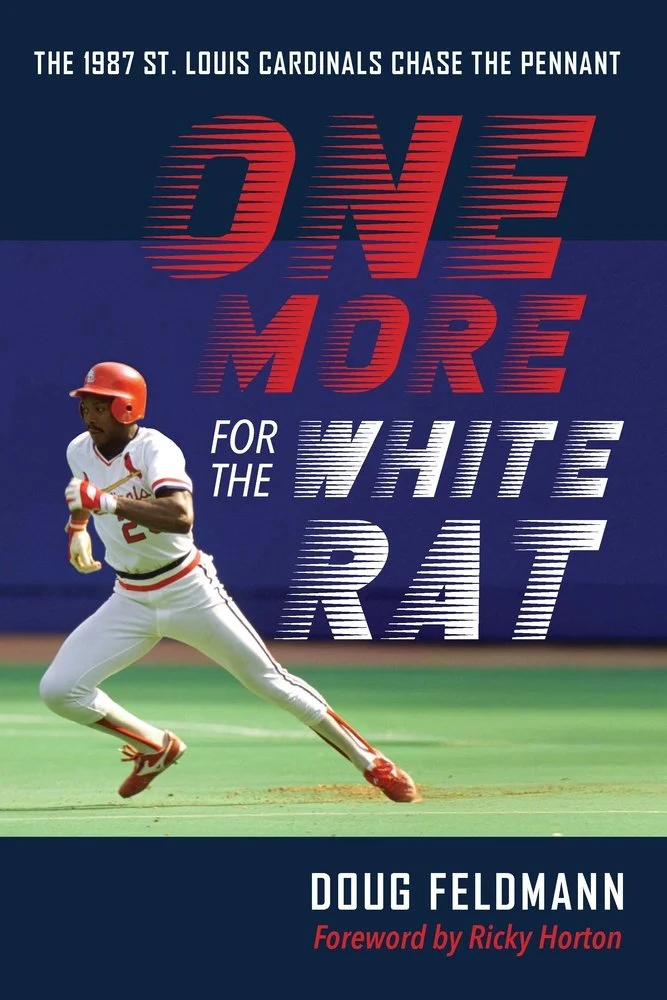
One More for the White Rat: The 1987 St. Louis Cardinals Chase the Pennant
As I used to say, ‘You’re in the most exclusive men’s club.’ You can’t buy or unduly influence your way into it; you’re strictly there on merit. You’ve got a lot of alpha dogs in that locker room…
—St. Louis Cardinal pitcher Joe Magrane reflecting on his career in One More for the White Rat, 180
St. Louis blues
What was Major League Baseball in 1987:
• No in-season interleague play as the American League and the National League met only during spring training, the All-Star Game, and the World Series; interleague play began in 1997.
• Pitchers still batted in the National League, and only the American League had the designated hitter.
• No wild-card teams in the playoffs, as there were only two divisions in each league, and second-place playoff teams were not a thing; either win your division or go home.
• Multi-use stadiums such as the Cardinals’ Busch Stadium and the Minnesota Twins’ Metrodome (the 1987 World Series opponents), also used by their NFL counterparts, were a practice that would be discontinued beginning with the construction of Camden Yards in Baltimore in 1992, as each sport would eventually have its own stadiums.
• There was no talk of WAR, WHIP, exit velocity, OPS, launch angle, and the like that would characterize the analysis of players’ performance with the proliferation of “data” and “analytics.” Sabermetrics was still new.
• Closers frequently pitched more than one inning, sometimes as many as three to earn a save, as Cardinal closer Todd Worrell often did.
• Wins and losses for starting pitchers still mattered in evaluating a starting pitcher’s worth.
• Astroturf was a thing that horses could not eat (Hall of Famer Dick Allen’s assessment of why he would not play on it), but players played on, much to the regret of their knees (just ask Hall of Famer Andre Dawson about why he left Montreal to play for the Chicago Cubs).
• There was no pitch clock, no team appeals for instant replay reviews of close plays, no ball and strike challenges, and pitchers could throw to first base to hold a runner as much as they liked.
• There was no mandatory drug testing.
For youngsters born in the twenty-first century, baseball in 1987 might scarcely seem modern since it was not governed by computers, streaming services, and the sports betting industry. The internet and smartphones did not exist. It was still possible to see games for free on network television. The Game in 1987 lacked so many features of today that I feel a bit like Henry James describing the America that Nathaniel Hawthorne looked upon when he began his writing career in the 1830s. That is an exaggeration, of course. Baseball in 1987 was still baseball—bats, balls, gloves, uniforms, players’ autographs, strikes (in two senses of the word), balls, walks, homeruns, stolen bases, and the ferocity of competition between intensely driven, highly skilled men who knew little else but playing the game, the implacable passion of singlemindedness. The rule of the regular season: win or die a slow, agonizing death of ever-mounting losses and demoralization. The rule of the post-season: win or die quickly. And the Cardinals under Hall of Fame manager Whitey Herzog (nicknamed the White Rat) were the daredevils of St. Louis in the 1980s, our biggest disappointments and our greatest heroes. For instance, the Cardinals had the highest attendance in baseball in 1987, better than either the New York Yankees or the Los Angeles Dodgers, both big-market teams. In fact, during the 1980s, the Cardinals outdrew every team except the Dodgers. St. Louisans lived and died for the guys who wore the birds on the bat. And this era was named for the style that the Cardinals brought to the game, Whiteyball.
The Game in 1987 lacked so many features of today that I feel a bit like Henry James describing the America that Nathaniel Hawthorne looked upon when he began his writing career in the 1830s.
They lost 11-0 the next night. They seemed to have simply given up, imploded. Pitcher Joaquin Andujar entered in relief and completely melted down, reduced nearly to hysterics as Denkinger was now the home plate umpire, and Andujar disagreed with his calling balls and strikes. Andujar not only gets ejected from the game, breaking a sink and toilet with a bat in the visitor’s clubhouse, but out of St. Louis as the Cardinals front office, embarrassed by his behavior, traded him during the offseason to the Oakland Athletics. “One tough Dominican,” as Andujar called himself, was, shall we say, less than tough when his team needed him to keep fighting. There is something unsettling about the lack of resilience the Cardinals showed in having a call go against them. Admittedly, it was at an important point in an important game, but nonetheless, one expects a championship-caliber team to overcome such a turn and be even more determined to win. Maybe the Cardinals should have tried harder to pick up Denkinger as if he were a teammate who made an error. If the Cardinals had won the sixth game, Denkinger would not have wound up being vilified as the reason the Cardinals lost. He would have been forgotten, as umpires typically are and want to be. If the Cardinals had won the seventh game, Denkinger would have been a minor trivia question, a small amusing memory, and almost forgotten, a foil merely to amplify the Cardinals’ inevitability and invincibility.
The Cardinals suffered a nervous breakdown in the seventh game of the 1985 World Series against their cross-state rivals, the Kansas City Royals. (As Herzog had managed the Royals from 1975 to 1979, beating them would have been particularly satisfying.) Everyone who followed the Series knew the cause: in the ninth inning of the sixth game which the Cardinals were winning, 1-0, and about to win the World Series if that score held, first base umpire Don Denkinger called Jorge Orta safe on his ground ball dribbler to first baseman Jack Clark who tossed to closer Todd Worrell who was running to first to put his foot on the bag to record the out. Orta was clearly out, as television instant replay showed. He was out even to the naked eye, watching the play in real time. Watching the game on television, I was puzzled that Denkinger called him safe. Herzog, who thought highly of Denkinger as Doug Feldmann notes in One More for the White Rat (2), came out to argue but to no avail, although surely by this time, with the television replays, Denkinger had to know or sense that he blew the call. Of course he could not reverse himself, and none of the other umpires could bail him out by overruling him. Nonetheless, it was not fatal to the Cardinals’ chances. They still had the lead with one of the league’s best closers on the mound. As Feldmann writes, Worrell “composed himself and did his job.” Denkinger’s error was no different than one of the Cardinals making an error. (3) But Clark misplayed a foul pop-up that should have been caught. Catcher Darrell Porter missed a pitch for a passed ball, and suddenly the Cardinals were up against it with the Royals at second and third. Dane Iorg, a former Cardinal, singles both home and the Cardinals lose the game. But there is another game for the Cardinals to redeem themselves.
Perhaps it was not a nervous breakdown but rather post-traumatic stress disorder that afflicted the Cardinals in 1986 because it seems as if losing the World Series, as they did, made them completely dysfunctional as a team. They won 101 games in 1985 but only 79 while finishing third in 1986. Perhaps a better word for the play of the 1986 Cardinals is haywire or harebrained. As Feldmann recounts, Herzog was ready to quit from a combination of disappointment and frustration, and probably a feeling that maybe he had lost the team. “I halfway wish [owner] Gussie [Busch] would call me up and tell me he’s decided to make a change, so I could get the hell out of here…” Herzog wrote in his diary. (12) Elsewhere, he said, “The fact that we won only nine games all month [May] was bad enough, but there were things going on with our club that publicly I can’t talk about and privately I didn’t know to do about…. I will say that we had some deep divisions on our club, personal animosities that had nothing to do with baseball…. I couldn’t believe that some of our players were acting the way they did. We had guys who weren’t talking to each other, guys who wouldn’t even carry other guys’ gloves and hats out to them between innings. They were almost like a bunch of little kids, pouting out there.” (12) That happens a lot with coaches and managers. Not only did key players—John Tudor (went from 21 wins and a 1.93 ERA in 1985 to 13 wins and a 2.92 ERA in 1986), Tom Herr (drove in 110 runs in 1985 but only 61 in 1986 and his batting average dropped from .302 to .252), Vince Coleman (batting average dropped from .267 in 1985 to .232 in 1986, as did his total number of hits from 170 to 139 and his on-base percentage), Terry Pendleton (drove in ten fewer runs in 1986 than in 1985), the Cardinals’ lone power hitter Jack Clark (played only half the number of games in 1986 as he had in 1985 because of injury), and Willie McGee (went from the National League MVP in 1985 leading the league with 216 hits, 18 triples, and a .353 batting average to an injury-riddled 1986 of 127 hits and a .256 batting average)—have sub-par years or, in the case of Tudor and McGee, far less than the career year they had in 1985, but the team seemed willfully to play bad baseball. The Cardinals finished last in the Majors in 1986, scoring only 601 runs. The club hit only 58 home runs in 1986, fewer, as Herzog noted, than Yankee outfielder Roger Maris hit by himself in 1961. (15) Maybe it was self-punishment, atoning for the sin of not winning the previous year. The New York Mets smashed everyone that year en route to winning the championship over the Boston Red Sox. The Phillies finished second, 21.5 games behind, and the Cardinals were third, a whopping 28.5 games behind. The haunted Cardinals had been caught, not by the other teams, but by their own ghosts of themselves.
Perhaps it was not a nervous breakdown but rather post-traumatic stress disorder that afflicted the Cardinals in 1986 because it seems as if losing the World Series, as they did, made them completely dysfunctional as a team.
Then came 1987. Herzog and general manager Dal Maxville traded outfielder Andy Van Slyke, catcher Mike LaValliere, and pitcher Mike Dunne to the Pittsburgh Pirates for All-Star catcher Tony Pena. They had a rookie lefthander named Joe Magrane. “It’s almost as if,” Cardinal pitcher Ricky Horton said, “‘87 was the second half of the 1985 story.” (181) And so it was.
Meet me in St. Louis
One More for the White Rat, once it recaps the 1985 World Series and the dismal 1986 season, nicely tells the story of the Cardinals’ resurrection in 1987. The team’s starting eight did not change greatly from 1985: Herr, Pendleton, McGee, Clark, Ozzie Smith, and Vince Coleman were holdovers. Tony Pena replaced LaValliere at catcher, and John Morris, Lance Johnson, Curt Ford, Jim Lindeman, Tito Landrum, and Jose Oquendo replaced Van Slyke in right field with varying degrees of success. They also had ace John Tudor returning as well as the tough Danny Cox, the stalwart Bob Forsch with rookie Magrane, and the two-headed relief monster in the bullpen of Ken Dayley and Worrell, along with the durable, dependable Ricky Horton. It was the 1985 core, except Worrell replaced Jeff Lahti as the main closer. Feldmann relates in detail the fortunes of the season, the ups and downs of various players, and the injuries that plagued the Cardinals but did not stop them.
The book is especially fine in recounting the intense rivalry with the New York Mets, who had so dominated baseball the previous year, and who had the look of a dynasty. All the knowing coves favored the Mets to repeat as champions. But star Mets pitcher Dwight Gooden entered a rehab facility in early April 1987 after testing positive for cocaine, a violation of his parole on drug possession charges from the previous December. The Mets were also having to do without their star reliever, Roger McDowell, due to an emergency hernia operation that kept him on the shelf for nearly eight weeks. The Mets star outfielder Darryl Strawberry was also turning out to be a problem child, missing team meetings and occasionally even games, perhaps annoyed or unnerved by the expectations placed upon him. But Mets star first baseman Keith Hernandez, shockingly traded in June 1983 from the Cardinals to the Mets because of his cocaine use, kept up a steady stream of trash talk in an effort to gain an edge over his former team. Call it an athletic psyop. Probably nothing suited him better than beating the Cardinals’ brains out every year. But Hernandez knew a good team when he saw one. He may have thought at first, with the Cardinals’ hot start in ’87, that they were more lucky than good, but eventually he realized that they were more good than lucky. Mets third baseman Howard Johnson feuded with Cox, who nailed Johnson with a pitch that Johnson swore would mean war the next time Cox did it. The Cardinals harassed Johnson by accusing him of using a corked bat, cheating, which Herzog claimed explained why he was suddenly hitting so many home runs. The Cardinals and voices from around the league made a passionate response against cheating and the whole corked bat incident, which explains why there are so many players who vehemently oppose the star players who used steroids being elected to the Hall of Fame. (100) But for Herzog, this was counter-psyop stuff. (110) What surprised the Mets was how hard the Cardinals played against them, beating them in the season series, ten wins to eight. Feldmann also does a good job describing the games against the Dodgers, another rival with a grudge, as the Cardinals beat them in the playoffs in 1985. Dodger manager Tommy (I bleed Dodger blue) Lasorda thought the 1985 Cardinals were “an anomaly” (61), an accident, a mistake. The club the Dodgers beat up on in 1986, winning eight out of twelve, misfiring and faltering, were the real Birds. In 1987, the Cardinals won eight of the twelve games the teams played, including a three-game sweep in Los Angeles. That may have planted some doubt in Lasorda’s mind about the matter: Will the real St. Louis Cardinals please stand up?
What is surprising about the Cardinals’ resurgence in 1987 was not only that the team’s core was basically the same as 1986, but that Herzog faced the same injury problem as he did in 1986. Feldmann writes, “It seemed like 1986 all over again, as one player after another visited the infirmary and prevented Herzog from making any semblance of permanent plans.” (66) Yet the substitutes did the job which every baseball team needs to succeed: unexpected players to make key contributions. The Cardinals won 95 games in 1987. The Mets won 92. Beating the Mets head-to-head in the season series made all the difference.
The book is especially fine in recounting the intense rivalry with the New York Mets, who had so dominated baseball the previous year, and who had the look of a dynasty.
Even though the Cardinals lost the World Series to Minnesota in seven games, the team did not fold or give up as it did in 1985. In fact, the Cardinals played the postseason without Jack Clark, who was having a huge year with 35 home runs, a .459 on-base percentage, a .597 slugging percentage, and 106 runs driven in. Clark badly twisted his ankle in September against Montreal and, with the exception of one pinch-hit appearance, did not play again that season. Yet the Cardinals beat the San Francisco Giants in the league playoffs and probably would have beaten the Twins, who had a wretched road record in 1985, had they been able to play four games at home in the Series instead of three. The one-game advantage made all the difference as the seventh game was played in the Metrodome. Terry Pendleton had a serious rib cage injury and could only play three games in the World Series as a left-handed designated hitter. He had three hits in seven at-bats. The Cardinals clearly missed a healthy Pendelton. The Birds fought hard in the final game, losing 4-2. Horton was right that 1987 was the second part of the 1985 story, and the Cardinals proved something about themselves that seemed truer and more admirable in losing. In a strange way, this loss made up for 1985’s collapse in a way that a victory would not have quite done. Finally, when the Runnin’ Redbirds, known for their base stealing and gap hitting, their cockiness and their paranoia about getting enough credit, as sportswriter Thomas Boswell put it, looked behind themselves, they saw they had outrun their own ghosts of failure. Nobody caught them. And that is a great story.
One More for the White Rat is highly recommended for all Cardinal fans, indeed, for all baseball fans.