Documentary ‘Being Eddie’ Means to Cement Legacy
February 14, 2026
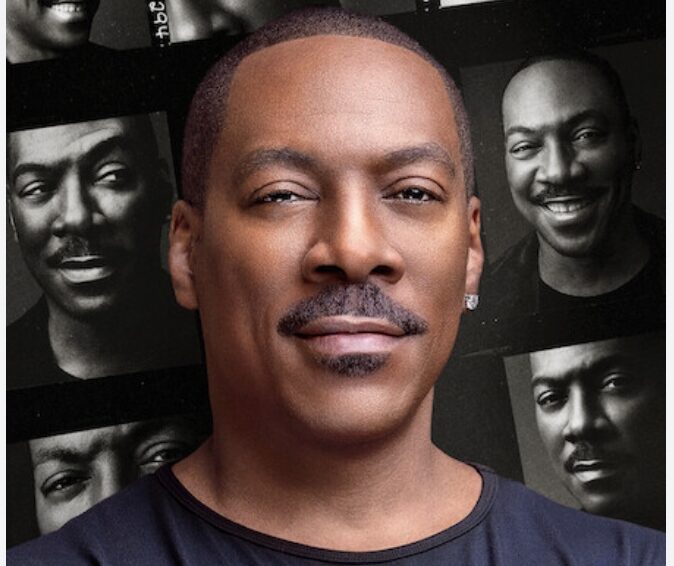
Being Eddie (November 2025), a Netflix Documentary, offers views of the life of Eddie Murphy, as narrated by friends, peers, protégés, and admirers such as Dave Chappelle, Jerry Seinfeld, Chris Rock, Jamie Foxx, filmmaker John Landis, critic Elvis Mitchell, and others. Murphy speaks a lot in interviews done for the film.
I have reviewed other documentaries here about comic entertainers I have admired, including Paul Reubens, Steve Martin, John Candy, and Jim Henson. Those films show some of the alienation, sadness, and self-perceived failure in the lives of famous people we think of as “funny” and investigate connections among hardship, talent, and drive. While Being Eddie is interesting, and Murphy is good in it, if somewhat restrained, it has little such complexity.
Murphy has, according to Wiki, ten children with five girlfriends, partners, or wives. Though he was reported to be at a distance in some of their lives, none of his children (the eldest is now in his 30s) are interviewed. Murphy instructs us, instead, in the documentary, “If you always put your kids first, you’ll never ever make a bad decision.” He appears in the film exactly as he described himself when hosting the 50-year anniversary of Saturday Night Live: a “boring, stay-at-home…father-of-10, house dad….”
Similarly, none of his romantic partners are given time, and he reduces the emotional content of those relationships to a joke about roaming around alone, after a divorce, in his mansion and deciding it “is like Dracula’s house. I was like, ‘I…I am…I am Dracula.’” He laughs. He mentions an old “circle” of trusted people, but speaks of only one and says without explanation that others have been banished.
Much of the information conveyed about Murphy’s childhood and early fame is from now widely-seen tapes of his brother Charlie telling stories for Chappelle’s Show more than twenty years ago. (One of the rare times Eddie shows visible emotion is when he talks about missing Charlie, who was a brilliant comedian too, and died in 2017 from leukemia.) Nothing is said about Charlie spending most of a year in jail as a teen, or about Eddie and Charlie living in foster care for a year when their mother grew ill. The brothers seem to have little interest in their biological father being stabbed to death by a lover.
Eddie starts to pose an idea about his early brilliance: “Sense of humor is ultimately just an acute sense of proportion. The funny person notices stuff first.” He adds, “I used to have that OCD when I was a kid. I didn’t know what it was. I would go and check the stove in the kitchen. And make sure all the gas was off in the kitchen. Right? And I’d lay down for about…five minutes, and I would get back up and go back in the kitchen and look at the stove again and check all the gas.” He says he would do that every night for an hour. We do not hear how this applies to being funny, or what “proportion” has to do with a sense of humor.
Eddie Murphy has worked consistently, without a break of more than two years, since at least 1980, when he joined the cast of Saturday Night Live at the age of 19. (“My college years,” he calls the experience. “SNL is like Harvard for comic actors.”) He is now filming Shrek 5 and has three projects in pre-production, including a turn as Inspector Clouseau in a reboot of The Pink Panther. He is reportedly worth $200 million and has won an Emmy, a Grammy, and a Golden Globe. He never won an Oscar, though, which still seems to bother him, and he was awarded a Razzie for “Worst Actor Ever,” which he says made him take a break. In this film he speaks often of prayer and other spiritual matters.
One of the chief reasons for the documentary seems to be to make the case that Murphy has not been duly acknowledged as an artist and cultural trailblazer. Murphy says, eg, that Denzel Washington, Morgan Freeman, and Spike Lee “come after my stuff. […] I was the psychological soil that was required for everything that happened after me.”
“Yeah, he was definitely Elvis to us,” Adam Sandler insists.
Dave Chappelle says, “In a weird way, he kind of served the same function in a young kid’s mind that hip-hop did, in the sense that, that gives you that edge or that confidence.”
Director and producer Reginald Hudlin points out the “negative forces” that Murphy faced in his career. Until Murphy’s Boomerang (1992), which Hudlin directed, “There hadn’t been a Black romantic comedy before,” Hudlin says. Murphy had told him, “[I]f I can use my clout to open that door, that’s a good thing.”
Murphy acknowledges a cohort of other Black talents who rose to fame alongside him, including Michael Jackson, Prince, and Whitney Houston. He suggests that they (too) changed the world, but that the other three had “a self-destructive nature.”
“My biggest blessing is not my comedic talent,” he says. “My biggest blessing is that I love myself, and I knew what I wanted to do really, really early. And that’s why I didn’t fall into any traps or anything….”
“I am an artist who can express hisself a bunch of different ways. Sensitivity is the gauge, not how much talent you have. The most sensitive one will be the artist that’s most in tune. I don’t wanna get too artsy.” He laughs. “I’m not trying to be, or get to. I just am.”
“The best thing to pray for, instead of money and everything,” he says, “[is to] pray for peace of mind. Pursue peace of mind. If you get that, you got it all.”
Being Eddie seems to show he has achieved some measure of that. He says he would prefer staying home these days. Still, he continues to work on the remainder of his legacy.