How Dickens Helped Us Understand “Neurodiversity”
October 3, 2025
Autism, autism spectrum disorders (ASD), and neurodiversity have dominated medical news, and now the political headlines, for so long that it is hard to imagine a time when we did not know the parameters of these terms or the symptoms they attempt to describe.
“Mad,” “insane,” and “crazy” have all been deemed too harsh and even derogatory. You might be a member of the generation, as I was, when we described our slightly batty friends as being “touched,” a term that implied gently that a person was not “all there,” but also that their condition was simply beyond their control, i.e., “touched by the hand of God.”
Characters with intellectual disabilities get their share of the stage in western literature, both to great effect and middling results. William Wordsworth was one of the first in the English-speaking world to write a poem about a young man with Down syndrome in “The Idiot Boy,” a 1789 ballad about a mother’s love and concern for her disabled son. Robert Louis Stevenson recast the human personality as a battlefield between good and evil, or sanity and insanity, in his 1886 book Strange Case of Dr Jekyll and Mr Hyde. Once upon a time, in the 1970s and 1980s, Daniel Keyes’s 1966 novel Flowers for Algernon was a staple of middle-school English classes. Keyes’s heartbreaking story of a janitor who experiences a dizzying ascent in his IQ, thanks to neurological experiments on a mouse named Algernon, only to see his intelligence return to where it was, seemed ahead of its time when most of society made open fun of the “stupid” and “dim-witted.” Never take your mental health and intelligence for granted, Keyes’s cautionary tale implied. None of us knows for certain that we will never lose our minds.
The English novelist Charles Dickens had a well-known soft spot for waifs, chimney-sweeps, and even seemingly responsible adults who fell into insurmountable debt. So it is not altogether surprising that Dickens would have sympathy sufficient to create the character of a grown man who suffers from obsessive-compulsive disorder to the degree that he must rely on the patronage of a single woman, David Copperfield’s aunt, Betsey Trotwood. What is surprising is that rather than portray such a character as worthless, decrepit, or bitter, Dickens instead gives us a character at once undeniably peculiar, but also full of peculiar resources.
Mr. Dick is one of but twenty-five major characters in Dickens’s most autobiographical novel, David Copperfield (1850). But he is easily its most memorable, and compared to the sniveling, grotesque white-collar criminal of Uriah Heep, certainly more charming. He is forever at work on a manuscript he calls his “Memorial,” but he is always being interrupted in his work by the thought, theme, or disturbance of the beheading of King Charles I. And yet, throughout Copperfield’s extended account of his rise from a turbulent childhood into the extremities of a career in writing and an unstable marriage, Mr. Dick finds ways around the singular dead end of his obsessive thoughts and wayward distraction. He flies a kite. He manages to heal a marriage on the rocks. Most of all, he stays alert to the rhythms of people around him and finds his own ways of managing his peculiar mental state.
“He [Mr. Dick] is the most friendly and amenable creature in existence,” Copperfield’s aunt tells him several times when he meets Mr. Dick for the first time. “But nobody knows what the man’s mind is, except myself.” (192)
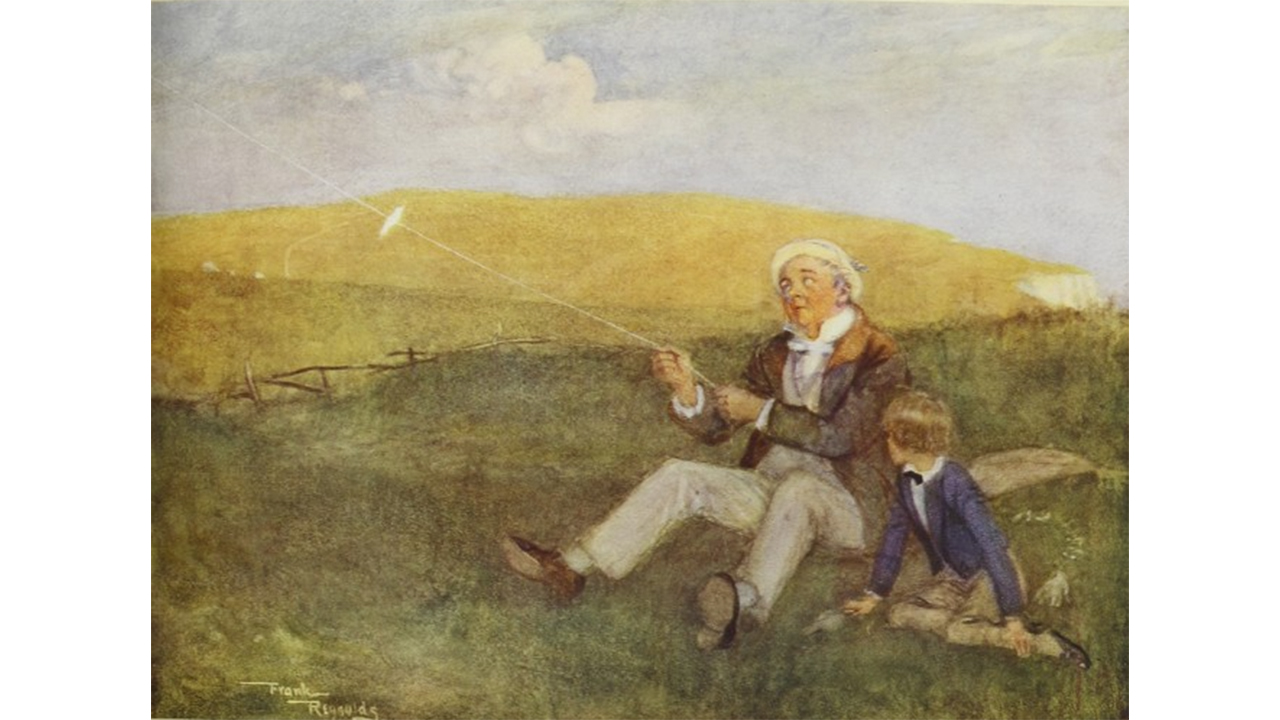
The kite Mr. Dick devises as an escape from his troubled thoughts is one of Dickens’s greatest creations of symbol and metaphor. Unable to make his obsession disappear altogether, Mr. Dick writes the name and various references to King Charles I’s beheading directly on the sails of his kite, then waits for the wind that will take his worries into the sky.
“There’s plenty of string,” said Mr. Dick [to Copperfield], “and when it flies high, it takes the facts a long way. That’s my manner of diffusing ’em. I don’t know where they may come down. It’s according to circumstances, and the wind, and so forth; but I take my chance of that.” (191)
The chance to find objective, analytical distance from our troubled minds through physical objects; the idea that our thoughts can be thrown to the wind, if only for a little while, and before their cruel return; the knowledge that all of us, even the “touched,” might have the chance to find certain refuge in a hobby or innocent passion. These are not just poignant scenes from the pages of a book. As Dickens shows us, they are tangible avenues of solace not just for “the neurodivergent,” as we say now, but for everyone.
Much later in the novel, as events in Copperfield’s life thicken, Mr. Dick uses his kite as a bizarre instrument of marriage counseling. When Uriah Heep threatens the marriage of Doctor Strong and his younger wife, Annie, Mr. Dick writes the doctor’s name on his kite, and sends it, too, toward the wind.
“The kite has been glad to receive it, sir, and the sky has been brighter with it,” he tells Copperfield. “A poor fellow with a craze sir … a simpleton, a weak-minded person—present company, you know! … may do what wonderful people may not do. I’ll bring them together, boy. I’ll try.” (607)
We would have every right to complain that Dickens draws his fictional character of a mentally disabled man for deliberate, even self-serving reasons. We all hope to meet people with mental disabilities who are charming and poetic rather than inscrutable, difficult, uncooperative, or even downright mean. The streets of cities worldwide are full of people unable to manage their anger, people who never found ways around the roadblocks of their minds, or fell prey to uncontrollable hallucinations.
But we also need portraits, however fictional, of the mentally stricken who found ways to invite the rest of us into their unique world, filled with thoughts, similes, and metaphors that might never have occurred to us. We need portrayals of people with mental disabilities, or people who are neurodivergent, who are not insufferable burdens, hopeless eccentrics, or grotesque, deranged serial killers.
Mr. Dick and his kite may offer an ideal escape from troubled thoughts, but we are drawn to him because he is also heartfelt enough to be real. As pointed out earlier, David Copperfield is Dickens’s most autobiographical work. We read fiction because it is not fact. We also read fiction because it never strays too far from fact.
• • •
All page citations: Charles Dickens, David Copperfield (New York: Random House, Modern Library Paperback Edition, 2000).