All The World’s Wisdom
April 10, 2026
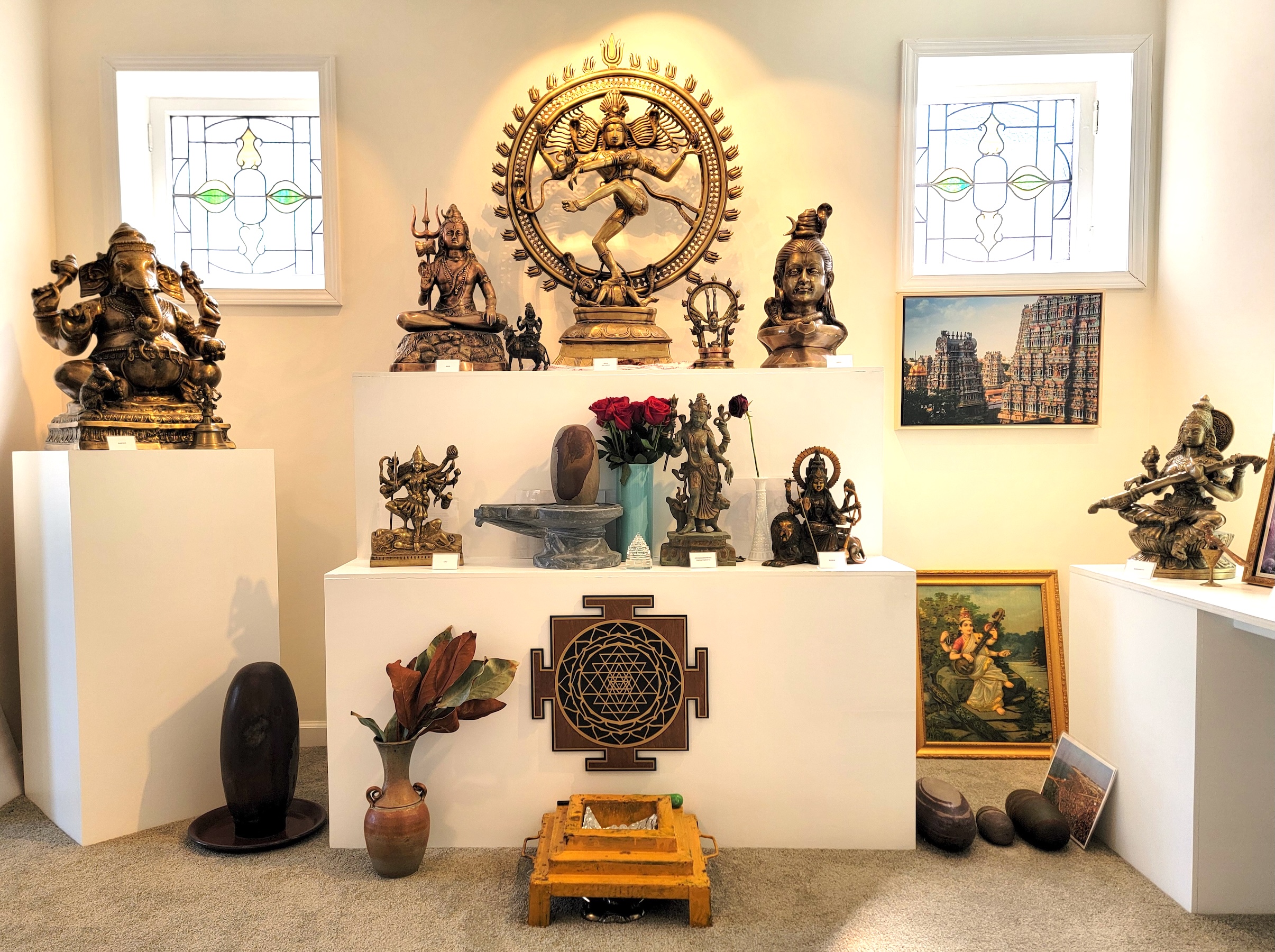
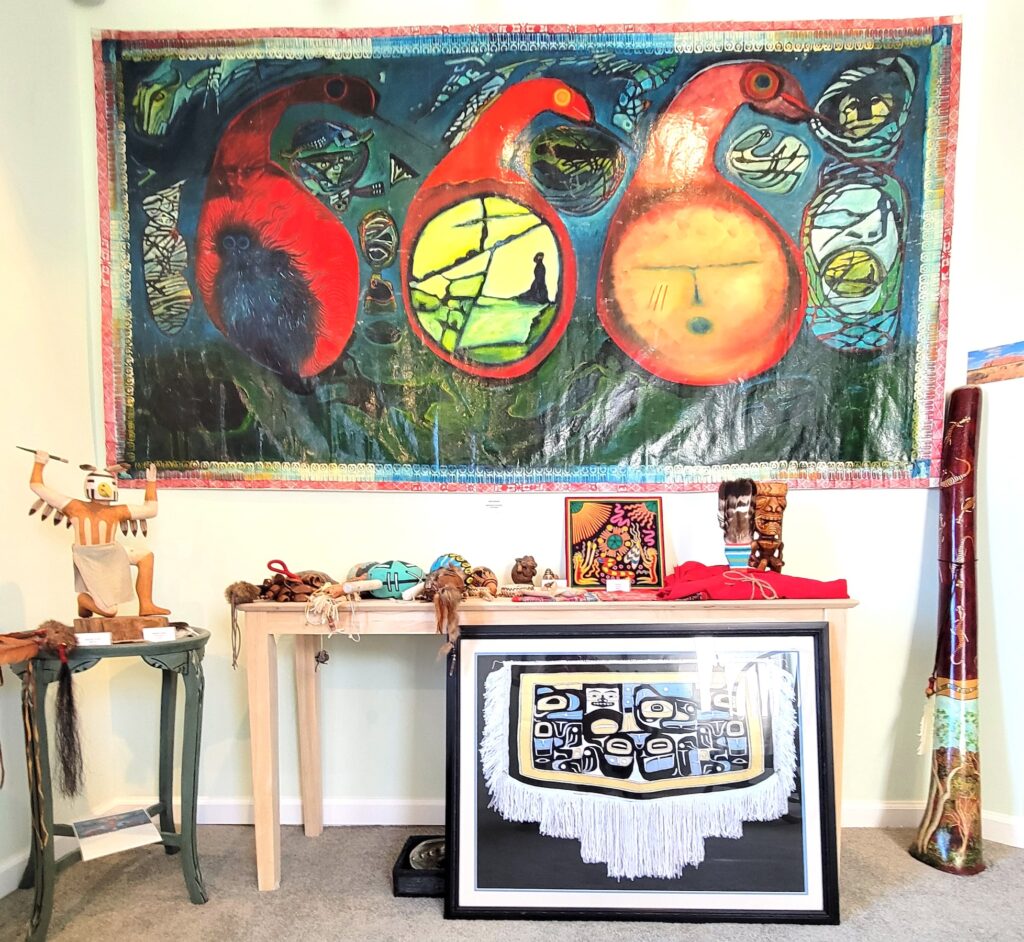
A solid old brick house on Clayton Road with a sign outside: Living Insights Center. A meeting place, maybe, some kind of recovery program? I step inside. In the first room to the right, a lifesize statue of St. Therese of Lisieux gazes at an illuminated Qu’ran, a silver menorah, intricate statues of Shiva and Ganesh…. In the hall, a Tibetan Buddhist statue guards a dharma wheel tapestry. Upstairs are rooms dedicated to native American beliefs, bookshelves of knowledge about Jainism, Sikhism, Zoroastrianism, Taoism, neopaganism, Greco-Roman and Egyptian beliefs, and chairs ready for talking circles attended by people of all faiths (one regular is a Sufi Druid Episcopalian). Downstairs, there is space to meditate alone.
My eyes dance from one sculpture or painting or book to the next. What richness, to gather all the world’s wisdom together instead of letting adherents pit themselves against one another.
The center’s founder, Jack Sisk, grew up Christian, but at fourteen, he had an extraordinary vision that led him to Hinduism. For sixty years now, he has practiced that faith. Its gods are not jealous; they opened him to other traditions as well. So after an excellent education (John Burroughs, Yale University, George Washington University) and a high-powered career in corporate law (he was general counsel for Barnes Hospital and helped guide the BJC merger), he opened Living Insights, an unpaid labor of love.
I stand, soaking in the beauty of what is essentially, small-scale, a museum of world religions. “I’ve never understood why people fight so hard for specific traditions with specific narratives and dogma,” I remark, “when there is a whole world of wisdom open to us.”
Sisk nods. “When I was young, we spoke in terms of religion and organized religion. Religion was your personal spiritual relationship with reality. Then there was organized religion. And whenever you organize anything, you invite in all the perversions of ego”—abuses of power, and the desire to validate yourself by evangelizing, excluding, or even killing others. “Naturally, people have increasingly turned away from that. Now, what we used to call religion, we call spirituality, and what we used to call organized religion, we call religion. And almost all the religions are losing adherents.”
The major religions all have a mystical tradition, though, and that is where they overlap. “Almost all the mystical traditions I think basically see the same reality,” Sisk says. “They may couch it in the iconography of their tradition, but we all get past those boundaries.”
He mentions universal Sufism, brought to the West by a mystic steeped in Hinduism as well as Islam. The understanding that emerged is “that there is only one God: infinite, incomprehensible, indescribable, formless, nameless.” Were we to try to describe that God, knowing full well that we could never capture the whole, “we could say the ocean of consciousness is continually creating vibrations within itself, and when the frequency of those vibrations is lowered, it becomes patterned and dense, and that is the physical universe.” He gives me a lopsided grin: “Science is basically saying the same thing. Every particle we experience as matter, or mental construct, or soul, is constantly disappearing and reappearing: form, formless, form, formless, form, formless. It’s a wave.”
No wonder we are prone to think in terms of good and evil, black and white, heaven and hell. Another universal mystical belief is that God transcends all these dual conceptions. But we perceive ourselves as separate and divided, and we live with the tension of struggle. “There are certain dynamics that pull everything back into harmony with God and others that push everything apart,” Sisk adds. “At the cosmic level, dark energy is perceived as pushing everything part but actually, it is continually expanding our universe—and then there is gravity, which pulls everything back together. At the individual level, we have love, which pulls everything together, and ego, which pushes us apart.”
The mention of ego leads him back to my earlier question. “Your ego separates you and makes you afraid,” he says. “It’s ego and fear that make people grab onto religious dogmatism—for protection, for comfort, for the assurance of an afterlife. Mystics know words can never describe the ultimate reality. But people want some certainty, some sense that there is fixed truth and they can reach it.” He shrugs. “This is Earth School, and you have to repeat grades until you get the curriculum right. Everyone will eventually evolve into a state of oneness with God. But I feel sad for people who are still afraid of God, afraid of dying, in terror of Hell. The fear makes them intolerant. It makes them think they need to convert and evangelize.”
In Christianity, the crux of that fear is original sin, multiplied by all the quirky little sins we each pile on top of it. But Hindus believe that “our fundamental deficiency is not that we are sinners. It’s that we are ignorant of the fact that everything is God. There is nothing you do that is not interacting with God. You are immersed in God. God is closer than your breathing. But we forget that.
“Why God has clouded us with ignorance, we don’t know,” he continues, sounding ever so slightly annoyed. “But if we got everybody to recognize that everyone is sacred, every object is God, every task is an interaction with God…. The ultimate reality is not here, where everything breaks and dies, and fear sends us into our egos, which produce sin. For whatever reason, we have been given these temporal physical forms to travel in, and we have clothed our souls in mental constructs which are also fragile. They depend on this physical form remaining intact—and it doesn’t. Nobody escapes this life without some kind of physical or mental pain.”
He has thought hard about that pain and its sources. “Say the universe gives you one hundred strands of energy to live on per day,” he suggests. “If you plug fifty into dragging around your past like a backpack full of lead, and another fifty into worrying about the future, what do you have left to live on? You have to start using up the energy in your body. And that makes you sick.”
I do not believe this altogether; I live in nervous awe of germs, toxins, and flawed genes. Still, there is truth here I cannot deny. Why else would so many of the world’s traditions urge us to live in the present?
The center’s logo is a sun, its many rays representing different paths to God. Below the sun is a range of mountains—the challenges of our daily, physical lives. “You’ll notice that only one of the rays goes down into the mountains,” Sisk says. “That’s yours. Everybody will find a ray that works for them.”
This meshes with what I have long thought: that religion, when it is more than inherited and passively obeyed, is a function of temperament. My husband craves the clarity of Judaism, with its emphasis on history and law. I like a messier beauty, made of poetic metaphors vague enough to forgive and welcome everybody. For years I have longed for a creed that would embrace all the world’s insights, rather than elevating its own dogma as the one true whatever.
If we were brave enough to be honest, we would all be agnostic. None of us knows the full truth. But every story contains a clue.
Before I leave, Sisk offers me one of those metaphors I crave: God as clear light, containing all colors. We are not enlightened, so when God’s light enters our sorryass broken selves (my term not his), it gets bent. Each individual’s past experiences, temperament, and psyche bend the light in a different way, so each of us receives a different color. But to make the light clear again, we have to put all those colors back together.