Update from the Shawnee National Forest
September 10, 2025
In May and July I wrote about the decades-long legal fight by local environmental groups to protect the Shawnee National Forest in Southern Illinois.
On Thursday, September 4, a federal judge at the US District Court in East St. Louis held a hearing on a temporary restraining order against the US Forest Service (USFS), initiated by the Friends of Bell Smith Springs (FOBSS) and the Regional Association of Concerned Environmentalists (RACE), to see if it would be dropped, extended, or converted into a preliminary injunction.
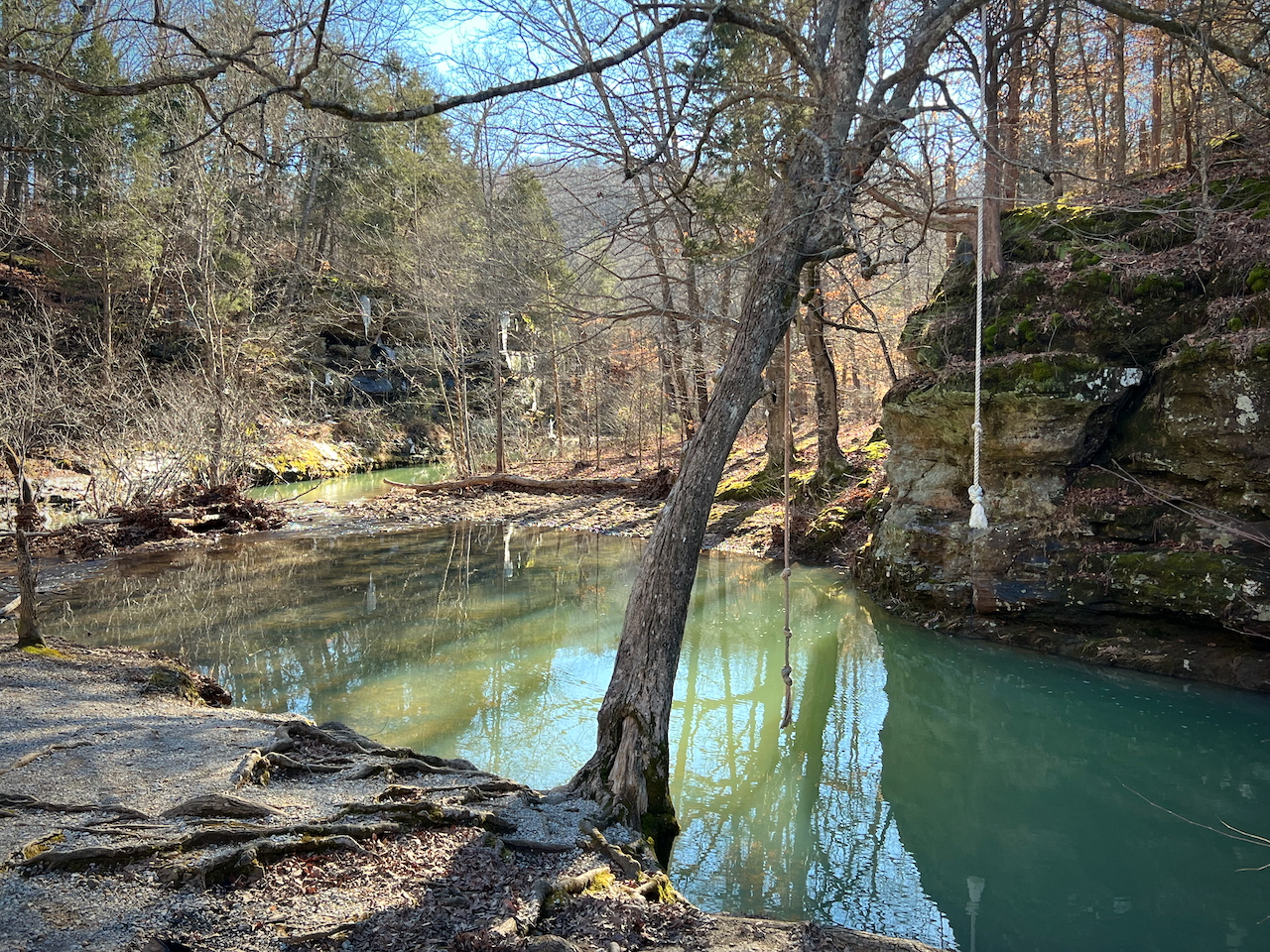
The groups’ main goal is to prevent the Forest Service from logging 70 acres above a waterway that flows into Bell Smith Springs, an astonishingly beautiful, National Natural Landmark in Pope County, near the Ohio River. They say logging will erode and compact thin soils on steep slopes, denigrate the water, and harm endangered species in the area. The short-term goal is to stop logging until the court can decide if the Forest Service acted legally in regard to the National Environmental Policy Act.
FOBSS and RACE believe the logging is an attempt by the Forest Service to return to its plans from 30 years ago to escalate logging and other resource extraction across thousands of acres of the Shawnee. The groups often point out that the USFS is under the US Department of Agriculture, which they say has a “commodity mindset” and treats forests as something to be sold and consumed, not as a good in and of themselves to be nurtured, preserved for climate reasons, and enjoyed for the wildness they represent.
“[U]nder the guise of a Categorical Exclusion, which allows the Forest Service to log up to 70 acres without first doing an environmental analysis of the area…[t]hey intend to decimate the [Shawnee], one 70-acre bite at a time,” FOBSS says. The group refers to this as a trick to “eat the elephant” and a form of corporate welfare. Opposition to the USFS’s original plan was one impetus for the founding of the environmental groups.
I drove down to East St. Louis for the hearing. Tom Buchele, Professor of Law at Earthrise Law Center, argued for the plaintiffs’ request for the preliminary injunction on the basis that the Forest Service “illegally withheld information from the public concerning steep slopes, thin soils, and the presence of endangered species [and that] this obfuscation…prevented the public from making informed comments [and] violate[d] multiple laws,” as the FOBSS press release said when the suit was filed. The current temporary restraining order is in effect until September 12.
Buchele focused on what he said were the Forest Service’s failures to disclose information publicly, to give required explanations on their decisions to log the area, and to hire logging contractors by existing rules. He also objected to how its managers “averaged out” data (such as slope angles) to minimize concern about the effects of logging in the plot and dismissed their own findings about endangered bat populations. This, Buchele, said, is why a future court finding was needed to determine the truth of what his clients believed would be “irreparable harm” to the area. For these reasons, he asked the judge for the injunction to pause the case “for the fight down the road.”
The Department of Justice had sent a young lawyer to the hearing to represent the Forest Service. He seemed ill at ease, and his defense sometimes veered into circular logic (that the Categorical Exclusion is meant to reduce paperwork and prevent “paralysis by analysis,” suggesting shortcuts to due diligence are acceptable); comic definitions for the court, such as how bats “are winged creatures that can move around”; and an admission that he did not know if the USFS was required to post certain information.
“How’s the public meant to find out about it?” the judge asked.
The young lawyer sniffed and said that the way in which the USFS contract with a third-party logger was signed—part of the basis for the injunction—“has nothing to do with this case.”
“It’s a really small job,” he said. “Anyone who knew how to look for the contract info” could find it. He said “it’s frustrating” to find a contractor, then a Freedom of Information Act request comes in, delaying the start of a project, and some contractors try to drop out.
“Contractors,” he said, “need to get paid.”
“That’s not a factor for me,” the judge said.
The DOJ lawyer also said already-downed trees in the 70 acres were now a safety hazard, and the project must be completed so “recreational activities” will not be stopped.
Tom Buchele responded, “People recreating in this area are my clients, and they’re the ones requesting the injunction.”
It is a redundancy to say heroism must be shown in inopportune times. The current administration recently put 59 million acres of national forestland at greater risk in an opening salvo of a commodity-mindset war against the environment. These forests belong to the American people, but the trees will be sold at a loss to taxpayers in most cases. FOBSS and RACE have been fighting the fight before this escalation. They continue the work even in this climate, pun intended.