Two Nigerians at a Table
By Tolu Daniel
September 30, 2025
Last weekend, I went on a date with a Nigerian American. We had arranged to meet under the awning of a small bar on Delmar Loop in St. Louis, a city that on that particular night, felt suspended in a soft, electric glow. The air was warm, carrying the distant hum of traffic and laughter from other patios, and the sky was a deep, forgiving blue. We found each other easily, two strangers tethered by a familiar name and a common history. Our connection was immediate, sparked by a mutual and somewhat urgent desire to find other Nigerians in a city that often feels like a vast, sprawling crossroads.
As we settled into a corner table, drinks in hand, the conversation quickly moved past pleasantries. She spoke with a palpable intensity about her love for Nigeria. Not just as an idea, but as a living, breathing presence in her memory. She described the vibrant chaos of Onitsha markets, the specific taste of puff-puff eaten by the roadside in Lagos, the layered rhythm of pidgin English that felt like a secret handshake. But more than places and things, she spoke of Nigerians themselves: our resilience, our humor, our insistence on wringing joy out of even the most ordinary moments. Her quest, she explained, was a constant one: to recreate those textures of home in the quiet streets of the Midwest. It was a desire to build a small outpost of that world within this one, to find a community that understood the references without needing a translation.
Listening to her, I was struck not only by her devotion but also by the quiet dissonance between her Nigeria and mine. The Nigeria she remembers and still visits is vibrant, alive, and promising. The Nigeria I carry is altogether different: a country intentional in the ways it hurt me, where my earliest encounters with power and bureaucracy were not playful or colorful but bruising. For her, home is an ideal, something worth curating, something that offers continuity in the midst of migration. For me, home is static, a reminder of what I have lost and, paradoxically, what I still miss. Memory, I realized, is never neutral. It is always shaped by class, by access, by the vantage point from which we leave and to which we return.
We cross oceans and continents in search of the new, the other, the unknown. And yet, almost instinctively, what do we do? We seek out the familiar taste of our food, the cadence of our language, the eyes of someone who knows the same proverbs. We work tirelessly to recreate the very worlds we left behind.
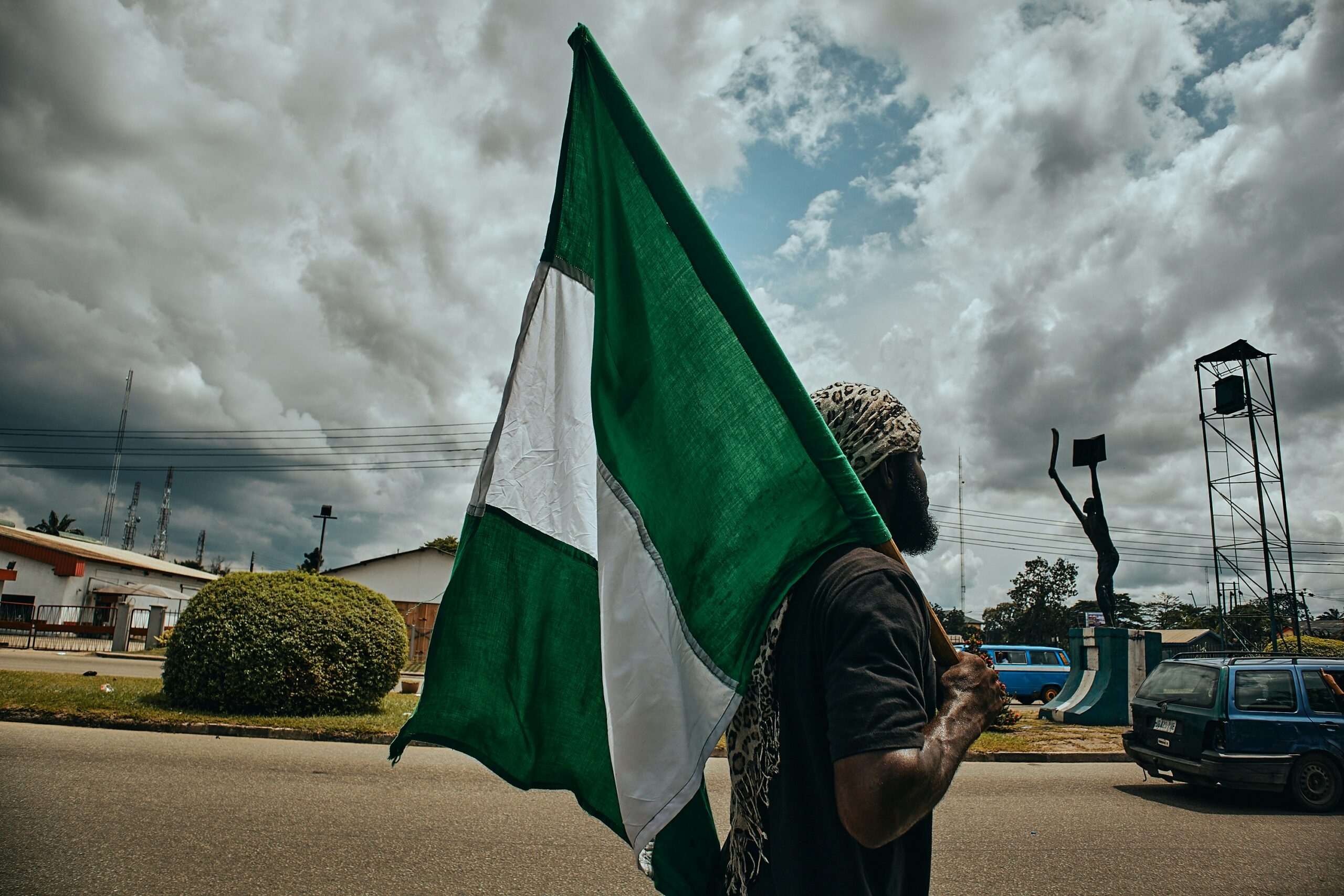
In her attempt to find a common ground within our experiences, she recounts standing under the cold weather at the Nigerian embassy in Washington DC and holding placards, joining other young people in the protests that engulfed the country those years ago. To participate in those moments felt like a natural thing. But I could not help but think about how her Nigeria, alive with puff-puff and pidgin, belongs to the traveler who can always leave again, who can carry the pleasures of home as a compass rather than its burdens as a weight. While my Nigeria is the one that clings, that wounds, that insists on shaping me even in absence. Sitting there, I began to understand how both of our class allegiances inflect the way we hold on to home: for her, a country that can be re-entered at will, lovingly remembered; for me, a country that never stopped exacting its toll, even as I tried to move away.
This divergence complicates the paradox of the migrant’s journey. We, or those who came before us, often leave home chasing difference: a new opportunity, a safer future, a chance to redefine ourselves beyond the limits of birthplace. We cross oceans and continents in search of the new, the other, the unknown. And yet, almost instinctively, what do we do? We seek out the familiar taste of our food, the cadence of our language, the eyes of someone who knows the same proverbs. We work tirelessly to recreate the very worlds we left behind.
At first glance, this looks contradictory, even timid, a refusal to fully let go. But that explanation is too thin. These miniature Nigerias abroad are not built out of fear. They are acts of preservation. They are not rejections of new homes but touchstones from which we face them. For her, that ark of culture is a joyful archive, proof of Nigeria’s inexhaustible vitality. For me, the same act feels like salvaging scraps from a wreck, clutching what I can from a country that seemed determined to discard me.
So the question lingers: how do we fall in love with the countries we ran from? What is the strange alchemy that turns distance into longing, and absence into affection? Distance is not impartial. It decides what to soften and what to sharpen. For some, absence polishes memory into a shining gem; for others, it preserves the edge of the blade.
What pushes us, then, is not just the need for community but the deeper search for wholeness. We are chasing the parts of ourselves we left behind, though the versions we seek are not the same. For her, it is the exuberance of the market and the untranslatable cadences of speech. For me, it is the stubbornness of loss, the recognition that home is less an embrace than a scar I cannot stop tracing.
That night on Delmar Loop, under a canopy of stars and city light, I saw both truths reflected: her eyes carrying the light of an ideal, mine holding the weight of permanence. Between us stretched the complicated spectrum of what it means to belong to a place that refuses to be one thing. Maybe that is the most human act of all, to carry these conflicting worlds within us, and still reach, across the table, for someone who recognizes their shape.