The Culture of Animals, Why They Are Not Us, but Why We Need Them as Our Co-Creators of Reality
The difficult task of understanding animals by breaking down our solipsism.
March 31, 2026
“The world has been going on now for thousands of years, hasn’t it? And the only thing in animal language that people have learned to understand is that when a dog wags his tail he means ‘I’m glad’!”
—Polynesia the parrot, speaking her mind in The Story of Doctor Dolittle
The minute Dr. Dolittle nodded gravely, accepting the counsel of a parrot, I was hooked. I would go with him on one of his voyages and learn to talk to the animals. An only child, I was lonely, and I felt sure they would be kinder than my kindergarten tormentors.
While I waited for the invite, I concentrated on teaching our dachshund to write—but the pen kept slipping through his paws. On TV, Lassie and Flipper were doing better, rescuing humans every week with alerts too obvious to miss. I was sure we were on the edge of a thrilling new world. Forget the U.N.—there would be councils of elephants, humans, tigers, and Pomeranians….
Then I grew up, and a grid of compartments snapped shut. Those not human were separated from us in a way I did not understand. In college, my favorite philosophy professor was a Jesuit with a quiet, resonant voice and a twinkle in his eye. I adored him—until the day he told us animals had no soul. Humans were “made in the image of God,” aware of our awareness (“A of A” in his chalkboard scrawl), and thus ensouled, able to use our symbolic language to infuse the world with meaning.
He’s wrong, I muttered under my breath, dismayed that this gentle man could ignore what was so obvious to me. Look into a dog’s eyes, or a cow’s, and swear to me that they have no soul. Tell me they are not conscious of themselves in relation to us and to the world around them. Sit with them awhile and feel messages move back and forth, conveyed without a syllable. Something alive passes between us and other species, and it can remake us.
Years later, I mentioned my silent rebellion to my new husband.
“For me it was our high school science teacher,” he said. “I asked what he thought about Koko, the gorilla who learned sign language, and he went nuts, practically yelled at me: ‘It’s just an animal. It’s just mimicking what it sees. Only people can think and communicate.’”
In college, my favorite philosophy professor was a Jesuit with a quiet, resonant voice and a twinkle in his eye. I adored him—until the day he told us animals had no soul.
Determined to disprove our teachers, we began collecting examples for each other. Cleaner fish recognize themselves in a mirror! Chickens can track whether other chickens have been honest or deceptive! Sperm whales group their clicks into temporal patterns like Morse code!
Though these reports delighted me, I was careful not to make too much of them. By then, I understood why my professor had drawn such a hard line. Philosophers and linguists had been building that case for centuries, because our species has this unusual ability to express the invisible. Referring to something we cannot point to in our immediate environment is quite a conjuring act. So is teaching language and telling stories to our young, transmitting not just food but culture. We can nest layers of meaning in a single statement. We can structure that statement with rules of syntax to make its internal logic clear.
Now I felt bound to honor the distinction; words, after all, were my life. None of the books I cherished, the wisdom accrued over centuries, would make any sense at all to a collie or a dolphin. We can construct a sentence so nuanced that it contains sly implications but arouses no defenses—is an art. Our conversation sparks fresh ideas, lets us know and love each other, and makes it possible to scheme a diamond heist or negotiate a treaty. Language has allowed us to be bound together by codes of law; to move easily between past, present, and future; to fathom the deepest mysteries of the universe.
But while scholars were busy defending our species’ superiority, biologists were uncovering mysteries of animal communication that shot down one “special” human capacity after another.
• • •
“Each time a property is proposed to set human language apart (e.g., reference, syntax), some (attenuated) version of that property is found in animals.”
—Erica Cartmill
“Fuck!” a toddler blurts, mortifying her parents. She has learned by imitation, as human children do, babbling nonsense until the sounds reveal their meanings. But guess what? Young songbirds babble, too, until their elders teach them how to communicate. Same with parrots and hummingbirds; also whales and possibly bats: cultural transmission.
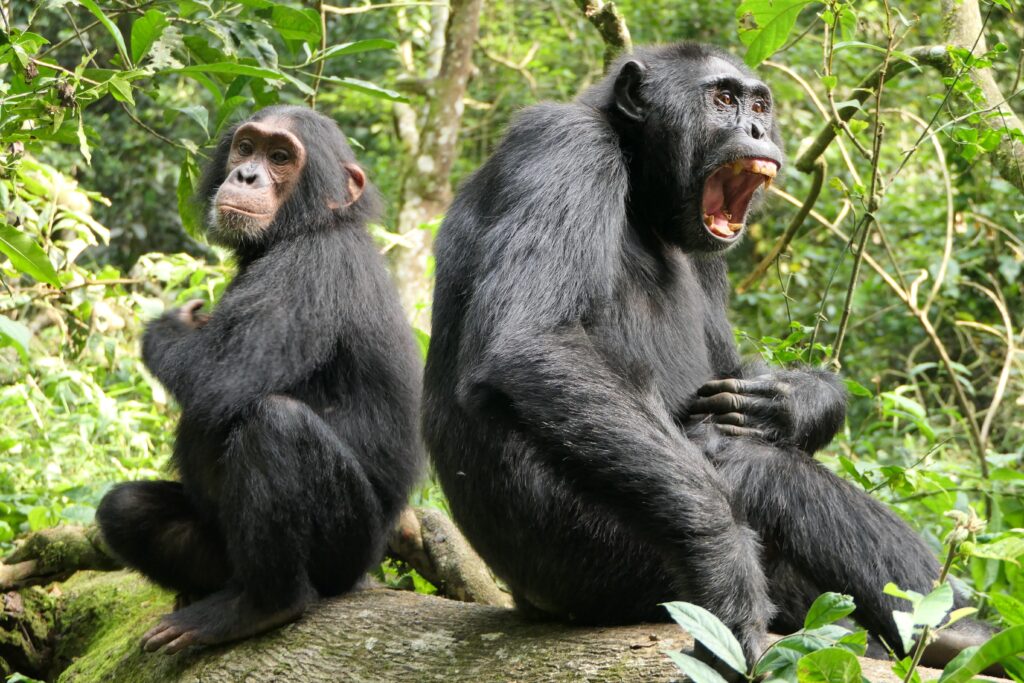
Our ability to make abstract references? Great apes also communicate about objects that are displaced in space and time. They not only use tools but plan for the future, storing those tools where they will be needed to retrieve future rewards. There is evidence that they “understand what others can and can’t see, as well as what others know and don’t know.”
What about recursion, our ability to create complexity by embedding phrases or clauses within a sentence? The alarm calls of female Sumatran orangutans have a structure self-embedded across an impressive three levels.
Syntax was the last stand, the conclusive proof of language as exclusively human. But the Japanese tit has rules, too. A tiny bird with a black head and white cheeks, it can express curiosity, agitation, or sociability; coordinate a group forage; issue a call to mob and distract a predator. One of its many calls means Look out, danger! and another means Come here!—and if those two calls are chirped in that order, other birds in the forest, no matter what species, will cock their heads, alerted to the chance of hawk or weasel, and fly toward the caller. Reverse the order, and they will ignore the call like it is the hundredth fake fire alarm.
That necessary order is an early form of syntax. Many other bird species have “rules” about how sounds must be combined, as do whales and some primates. The message for us is disappointing: language did not evolve romantically, because humans wanted to tell stories around a campfire, but urgently, to avoid predators. And little Japanese tits have tons of predators to dodge.
Syntax was the last stand, the conclusive proof of language as exclusively human. But the Japanese tit has rules, too. A tiny bird with a black head and white cheeks, it can express curiosity, agitation, or sociability; coordinate a group forage; issue a call to mob and distract a predator.
“What’s unique about language isn’t the brilliant humans who invented it to communicate high-level abstract thoughts,” remarks Temple Grandin. “What’s unique about language is that the creatures who develop it are highly vulnerable to being eaten.”
• • •
“Even if a lion could speak, we could not understand him.”
—Ludwig Wittgenstein in Philosophical Investigations
Gua was an easy baby. She rarely cried, and unlike her human sibling, Donald, she was calm and attentive, quick to obey simple commands. Her adoptive parents, Winthrop Kellogg and Luella Kellogg, were determined to rear the chimpanzee alongside their own infant, dressing both in diapers and clothes, giving them blocks and other toys, watching to see if Gua could learn human language along with their son.
She did not. And instead of imitating the tall humans, Donald began to imitate Gua, grunting and barking. Words…were not forming. His parents hurriedly wrapped up the study and wrote a rueful book, The Ape and the Child. Biology sets hard limits for chimpanzees, they concluded.
Yet fifteen years later, in 1947, a newborn chimpanzee named Viki was settled into a crib in the home of researchers Keith and Catherine Hayes. Three years into the experiment, they wrote, “By manipulating Viki’s lips, as she vocalized, we were able to make her say ‘mama.’ She soon learned to make the proper mouth movements herself, and could then say ‘mama’ unaided softly, and hoarsely, but quite acceptably.”
She later added “papa,” “cup,” and possibly “up” to her vocabulary. That was it. “Man’s superior ability to use language,” the Hayeses concluded, “may be his only important genetic advantage.”
When Viki was five, they sent her off to a primate center. Separated from the only home and family she had ever known, she died soon after.
Today, the ethics of these experiments appall us, and the truth seems obvious: chimps were simply not built for human words. But wait, said the researchers—great apes do better with gestures—what about American Sign Language?
Anthropologist Daniel Povinelli knows these experiments well; he once shared that romantic yearning to discover unexpected selves. In first grade, he was obsessed with the Loch Ness Monster, not because he was sure she existed, but because he “wanted to live in a world where it could be true.” By high school, Danny had switched his obsession to chimpanzees, intrigued by their reaction to their own image in a mirror. “The chimp’s mind replaced the body of the Loch Ness Monster,” he says now. “Chimps were real. The mystery was interior.”
After earning a doctorate from Yale, Povinelli piled up grants, research publications, and awards. But after a quarter-century of experiments in animal intelligence, he realized they proved nothing. “Koko learned one thousand words,” he tells me. “Or, Koko never learned one thousand words or talked about the past or the future. All that happened with these experiments was that the apes learned how to produce a small number of signs. We gave very intelligent creatures a way to manipulate us into believing that they were using language.”
We have no idea what happens inside the tit’s tiny skull, or an orangutan’s. And testing their capacity to do what we do reveals little—except our preconceptions about how our own minds work.
Dismayed, I rattle off studies that hint at symbolic communication.
“I think people are very generous when they are looking at these results,” he says gently. “There’s zero question that some species are capable of combining signs in a productive way. People confuse that with syntax. But combination systems are as common as cornflakes. Even mating systems have to be in sequence—why not call that syntax?”
“But the Japanese tit!” I exclaim. “Reverse the order, and other birds don’t heed the alarm!”
“Exactly! For us, ‘Mary loves Bill’ means something, and if you change the order and substitute ‘Jack loves Mary,’ the relationship might be in trouble, but the communication system doesn’t break down. It does for the Japanese tits.” I had been so eager to find syntax, I had missed the obvious.
When we see behavior we recognize, we presume a similar mind. Why? Because when we see behavior we recognize, we assume a similar mind must have been responsible. Our imagination is bounded by our own umwelt, the slice of the world we are capable of sensing and experiencing. We have no idea what happens inside the tit’s tiny skull, or an orangutan’s. And testing their capacity to do what we do reveals little—except our preconceptions about how our own minds work.
When Povinelli began his research, “the goal was to show that these animals had higher order abilities. So I kept devising tests. That’s the coin of the realm, your experimental design. But eventually, I had a crisis of faith about that edifice we had built up.”
There was a crack of logic in the foundation, and it is now known as the Povinelli Problem. Most scientists agree that animals have mental activity; they can represent the external world; they understand object permanence even if an object spins or vanishes; they can navigate around an obstacle to reach an object they want. But all those triumphant studies showing bits and pieces of language capacity scattered across different species? They could all be the result of these first-order mental capabilities. The animals could just be picking up on visible patterns, stumbling onto what works.
Second-order thinking deals in true abstractions, ideas, and beliefs that cannot be observed. But even humans use first-order thinking to get there. “How do you devise a test that can only be solved by higher-order thinking,” Povinelli asks, “when there is nothing we do that is only higher order? It’s not only that we’re tempted to overinterpret the results—it’s that the structure of the tasks themselves prevents them from deciding the issue.”
Some scientists find Povinelli’s conclusions too negative and too sweeping, his bar for proof raised way too high. He counters by reminding his colleagues that an intelligent animal is often intuitive enough to figure out what you want from them and clever enough to earn your reward. We are so eager for a shared language that we seize upon sophisticated pattern learning as evidence of language.
“The similarity between human and ape behavior produced as the result of training can be so emotionally striking,” he writes in World Without Weight, “that it overwhelms the skepticism that might otherwise be generated by the knowledge that it took dozens, hundreds, or even thousands of trials to achieve.”
• • •
“In a world older and more complete than ours they move finished and complete, gifted with extensions of the senses we have lost or never attained, living by voices we shall never hear.”
—Henry Beston
We christened language the human superpower, then spent years trying to prove it, either pointing out how inferior other animals’ communication was or trying to teach them ours. Was this arrogance? Or are we all lonely in the universe, eager to connect in the only way we know how? Trapped in our own umwelt, we cannot imagine ourselves in other worlds, so we assume ours to be superior, divine, and definitive.
Maybe I will never go on that voyage and learn to speak Tiger or Rabbit. Maybe the point is to listen, instead. The big question—Can other animals have language the way humans do, and can we find a way to talk to each other?—is a fascinating hypothetical, but it has generated a lot of silliness. Why all the fuss about training animals to speak a few words of English, when what they do already, all by themselves, is stunningly complex?
Prairie dogs can pop up to tell each other that a short, thin human in a blue shirt is coming and is carrying a gun. Forest-dwelling monkeys of the Cote d’Ivoire can combine six different calls into long, complex vocal sequences they keep modifying to shade the meaning. Dolphins have signature whistles, names, that let them communicate with another dolphin they care about when they are separated, deep underwater. Crows are aware of their own sensory experience, and can be influenced by the negative moods of others. They have memory of the past, and they plan for the future.
Why all the fuss about training animals to speak a few words of English, when what they do already, all by themselves, is stunningly complex?
Scout bees fly out to find a new hive site, then come home and dance to convey their findings. Other scouts check out the possibilities and dance for their favorite. They listen to disagreement and recheck the sites. The new hive is chosen when all the scout bees are in agreement, dancing for the same site.
Gibbons can sing almost 1.5 million different songs, many of them duets. When bats talk, they are usually arguing—over food, perch and sleeping space, or unwanted sexual advances. A horse’s whinny combines a low-frequency “nickering” with a high-pitched whistle, a multilayering that can convey independent messages concurrently.
We once thought elephant communication was limited to trumpeting and a few grumbles or roars, notes Ed Spevak, a curator at the Saint Louis Zoo. “When infrasound was discovered, we started learning that they are communicating over vast distances, to elephants miles and miles away, who are responding.” Then we realized they had lifelong friendships, profound empathy, and grief rituals. “And we were just killing them for their teeth,” he finishes bitterly.
Spevak’s expertise is in invertebrates—who make up 95 percent of the life on the planet, yet whose communications are often opaque to us. “Everything is seen from a human perspective,” he warns me, “and how we see things is very different from most of the planet. We have a very biased perspective on life in general.” He looks up, meeting my eyes. “Say we can start understanding the language of other animals. Do we want to do that? They’ve gotten along for millennia without us.”
• • •
“And then there’s that big awkward silence, you know?”
—Donkey in Shrek
The talking animals we invent—Donkey on Shrek; Kermit the Frog; quirky little Jiminy Cricket; Brian, the martini-sipping dog on The Family Guy—are our court jesters, revealing our interiority with sharp wit. On the videos I scroll to escape doom, animals pretend to reveal their interiority—via English voice-over. Every time RxckStxr Bobby Johnson imagines the inner monologue of a dog or seal or bird, I am delighted, because the sync and tonality are so perfect, they suddenly do have our language.
Humans anthropomorphize helplessly. “Is it also a bit of narcissism,” I ask Povinelli, “that we are only charmed by creatures like ourselves?”
“That question’s proof that you are human,” he remarks, his grin sly. “You framed it in the space of humanity as a whole, and you asked about an unobservable essence. But if we ground the question in biology, humans are adapted to assume, when we interact with other creatures, that they are intentional agents like us. Anthropomorphism is a native part of the human mind. It requires tremendous effort not to think that way.”
The Qu’ran warns that on the Day of Judgment, the dog will testify against us if we kicked him. In Arthurian legend, Merlin knows the speech of beasts and birds and can become them, assuming their bodies to borrow their perspectives.
Willie, our standard poodle, definitely has intentions and goals, along with emotions, opinions, and preferences. He has obvious dreams, eyelids fluttering and paws galloping in midair. But does he have dreams as we do, ambitions, questions about the universe? Despite six years of love and safety, he still fears abandonment, as well as a list of specific dangers that includes The Postal Carrier. But does he fear death, or a life without meaning? His interactions with other dogs are richly communicative, but the messages do not seem to be conceptual. And all those studies showing species that possess one aspect of our communicative ability? The operative word is “one.” “No other animal has all the aspects at once,” Povinelli points out. “To think they might have language as we do is a category error.”
One we have made forever.
To understand this age-old yearning, you have to ask, “What do we want from animals?” Povinelli says. The wording feels a little too instrumental to me, evoking dead flesh on Styrofoam, sacrificed lab rats, worn-out greyhounds, beasts of burden. Silently, I rewrite the question: What do we want to be possible in our relationships with animals? Camaraderie, trust, willing help—and access to their knowledge. Though they already rescue and help us in myriad ways, we are greedy for their secret wisdom.
In folk tales the world over, animals speak, bargain, trick, or advise. Folklorists estimate that at least a third of these tales include animals that communicate with humans in humanlike ways. The Qu’ran warns that on the Day of Judgment, the dog will testify against us if we kicked him. In Arthurian legend, Merlin knows the speech of beasts and birds and can become them, assuming their bodies to borrow their perspectives.
An old hunger, made ravenous by today’s technology.
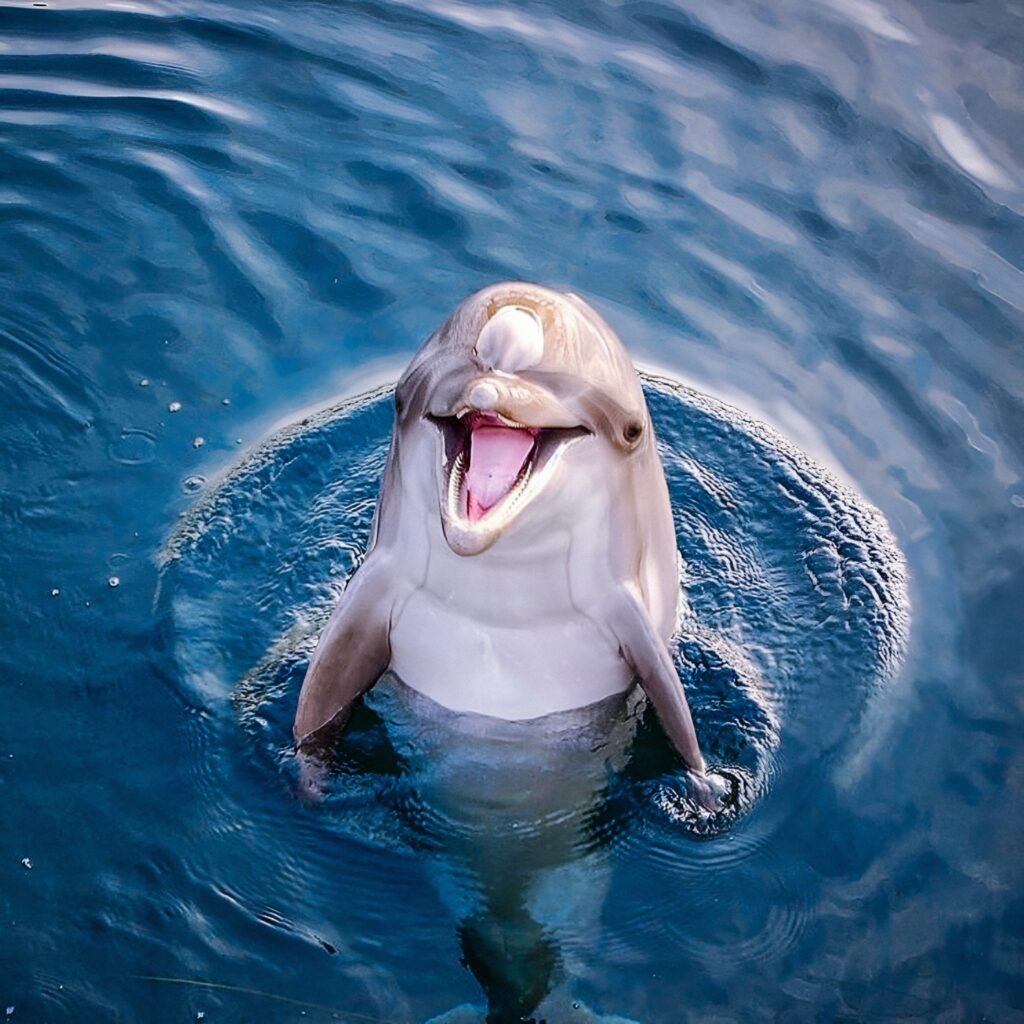
Google DeepMind has an LLM called DolphinGemma. It analyzes dolphin vocalizations to predict the next sound in the sequence. Thinking about the possibilities, I feel myself tempted all over again. We could crack the code, bridge the gap….
This use of AI seems the usual double-edged sword, though, capable of deepening our understanding and expanding communication, but also capable of getting it way wrong. LLMs have an unprecedented ability to decode, finding patterns and inferring any grammatical rules that exist. But none of that will tell us what these sounds mean to the dolphin; what the context is; what they mean within the dolphin umwelt.
Maybe someday we will be able to read their minds. But for now, there are new worries: LLMs spew out anything just to please us, and they are also capable of malevolence. What if DolphinGemma hallucinates, or even reports or sends wrong information? What are the ethics of communicating with a species we do not understand via an intelligence we cannot control?
The rationale is a powerful one: surely people will care more about animal rights if the animals can speak. But if we care at all about animals, they already speak to us. And a transcript is no guarantee of compassion. Think how easy it is to deny other humans—who are capable of speaking in symbolic, syntactically choreographed words—a voice. Where is the technology that lets us feel what it is like to be a refugee, or to lose your sight, or to live with schizophrenia or autism? And where is the technology that will let us feel, deeply, with all our senses, what it is like to be a different sort of animal?
DeepSqueak software can interpret rat noises to determine when a rat is sick or in pain, which seems like progress—except that we will continue to exterminate the wild ones anyway. “Farmers might benefit from a machine that allows them to ask a cow about its health,” researchers note, “though it might turn them vegetarian.” We already coopt dolphins’ sweet helpfulness to locate underwater mines and lost torpedoes. These sleek, friendly creatures outperform machines in complex natural environments, and they do not execute tasks like automatons; they understand them. So when I read that the LLM goal is to enable “productive exchange” between humans and dolphins, I wonder just what we expect them to produce for us now.
Our species always wants profit, and it is nearly always cheaper to exploit than to heal and help. AI models are already biased against farm animals. And while LLMs are astoundingly good at finding patterns, “they are often not actually deciphering meaning,” note ethicists. Even if they guess right, we cannot know how they reached their answer, and we cannot confirm its accuracy. “We might end up generating digital animal sounds that seem meaningful to the animals, but without actually knowing what we are saying.”
The rationale is a powerful one: surely people will care more about animal rights if the animals can speak. But if we care at all about animals, they already speak to us.
Like us, other animals use their communication systems to cooperate and survive, and they have evolved rich cultures over the centuries. We might be introducing distortion, confusion, and deception. Without context, we would still have no real understanding of that animal’s life world. We would get a lot wrong, the way people stumbling through a new language use Google Translate and wind up uttering street-slang obscenities.
Look at the experiments already conducted. A dancing robotic bee convinced other bees to let it lead, and they all flew to a specific location. A robot gussied up to look like a female frog seduced male frogs into mating behavior, like a sex robot with lonely young men. A fish-robot interacted with live fish during schooling behavior and changed their movement. How dare we? What if we break their instinctive trust in one another’s messages? What if this is like those early chimp experiments, and we train away what they do best, so they obey us instead?
• • •
“Some people talk to animals. Not many listen, though.”
—A.A. Milne
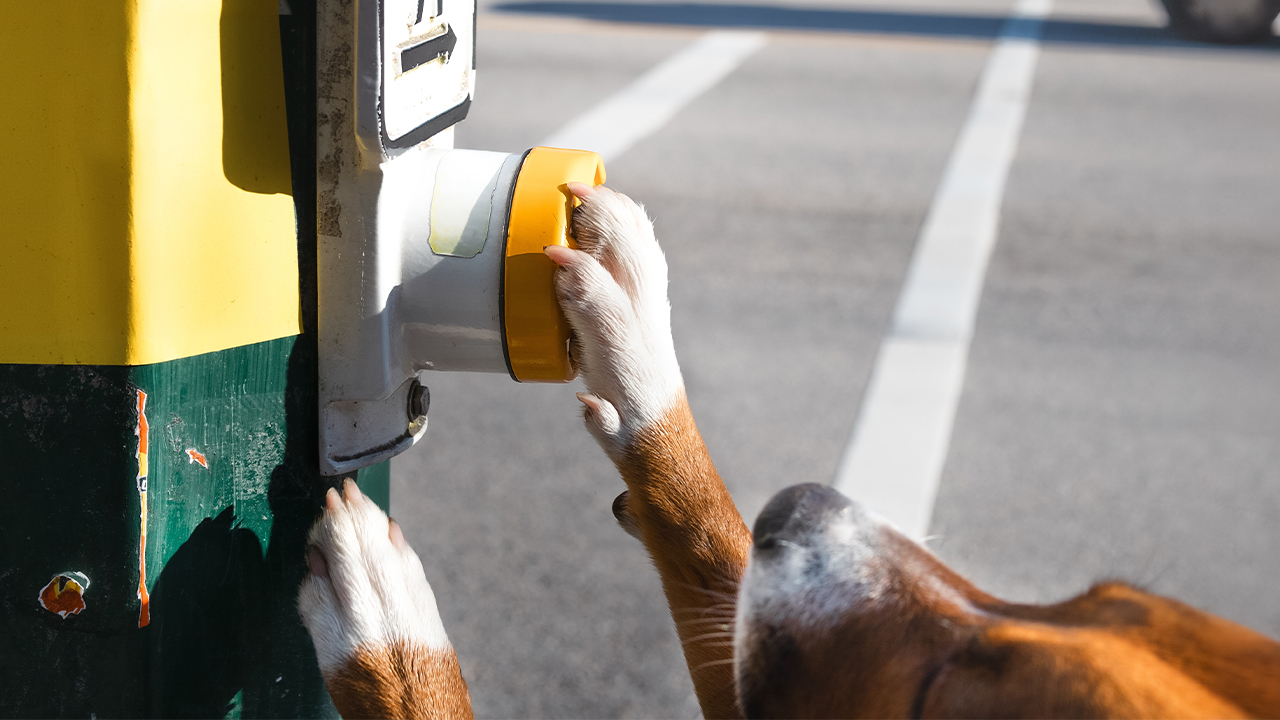
When articles popped up hyping smart boards and the dogs who tapped their buttons to communicate, I had immediate misgivings. Willie, a quick study, would be pawing the go-outside button every ten minutes, and I would only be annoyed. Canine behaviorist Alexandra Horowitz deepens the point: “Pressing ‘Outside’ could mean ‘It’s been a long time since I went outside,’ or ‘I want to go outside,’ or ‘I need to go outside.’ But you won’t see any subtle differences, which you might see behaviorally, because you’ve collapsed them all into one button.”
I would rather pay attention. I love exchanging glances with the dog when there is an unexpected clap of thunder; an unusual, giant bird swooping down in front of us; or just a weird social situation. We are in new territory together, not the routine pleading (from me: come, sit, obey; from Willie: treat, walk, cuddle). I love our shared jokes, as when we are playing ball, and one of us tricks the other. I love how, when he is barking madly at a door knock, and I say, “Thank you for telling me,” he subsides, but if I just tell him to shush, he feels obliged to disobey and keep alerting, because apparently, I still do not realize we are in danger.
When Koko the gorilla was allowed to choose her own assistant, Dr. Mary Lee Jensvold, a student at the time, interviewed for the job. She brought a hat as a gift. Koko pronounced it a “toilet hat,” and the interview went downhill from there. But Jensvold (who did not get the job) flew home thinking, “I’ve just had a conversation with a nonhuman. So where am I going to draw that line now? Does it go between apes and monkeys, or between primates and nonprimates? Then I realized. That line didn’t need to be drawn at all. Evolution doesn’t have sharp boundaries. It’s a continuity.”
Our ancestor Lucy, a hominid who lived 3.2 million years ago, was probably “as vocal as a chimpanzee—and she may have sounded a bit like one, too, with a similar high larynx. Because of this, her vocalizations were likely limited to a few distinctive sounds, with no syntax.” Koko combined her 1,000-words-plus cleverly, for example calling a ring “a finger bracelet.” Kanzi, a bonobo, grasped a sliver of grammar that let him track word order. Still, these are not stable grammatical rules or sentences rich with recursive syntax. Nor are they spontaneous acts of communication; instead, they are clever responses to human prompts. Like toddlers, apes show some capacity for genuine abstraction and clearly track others’ goals and perceptions. But they show no sign of thinking about beliefs, unseen forces, or invisible causes. Why would we want them to? That is our curse.
When I reread the Dr. Dolittle stories, I was disappointed to find that most of the dialogue was between humans, and when other animals talked, they talked like humans. In my memory, Dolittle had been in constant conversation with animals, but no: they simply brought him occasional, extraordinarily helpful messages. We just cannot crack our way out of our own world, can we? No wonder we have been asking the wrong question for ages, imposing the human norm and testing other animals to see if they can meet its standard. After decades of strenuous effort, all we have is a handful of prodigies. Animal savants, I would call them: the spelling-bee and Jeopardy winners of their species. But what we taught them was about as relevant as astrophysics to a firefighter.
Like toddlers, apes show some capacity for genuine abstraction and clearly track others’ goals and perceptions. But they show no sign of thinking about beliefs, unseen forces, or invisible causes. Why would we want them to? That is our curse.
Words, which evolved long after the complex communication systems of other species, add nothing useful for most animals. What is coolest is what they tell each other, underwater or in midair, in caves or trees or hot black night. Infinite miracles of communication, if we step out of our suffocating umwelt for a second.
When Alex, a parrot, was confronted with a mirror, he asked his trainer, psychologist Irene Pepperberg, “What color?” She told him “gray,” adding the word to his already extensive vocabulary. It was and still is, famously, the only instance of a non-human asking a direct, existential question. Yet my dog is asking questions all day long. He sniffs, he paws, he stares quizzically, he cocks his head (What did you say? Did I hear “park”?) and he shoots me an anxious glance before entering the vet’s office (Is this gonna hurt?). Whenever I had to make a U-turn, a previous dog, sitting upright in the front passenger seat watching the road intently, would sigh theatrically. She is lost again. None of this counts as rational, symbolic communication, because science sees no sign of self-awareness. No vanity, no career goals, no fretting over the future. A different way of living altogether.
Our communicative capacities barely overlap, yet the intersections can be deeply moving, immensely helpful, funny, and revealing. When Pepperberg was showing off Alex’s knowledge of colors for a corporate sponsor of her research, he kept asking for his usual reward, a nut for every right answer. Because she had limited time with the sponsor, she ignored him and kept asking questions. Finally, exasperated, he glared at her and said, “Want a nut. Nnn, uh, tuh.” He was spelling it out for her.
The other day, I read my husband a passage from a book I was reading. The author had been in the barn with her horses when she learned that her mother had died. Her favorite horse came up, leaned his forehead against hers, and stayed, motionless, for a long time. Offering comfort, I will say, and if dismiss that as instinctive anthropomorphism, I will know you have never loved an animal.
I watched my husband’s face eagerly; this was one more example for our file of cross-species communication.
“I’m not so moved anymore,” he startled me by saying. I was crushed—until he continued: “Science has plenty of proof now. Animals are so much more than we ever thought they were.”
Cross-species communication will always feel like magic to me, though. Any time a significant idea or feeling jumps from one individual to another, without words, you stitch the universe a little tighter. What is extraordinary about human language is that it can record the epiphanies.