The Social Strikes Against Baseball
Two books deal with how baseball has resisted change and those who have made the game more just.
By Doug Battema
March 31, 2026
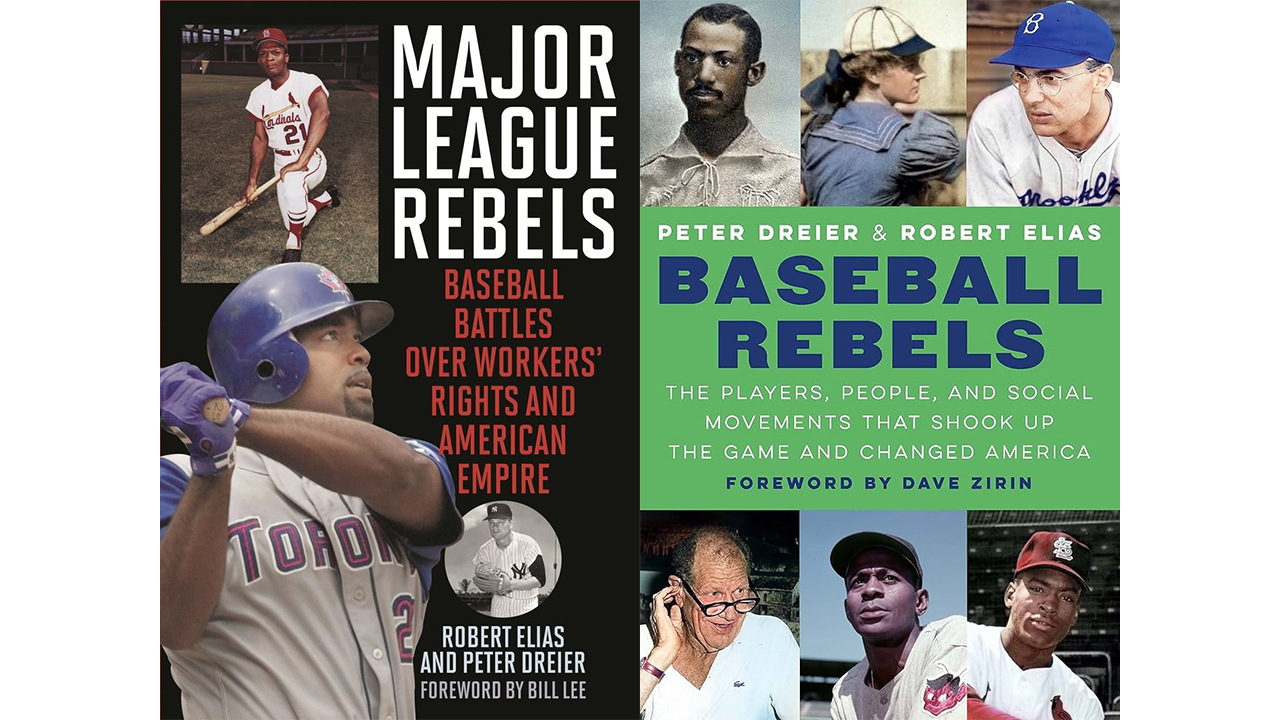
Baseball Rebels: The Players, People, and Social Movements that Shook up the Game and Changed America & Major League Rebels: Baseball Battles over Workers’ Rights and American Empire
Baseball is America’s national pastime: steeped in tradition and nostalgia, it is a timeless game, hearkening back to the bucolic idyll of rural America. It does not discriminate—or at least no longer does; all are welcome; anyone can play and enjoy this sport, regardless of their identity or wealth or past or genetic makeup.
So goes the myth. The reality has just a bit more nuance, in the way that Harry Doyle might describe one of Ricky “Wild Thing” Vaughn’s directionless high-velocity fastballs in the film Major League (1989) as “just a bit outside.” Baseball is a deeply conservative social, economic, and political institution that has been riven since its inception by debates over who can, or should, be allowed to play; under what terms; and with what restrictions. Its noxious and notorious color line, drawn sharply and firmly at the founding of the National League in 1876; its historic hostility toward female players; its hidebound economic structure, facilitated by a legally sketchy and unwarranted exemption from antitrust legislation; and its frequent alignment with nationalist jingoism are characteristic of the ways in which the game has excluded as much—if not more—than it has included. Peter Dreier and Robert Elias trace some of these divisions in the companion volumes Baseball Rebels and Major League Rebels, telling the story of individuals who sought to challenge the way in which the game is played and administered. The short profiles of these figures, stitched together with ample context and commentary, highlight the resistance to the conservative orthodoxy of baseball: radical thinkers and activists within the game wrenching it toward a progressive path. To paraphrase Dr. Martin Luther King Jr, these figures may see the arc of the baseball universe as long, but want to ensure that it bends towards justice.
Baseball Rebels devotes significant attention not just to Jackie Robinson’s outspokenness on racial issues while a player, but to his social activism after his baseball career ended, during which Robinson was unsparing in his withering criticism of MLB and broader American society for clinging to vestiges of its racist past and perpetuating systemic injustice.
Both volumes offer compelling insights into the people who have fought for significant progress toward social and economic justice in and around baseball. The most dynamic profiles in Baseball Rebels revolve around race: the sections about the experiences and tragic death of Octavius Catto, the nineteenth century activist and ballplayer who was arguably the most significant and underappreciated pioneer of Black baseball (8-17); the Depression-era efforts by journalists Wendell Smith and Lester Rodney to break the color line brought significant pressure from the Black and leftist presses to bear on Major League Baseball (48-57); and the combative response by the outspoken Dick Allen to the racism and pressure to conform to the conservative institutionalized orthodoxy of the 1960s and 1970s (134-146) are exceptionally insightful, highlighting critical figures whose contributions are perpetually overlooked. In this way, the book goes well beyond the oft-trod narratives that suggest Jackie Robinson ended racism—at least in baseball, though symbolically throughout the nation—when he stepped onto the field as a member of the Brooklyn Dodgers in April 1947. Baseball Rebels, fortunately, devotes significant attention not just to Robinson’s outspokenness on racial issues while a player, but to his social activism after his baseball career ended, during which Robinson was unsparing in his withering criticism of MLB and broader American society for clinging to vestiges of its racist past and perpetuating systemic injustice.
Baseball Rebels’ profiles about the minuscule number of players who do not identify as cisgender are also essential reading. The five pages devoted to the late Glenn Burke, who did not call attention to his homosexuality but whose sexual preferences were likely known by at least some teammates and club executives during his brief major league tenure in the late 1970s and early 1980s, are particularly moving. They suggest the immense power of heteronormativity and the casual brutal homophobia often afflicting baseball institutions; it is telling that neither Burke nor Billy Bean came out publicly as gay until after their playing days had ended, and that no active major-league player to date has identified as gay or bisexual.
Major League Rebels, similarly, offers a concise and accessible recapitulation of the struggles of players for autonomy and workers’ rights within the world of professional baseball, which quickly became dominated by capitalist entities. When baseball first openly embraced professionalism—when the Cincinnati Red Stockings in 1869 became the first team to be operated on an explicitly for-profit basis, paying players a salary and making the formerly amateur sport a locus for wage labor rather than merely a game—it quickly adopted a top-down model akin to many other organizations operating under the conditions of mid-nineteenth-century capitalism. Those with money and power treated workers as disposable commodities, serving at their whim and under terms dictated by ownership; those who misbehaved, challenged authority, even expressed sentiments not in line with their (economic, not moral) superiors, or had the temerity to suffer a catastrophic injury could be dismissed from service and, if necessary, blackballed.
Rather than treat this as a fait accompli, however, Dreier and Elias focus on the efforts of the likes of John Montgomery Ward, Jim O’Rourke, and Tim Keefe to reshape the business of baseball during the Gilded Age; on the rhetorical and legal challenges to baseball’s employment practices mounted by Tony Lupien, Al Niemiec, and Danny Gardella in the decade after World War Two; and on the direct assaults on the restrictive reserve clause by Curt Flood and by the Major League Baseball Players Association led by Marvin Miller. The questioning of America’s military activities, too, forms a part of this latter volume—players such as Ted Simmons and Carlos Delgado, who endangered their popularity with fans and risked the wrath of ownership by questioning U.S. actions in Vietnam and Afghanistan (respectively) are profiled, exemplifying the ways in which ongoing sociopolitical debates play out in the world of baseball just as they do in the world beyond. Some of this echoes Elias’s 2010 assessment of baseball’s geopolitical role in The Empire Strikes Out: How Baseball Sold US. Foreign Policy and Promoted the American Way Abroad, which traces the way in which baseball has functioned as a vehicle for projecting American power and influence; Major League Rebels, though, focuses principally on the resistance to such projections.
When baseball first openly embraced professionalism—when the Cincinnati Red Stockings in 1869 became the first team to be operated on an explicitly for-profit basis, paying players a salary and making the formerly amateur sport a locus for wage labor rather than merely a game—it quickly adopted a top-down model akin to many other organizations operating under the conditions of mid-nineteenth-century capitalism.
Major League Rebels also dwells in its penultimate chapter on “five individuals whose radical beliefs led them to become activists on multiple issues: Bill Veeck, George Hurley, Jim Bouton, Bill Lee, and Sean Doolittle.” (217) It is an interesting mix of four players and one owner, each evidently driven by principles that led them to reject the conservative orthodoxy of institutionalized baseball and to take controversial stands on sociopolitical issues. The inclusion of Veeck in particular seems odd at first glance, given his status as one of baseball’s owners; his effort (thwarted by Commissioner Kenesaw Mountain Landis) to desegregate baseball in 1943 by buying the Philadelphia Phillies, releasing all the White players, and hiring players who had starred in the Negro Leagues may have been racially inclusive and in line with Veeck’s progressive principles, but used all the regressive and exploitative levers of player control that figures mentioned earlier in the book agitated against. Characterizing him as a rebel while not even mentioning similarly innovative figures such as Charles Oscar Finley (“Charlie O”), the maverick owner of the Kansas City/Oakland Athletics who bucked tradition with garishly colored uniforms, sought to introduce orange baseballs, and paid players to grow mustaches in an era when most owners preferred clean-shaven employees, seems curious.
The countercurrents running against the apparently inexorable tide of baseball’s conservative institutional trajectory show clearly how the game could have taken—and still can take—different directions. Metaphorically, the books tell the tale of baseball not as a knee-buckling fastball but as a knuckleball, fluttering in unpredictable ways toward a desired goal; or, if you prefer, they highlight the seams on the baseball, focusing on the threads stitching together two pieces of cowhide instead of only on the finished product. Taken together, the volumes offer a glimpse of a complex and overlapping history. As a survey of these efforts that can point to all these distinct countervailing narratives, they are invaluable.
As an argument, however, the books are not fully convincing. Baseball Rebels successfully backs up its assertion about the ways in which individuals within baseball have resisted anti-Black racism—even (or maybe especially) when such efforts were unpopular with team owners or fans or both. But acknowledging other racial groups and their differential treatment within the game proves elusive. Though the authors detail how the likes of Vic Power and Roberto Clemente encountered anti-Black racism and Jim Crow laws in their careers, they do not probe the ways in which Latin Americans have been treated in professional baseball–the exceptionally articulate and intelligent Clemente, in particular, was frequently depicted in the press as ignorant because he lacked fluency in English. This is instead addressed in Major League Rebels, which frames the struggle for respect and autonomy waged by Latin American players as a functionally anticolonialist and international effort. Separated as it is from Baseball Rebels, this narrative seems like it is part of Major League Rebels’ tighter focus, defining its subjects as economic actors first and foremost rather than as people with a distinct racial/ethnic/national identity. Another absence is just as glaring. The sharply differential treatment of many Japanese players such as Hideki Matsui, Daisuke Matsuzaka, Shohei Ohtani, and Yoshinobu Yamamoto mimics, in many ways, the depiction of Asian-Americans as a “model minority”—yet the discrepancy is not part of either Rebels. And this barely scratches the surface: another volume or two may be needed to probe the racialized discourse in the press and popular imagination about Irish, Italian, Polish, Jewish, and Native American figures in baseball.
Dreier and Elias seem acutely aware that their efforts in these volumes are only part of the story. Each volume concludes with a chapter devoted to the “unfinished agenda” that baseball ought to undertake if it is to be the inclusive force for justice and equality that it can be.
More problematically, the authors’ contention in Baseball Rebels that “[b]aseball rebels have also resisted sexism and homophobia, promoting women’s role in the sport and taking courageous stands for sexual identity and equality” (2) is not fully borne out by the evidence. The chapters on women in baseball and gay men in baseball are distressingly thin; this is clearly not the fault of the authors, but a reflection of the institutionalized sexism and homophobia in American culture and in baseball since the sport was developed in the mid-1800s. Despite significant social progress toward gender equality and acceptance of people identifying as part of LGBTQIA+ communities since that time, baseball’s pace on the same issues has been glacial. Debra Shattuck, in one of the few works on the subject not referenced by Dreier and Elias, wrote in the Journal of Sport History in 1992 that several attempts by Vassar College—at the time a women’s college—to establish a baseball team for students in the 1860s and 1870s failed. Despite the clear passion for the sport among a handful of young Vassar students, most “did not flock to play baseball even when it was offered as an approved elective … only 25 of 338 students selected baseball as their optional form of exercise.” Shattuck mentions that among the reasons for eschewing baseball was concern over “how the activity would be viewed by outsiders.” Similar efforts at Smith College and Mount Holyoke College were perhaps marginally more successful, though as at Vassar the ballplaying students demonstrated an “apparent commitment to traditional social values. Even as they experimented with the masculine game, players tried to maintain a semblance of femininity.”1 Dreier and Elias sadly cannot point to many examples of female players in the professional or collegiate ranks beyond the World War Two-era All-American Girls Professional Baseball League and Ila Borders’ stint on the mound in college and a pair of independent minor leagues; perhaps Olivia Pichardo, whose groundbreaking presence as a member of Brown University’s baseball team in 2023 heralds additional steps toward more female baseball players. Women have made greater strides as owners and executives, and to a lesser degree as coaches and umpires, but Dreier and Elias only devote seven pages to their efforts. Again, more recent developments, such as Jen Pawol becoming the first woman to umpire a major-league contest, albeit a spring training matchup between the Houston Astros and the Washington Nationals in February 20242, and the Giants interviewing Alyssa Nakken for their managerial post in 2023, may portend more progress on this front. And the fact that Mordecai “Three Finger” Brown could count on his right hand the number of professional ballplayers who have played as openly gay men—all in the low or independent minor leagues, all in the 2010s, and all briefly profiled in Dreier and Elias’s work—suggest that homophobia may be as tough, if not tougher, for baseball to overcome as its misogyny.
Dreier and Elias seem acutely aware that their efforts in these volumes are only part of the story. Each volume concludes with a chapter devoted to the “unfinished agenda” that baseball ought to undertake if it is to be the inclusive force for justice and equality that it can be. Whether or not the progressive agenda they chart out can and will be pursued in a nation that currently seems as divided ideologically and politically as it was at the time baseball emerged as a national pastime more than a century and a half ago remains to be seen. For every move in the progressive direction Dreier and Elias endorse—the creation of a Minor League Players union capable of negotiating a collective bargaining agreement, for instance, or the New York Yankees appointing Rachel Balkovec appointed manager of their Low-A Tampa Tarpons affiliate—there is a similarly regressive move—the Oakland Athletics’ plan to abandon the Bay Area for Las Vegas (the apotheosis of capitalist excess), or the contraction of affiliated minor-league teams and leagues.
So, is that arc of the baseball universe actually bending toward justice, or is it a hanging curveball about to be crushed? Without much more sustained effort and commitment by many more of the sorts of rebels Dreier and Elias identify, it is hard to envision the former. May these books inspire a new generation of rebels to make a genuinely inclusive, thoughtful, and progressive sport a reality.
1Debra A. Shattuck, “Bats, Balls and Books: Baseball and Higher Education for Women at Three Eastern Women’s Colleges, 1866-1891,” Journal of Sport History 19, no. 2 (Summer 1992): 100 and 108, http://www.jstor.com/stable/43610534.
2Jennifer Pawol is now an official Major League umpire. She worked her first MLB game on August 9, 2025.