The Most Haunting, Nagging, Maddening Exchange from Jonathan Franzen’s “The Corrections”
By Ben Fulton
December 20, 2025
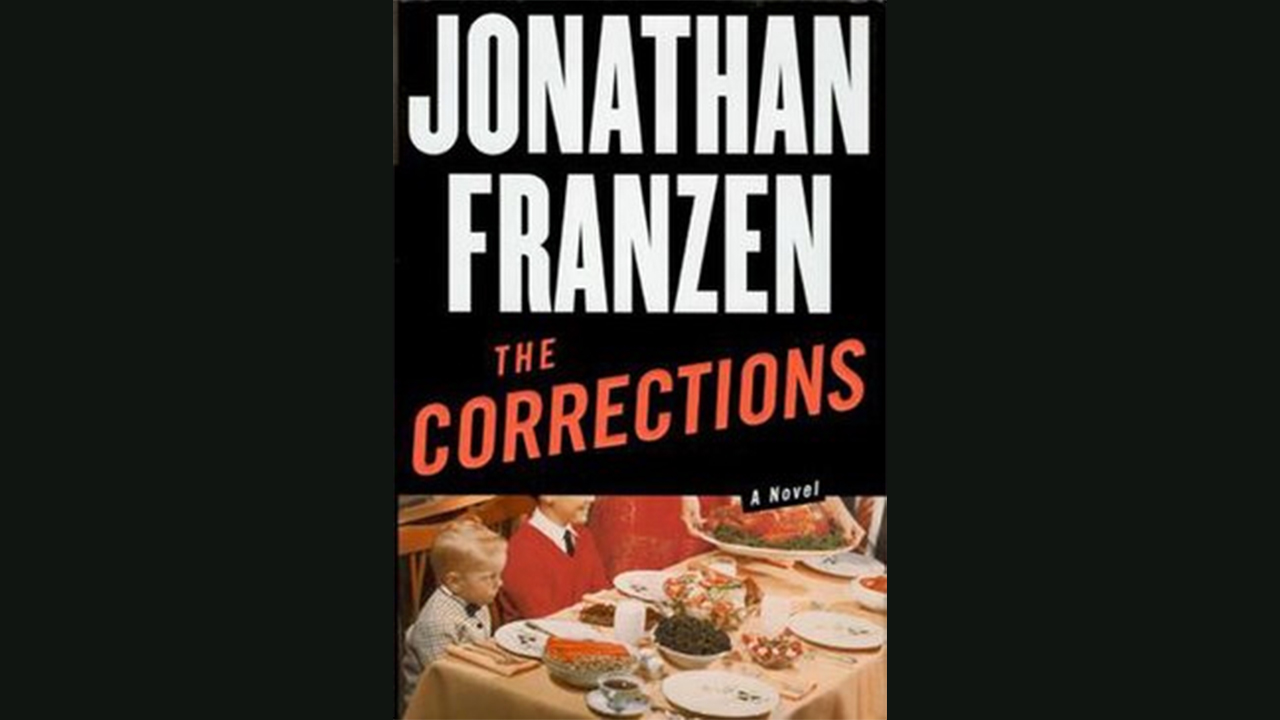
Jonathan Franzen’s 2001 novel The Corrections holds so many degrees of esteem with so many readers that, almost twenty-five years since it blazed across the literary world, it has disintegrated into a general sense of greatness not many readers get particular about anymore. Almost everyone who has read it agrees it is a great read. Curiously, though, no fan of the book I have come across seems eager to explain its greatness.
After reading it for the first time more than five years ago, so late to the party that no one cared I was finally reading it at all, I have a hard time remembering what it was about or why it moved me. All I remember is that it was more entertaining than most novels had any right to be, and that its prose was so deftly delivered that you doubted Franzen ever broke a sweat over his keyboard.
But of course The Corrections carries its weight, and then some. Most recently, it pulled down the No. 5 slot of The New York Times’s 100 Best Books of the 21st Century. Fans have long tired of asking when the book will finally, definitively, be adapted for film or a prestige TV series. (The last hot rumor that HBO would finally take the plunge, casting Anthony Hopkins and Ewan McGregor in title roles, fizzled in 2012.) Franzen’s long-branching tale of the Lambert family’s last-ditch attempt to reassemble themselves for Christmas before their patriarch’s anticipated death, with detours abroad to Eastern Europe, sticks to the ribs of just about everyone who has read it. The characters are zany and stubborn in a way that only middle-class Americans can be zany and stubborn. Its humor is mordant. And its dialogue, even when sub-vocalized in the reader’s head, comes straight from thousands of living rooms across the United States.
Having grown up in the Webster Groves neighborhood of St. Louis, Franzen never quite said out loud that his fictional St. Jude was a stand-in for St. Louis. Then again, he never had to. One of the novel’s many centers of action, St. Jude could be “any city USA,” the type of suburban locale that would produce a family as sour, but also as painfully earnest, as the Lamberts. To paraphrase a famous trope of literary advice, “Write well about one place, and you will have written about every familiar place to make it seem universal.”
There are a couple of pages in The Corrections, however, in which Franzen hits briefly, but ever so pointedly, on what seems to be the social glue holding St. Jude, and by extension so much of the United States, in its fragile state. The exchange comes about two-thirds of the way through the book, when the European character Klaus describes a curious invective against the way Americans interact with one another:
Klaus gave a harsh laugh and turned to Denise [Lambert]. “Do you know what I rilly hate about St. Jude?”
…
“I rilly hate the phony democracy. The people in St. Jude pretend they’re all alike. It’s all very nice. Nice, nice, nice. But the people are not all alike. Not at all. There are class differences, there are race differences, there are enormous and decisive economic differences, and yet nobody’s honest in this case. Everybody pretends! Have you noticed this?”
“ … How can you distinguish the people when everybody pretends to be the same?” (p. 394)
Most of us read in what can loosely be called a certain style, whether fast and furious to keep time, or slow and savory to honor the prose. I have always leaned more toward the latter, and always with a pen at the ready to underline or asterisk passages that hold and shock me. That particular passage still holds me, because it makes me wish like hell that Franzen had spent more time on what his character meant by the words “nice,” “democracy,” and in particular, “phony.”
It is an almost painful stereotype that Midwesterners are nice people, or at least more amenable than the edgy denizens of the East Coast and the nebulous cool of the West Coast. What is most striking about this exchange, though, is how Klaus’s criticism, that Americans cannot stand to be honest with one another for too long, could be a back-handed compliment, as in, “Do we not all tell lies to each other for the convenience of getting by or, more crucially, civil co-existence.
This simple exchange gets to the heart of an elusive American trait, both in manners and social demeanor. It explains, in large part, how millions of middle-class and poor Americans can trust a billionaire President, along with his billionaire cabinet, to allegedly look after their interests and welfare. It explains the racism and resultant social tensions we (for the most part) effectively camouflage until it can be hidden no more, then erupts in protests that shock and offend large portions of U.S. society, who insist there was never any racism to camouflage, let alone complain about.
Of course our country contains rich and poor, Black and White, along with a multitude of religions and ethnicities crossing paths. It makes a place, often begrudgingly, for LGBTQ people. Our country does all this, but lately with the attitude that it is better not to discuss how this is done, but what should unify us.
Alexis de Tocqueville hit on a similar observation near the middle of the second volume of his great study of the United States, Democracy in America (1840): “ … the man who inhabits democratic countries finds near to him only beings who are almost the same; he therefore cannot consider any part whatsoever of the human species without having his thought enlarge and dilate to embrace the sum. All the truths applicable to himself appear to him to apply equally and in the same manner to each of his fellow citizens and to those like him.” (p. 412, trans. Harvey C. Mansfield and Delba Winthrop, University of Chicago Press)
Maybe this is “phony democracy,” as Franzen puts it in Klaus’s words. Few of us as Americans believe honestly that we are equal in democracy. We only believe that it is better to believe so, rather than do so through policy and programs that will result in strife and arguments. Equality, or as de Tocqueville expressed it, the quality of being “almost the same,” exists mostly in our collective imagination. But if it does not reside there, it might not live anywhere at all.
The closest Franzen comes to showing his cards in this scene comes with the kicker of a reminder that Klaus is European, and also a bit of a snob. Why, pray tell, is it so important to “distinguish” people at all? For what purpose would we even want that, when most of us distinguish whatever is important to us in people well enough on our own?
The Corrections is, at a basic level, about an American family holding itself together, and an attempt to come together again after the children have grown up and the parents have grown old. It is a book about family arguments and the unresolved arguments that atrophy into resentment and even calamity. Franzen’s book is hardly unique among books, even if it is better written than most family chronicles. Reading Klaus’s indictment of the fictional, but all-too-real St. Jude, one hopes that Franzen will soon warm up his keyboard to travel even deeper into the soft truths and hard, necessary lies that make us, or at least most of us, “all very nice. Nice, nice, nice.”