The Long Goodbye to a Sofa That Would Never Die
By Ben Fulton
November 7, 2025
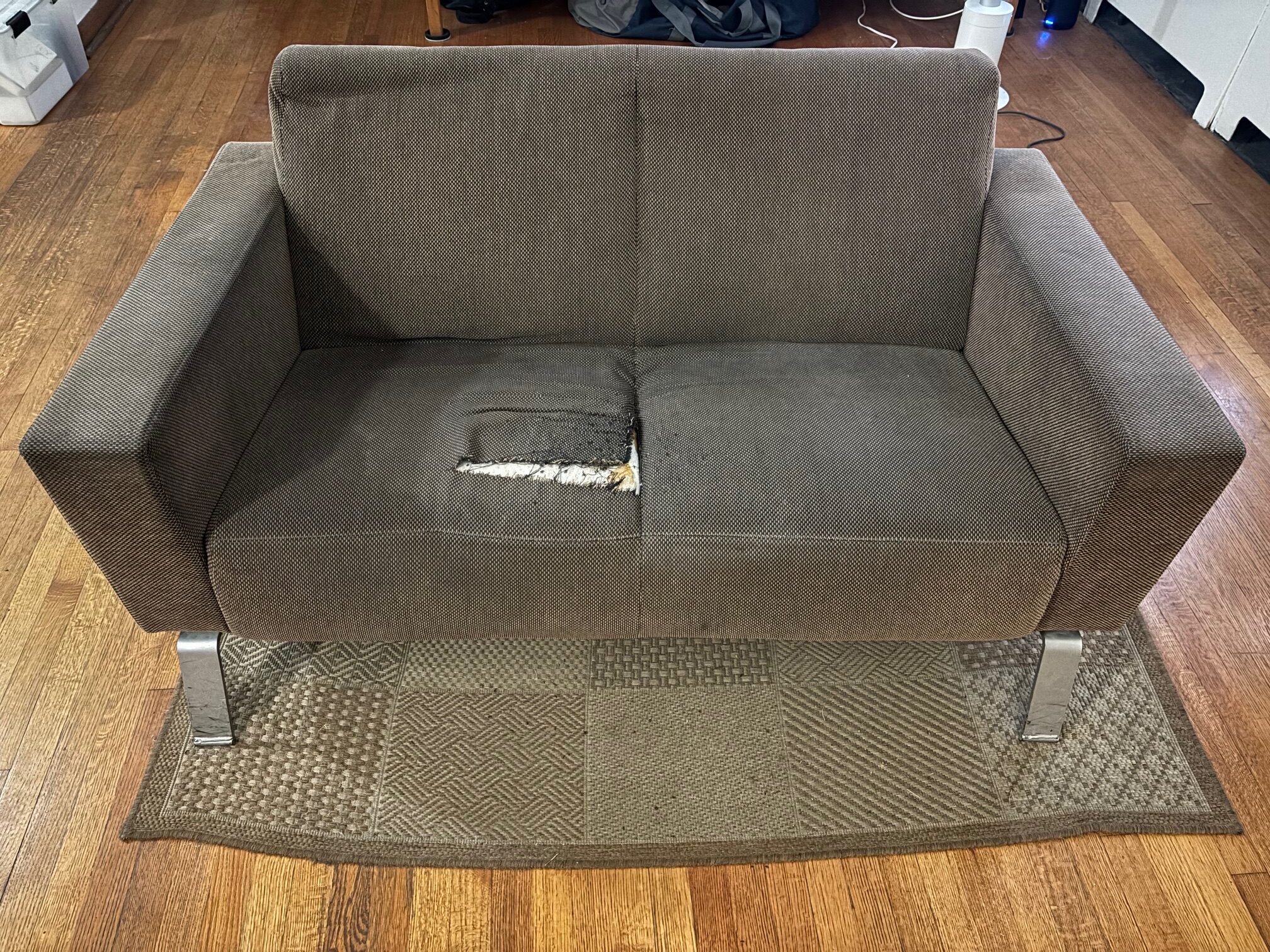
There are pieces of furniture that serve their purpose admirably but temporarily. Then there are pieces of furniture that, over time, appreciate in value so well you think nothing of mistaking them for a family member.
Such was the beloved status of my late, great, golden-brown, Danish sofa, consecrated in the middle of its life by a good friend of mine as El Trono, Spanish for “The Throne.”
This small masterpiece of furniture making was purchased in the year 1998 from a humble retailer called Copenhagen West. A part-time friend who worked the floor gave me a 20 percent discount. This was whole years before IKEA conquered the U.S. retail furniture market with low-cost, high-assembly-time particle board kits that still looked classy once assembled, but then devolved to shambles alongside apartment building dumpsters days before move-out.
El Trono became part of my “family,” if such a word does not seem inappropriate, in an age when furniture was built for the long haul of multiple moves and a social calendar over which I shed and grew new social circles like snakeskin and was transformed by various girlfriends as caterpillars morph into butterflies. It would be folly to count how many people have taken a seat on this sofa over the course of 27 years. I would not be at all shocked to learn that it scored more butts than most seats on public transit.
With a lingering gaze and after another exhausting move of furniture into yet another apartment, a friend of mine once remarked, “That damned sofa has seen more living rooms than a whore has whorehouses.” I remember taking a certain offense to his comment—sitting should never be compared to sex work—even if there was nothing offensive about its sentiment. Through at least twelve separate moves in Salt Lake City, three in Colorado, and eleven moves in St. Louis, El Trono never lost its sex appeal. Its golden-brown upholstery seemed to be woven from steel. It resisted, if not repelled, every odorous onslaught. And like classic sofas since the dawn of living room furniture, it yielded to naps easier than it yielded spare change slipped into the back of its cushions. Not once did its wood frame break down, groan under weight, or so much as emit a creaking whine. Credit must be given to the Danes who designed it and then brought it into existence. But credit must also be given to its generous spirit. El Trono never gave up, so I never gave up on El Trono.
I loved this piece of furniture for its backstory as well. The money used for its purchase was a gift from my mother, a gesture of reconciliation years after our mother-son relationship suffered a breakdown brought on by my having gradually abandoned the Christian faith in which she worked so diligently to raise me.
“I want to give you a little bit of money to buy yourself something nice,” she said, breaking the ice so many years ago, in her gentle way. “Buy something that will last, and that might even impress a woman dear to your heart.”
My mother died of cancer eight years later. But for years before her death, and years after, I took solace in knowing that I took her conditions to heart. Most of my friends never failed to remark on the sofa’s handsome initial impressions. Many young women, and several girlfriends, rested their palms on its armrest as if they had known El Trono all along and that, indeed, it was I who was the stranger.
The Japanese hold a belief rooted in folklore that after a century of useful and dutiful service to the human world, furniture and other household objects take on souls, if not outright personalities. This belief, called tsukumogami, makes cemeteries out of junk heaps and risks offending many professing Christians, but goes a long ways to explaining the plot points of Studio Ghibli animated films.
The only aspect of tsukumogami to take issue with is its stingy time limit. Why must a century pass before objects take on souls? Why not twenty-five years, or even ten? Why make time a condition at all? Surely the intense charms of El Trono’s speak volumes at an instant. Who needs even one year?
After this extended encomium, you would be well within your rights to ask why I am parting with an object so familiar to my daily life for more than twenty-five years. That answer is difficult to hazard, although my heart knows instinctively that the choice was easy. El Trono is, in the spirit of a great Rolling Stones’ song, “torn and frayed.” I could attempt a poetic paraphrase of Ecclesiastes 3, but that would be mawkish for an object whose greatness resides in subtle, silent humility. A couch lets us sit by virtue of the fact that it can never stand up. It is always waiting. It is content in its immobility. Like the apple tree in Shel Silverstein’s famous children’s book, El Trono gave until it could give no more; until I realized I was the selfish one for wondering if I might ask if it could still give more.
Having placed it on the curb for municipal pick-up, my seat of so many years assumed a look of noble resignation and austere utility. For a few days, I looked out of my newfound living room window to check if it was still there. Then, days too soon, it was gone for good.
People do not do well with, or by, the effects of pride. We use it to look down on others. Pride lies or at least hides the truth. Perhaps the Japanese cultivated and passed along the idea of tsukumogami because they understood that our emotions and virtues could be better calibrated by realizing that the world and all things in it hold emotions unknown, but that might be discovered. Sitting down to think about it does not quite do it justice. But when next I take a seat on someone else’s sofa, I am sure to discover that the idea has been there all along, waiting for me to think about El Trono all over again.