The Haunting Memory of the Ghost Housing Project in St. Louis
By Wen Gao
January 30, 2026
If I were your guide, I would first take you to the Gateway Arch to marvel at that silver arc slicing through the sky. Then, we would wander through Forest Park, where, amidst the amazing lawns, I would tell you tales of the city’s golden age.
But if you tell me you want to see the real St. Louis, we need to drive north.
Then we pull over next to a massive empty lot.
“Hey, Pruitt-Igoe!”
You hop out of the car with me and look around,
“ Where?”
“Here”
Am I messing with you right now?
No, actually, I really should charge you double for this tour.
I could have dropped you at the foot of the Arch, let you stare at that shining arc. But I bring you here because you told me you want to know the real St. Louis.
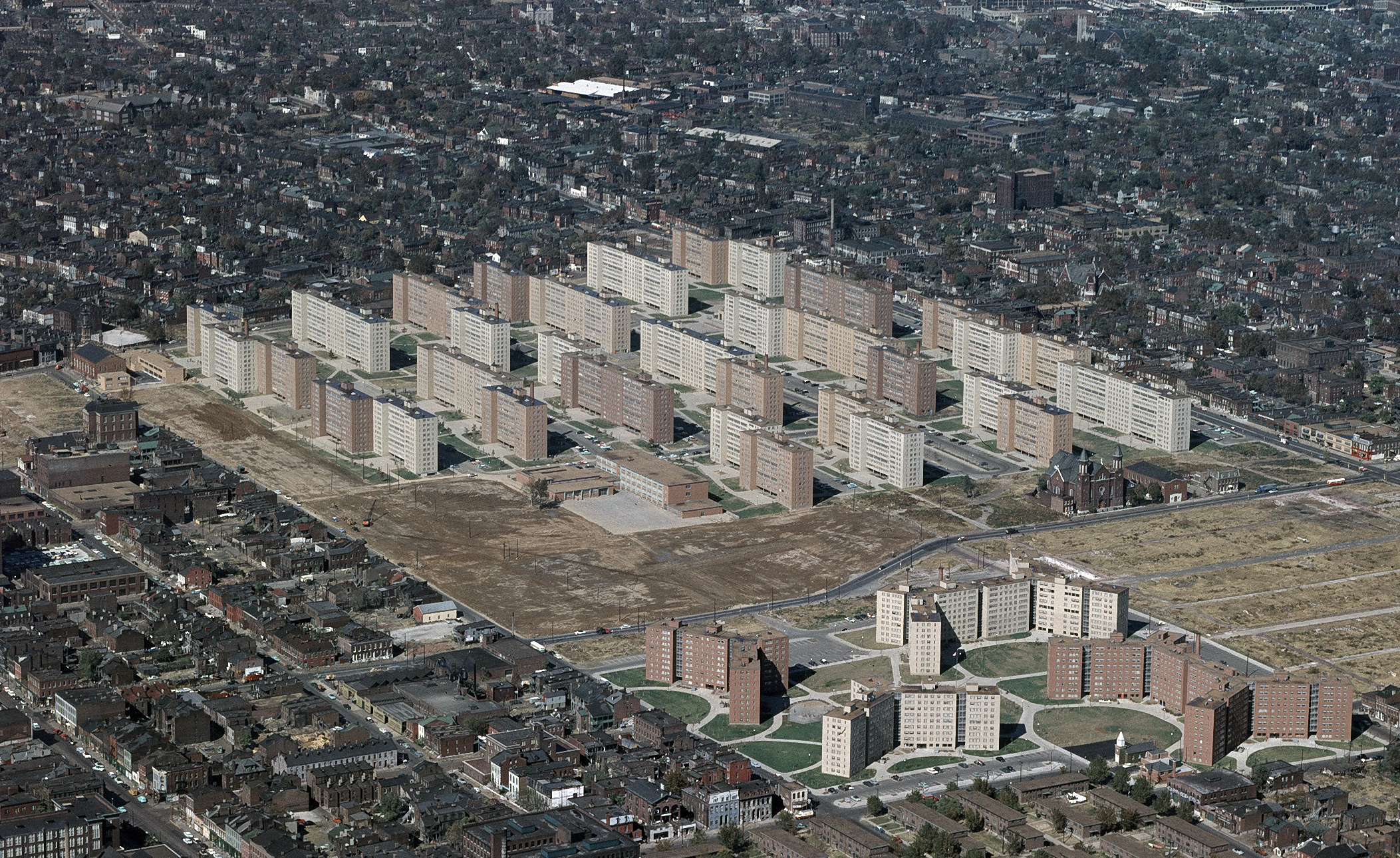
Pruitt-Igoe was one of the largest public housing projects in the United States in the 1950s: eleven-story buildings rising from North St. Louis, designed to house more than ten thousand people. At the time, it was celebrated as a model of modern urban living. There were elevators, open corridors with light, and green spaces between the buildings. It gave dignity and decency to the lives of the urban poor through the high-efficiency, purpose-designed.
At the very moment when Pruitt-Igoe was filled with hope, the foundations of St. Louis were quietly beginning to shift. The spread of the automobile and the construction of the highway system made it easy for the middle class and for capital to leave the city for the suburbs.
More than that, Pruitt-Igoe was not born from the will of St. Louis alone. It was also part of a larger national story. In 1949, the United States passed a new housing act that sought to clear slums and rebuild cities through large-scale public housing. It was an era full of confidence in planning, technology, design, and also the beginning of the Cold War. America needed to prove to the world that a capitalist society could provide decent living conditions not only for the middle class.
Yet at the very moment when Pruitt-Igoe was filled with hope, the foundations of St. Louis were quietly beginning to shift. The spread of the automobile and the construction of the highway system made it easy for the middle class and for capital to leave the city for the suburbs. Jobs, tax revenue, and public resources followed the flow of money. For middle-class families, this was a story of opportunity and “a better life.” The urban core slowly emptied out, and the quality of schools, public services, and infrastructure continued to move outward to the suburbs.
As for the “how” and “why” of Pruitt-Igoe’s collapse, you can find all of that in the documentaries, like Pruitt-Igoe’s Myth. They told better and deeper stories about the system and economy than I could ever do.
But I stand on this soil in 2026, fifty-four years later, after demolition. I feel complex emotions so dense.
In history class, we were taught to learn this way: 1954 (The Cause) ➡️1972 (The Result) ➡️ Impact (The Conclusion)
But in this very moment, it feels like time and space have collapsed into a single point. The pure happiness and hope in 1954, the year they set out to end the poverty, the sorrow, and the thunder of the 1972 demolition. The void I feel right now by looking at this empty lot, all of them, tangled together. I do not know what this means, but emotions like these are hard to digest; they stuck with me.
On Google Maps, “Pruitt-Igoe” is already a dead word. The search bar will redirect you to a new name, “New NGA Campus.” I have not found a small monument there. It seems like St. Louis would like to bury this heart-wrenching failure beneath time. However, fortunately and unfortunately, it is hard to be metabolized. For fifty years, no developer could truly swallow this land.
I have no intention to speculate why the government chooses not to memorialize this place; those gambles over politics, profit, or whatever. But for me personally, this emptiness actually gave me a purer weight upon this land.
The lack of a monument forces me to feel the soil beneath my feet directly. If there were a stone tablet here, I might simply read a few lines of carefully polished text and walk away with a sense of relief, dada—a box checked. But maybe because there is nothing, those seventy years of accumulated, bitter-sweet emotions have nowhere to be housed; they have no choice but to crash directly into my heart.
But what is it? To be honest, I have not figured it out, but my memories drift back to my hometown. I was born in China in the 1990s. We had something very similar there, which tried to solve the housing problems; we called them “Khrushchevks” buildings 1 (I have no intention of judging the merits or flaws of such places; I just find myself thinking about my rapidly developing hometown.) Returning to my hometown years later, I saw that the collapse of these grey concrete blocks was always followed by the rise of shining shopping malls and new buildings. This rapid metabolism provided me a perfect emotional outlet; My longing for “beautiful new buildings” was a righteous excuse to overwrite the old memories. Wrapped in that bright, upward-moving progress, I did not even realize what “disappearance” truly meant.
Those grey blocks back home were digested so quickly they were never given a proper burial; they found their headstone here, in this foreign ruin. Standing here, I finally perform the duty I dodged or ignored back home.
But here, standing on this empty lot, it strips away my right to simply “outgrow” the past. It forces me, as a bystander in 2026, to confront the raw weight of seventy years of ups and downs for Pruitt-Igoe and St. Louis.
In my rapidly developing hometown, those narrow, labyrinthine alleys (which we call “hutongs”), shared bathroom with other families, the narrow living rooms, those old dreams were iterated so fast. I must be honest: I was a direct beneficiary of their disappearance. My life moved into big apartments and big malls that rose in those places. For a long time, I never paused to think about what was being crushed beneath the weight of that progress. I came to the United States with that same instinctive longing for polished success. I expected to be inspired by the Gateway Arch. Surprisingly, in the site of Pruitt-Igoe, I found my deepest emotional resonance.
Those grey blocks back home were digested so quickly they were never given a proper burial; they found their headstone here, in this foreign ruin. Standing here, I finally perform the duty I dodged or ignored back home.
All right, my story about Pruitt-Igoe and St. Louis was told. This is my St. Louis. I own its ghosts, and in return, it gives me a home. The void is actually full of us.
Now, my story is told. How about you?
1 Khrushchevkas (Russian: хрущёвка, romanized: khrushchyovka, IPA: [xrʊˈɕːɵfkə]) are a type of low-cost, concrete-paneled or brick three- to five-storied apartment buildings (and apartments in these buildings) which were designed and constructed in the Soviet Union from the early 1960s onwards, when their namesake, Nikita Khrushchev, was leader of the Soviet Union.