The Adventures and Misadventures of Samuel Clemens
A noted Twain scholar weighs in on Ron Chernow’s mammoth life of America’s most famous writer
By Wayne Fields
June 30, 2025
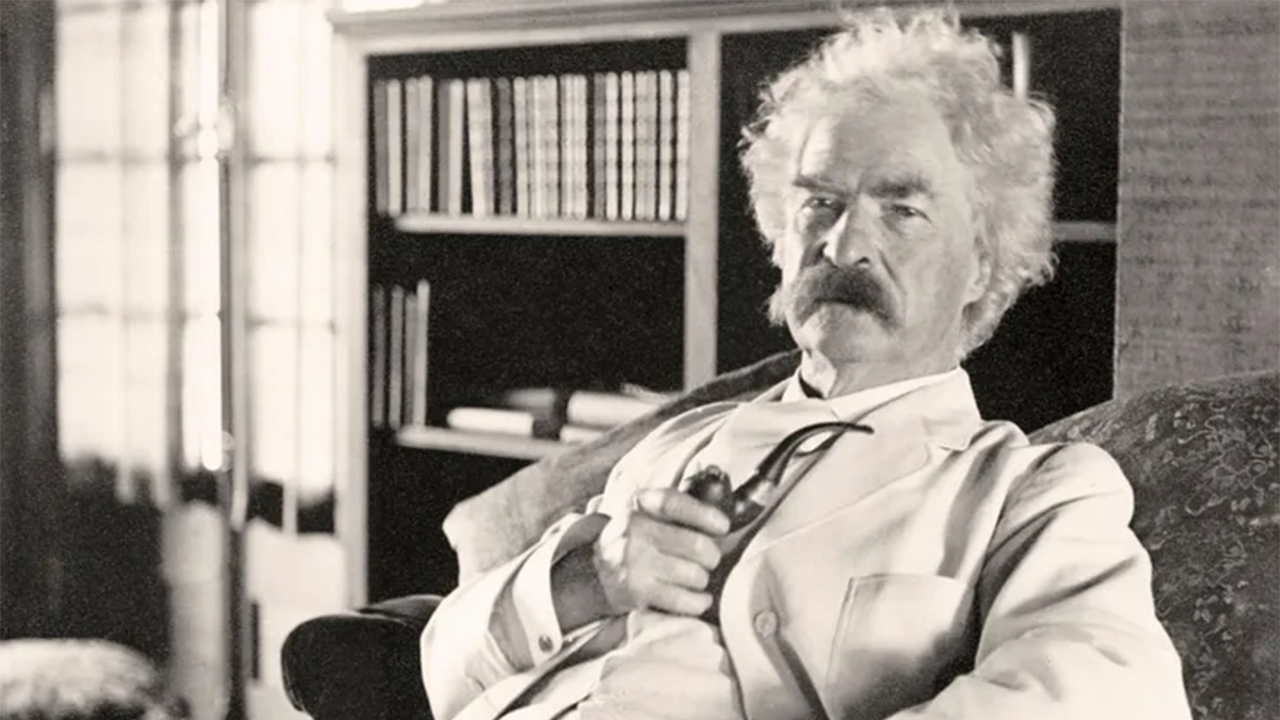
The occasion of a new Twain biography
Until the age of Trump, there would seem no better time for Mark Twain than the one into which he was born. Who would have thought? Well, most likely, Twain himself since he did not imagine any limits to human greed and corruptibility, no expiration date for infantile behavior, no dependable constraints on inhumanity and bigotry. His “gilded age” would hardly compete with the ruthlessness of our billionaires, eager to get their girlfriends into space and their children rich with bitcoin, but his extraordinary wit would have risen to the occasion with the colossal fury that fueled so much of his life, both public and private. The man who forced the Congolese butchery by a Belgian king into newspapers that were eager to keep it out would not have ignored a Russian terrorist insistent upon destroying Ukraine even if it meant releasing convicted murderers to sustain the slaughter, and God knows he would not have sat in silence when his own country, his own president, abetted such horrors. The anti-imperialist who damned Teddy Roosevelt for the theft of the Philippines would find a lust for Greenland and Canada a parody of such arrogance. Only American religion would have provided him more material for outrage than American politics, with its sex scandals, its collusion with power, its effort to build a “brand” around blame rather than repentance, all confirmation of convictions he held a century and a half ago when he declared, “If Christ were here now, there is one thing he would not be—a Christian.”
So much of what Americans presumed to have put into the past at the beginning of the twenty-first century has taken on a largely unanticipated new life with the rise of bro culture and White nationalism. But such a reemergence of our most primitive selves was only unanticipated by us. Not Twain. He warned that antisemitism, racism, and sexism were an integral part of the “damned human race,” and for the better part of a lifetime he was amazed at how unwilling humankind was to give them up, no matter how self-destructive they always turned out to be.
Twain, alas, is no more, dead and in many ways heirless, leaving a country that once more seems bankrupt in both morals and leadership, adrift on a sea of lies that sometimes make those of his own day seem more like fibs, and with insufficient wit and virtually no journalism to stand in opposition. And yet he does not go away. Beginning in 2010, following the hundred-year delay he himself demanded, his three-volume Autobiography has been added to our bookshelves. Then, only last year, Percival Everett’s remarkable and best-selling James brought new attention to Twain’s greatest book. More than a century after his death, Twain seems more timely than ever, our era like his own with a beyond-wealthy upper class prone to obscene extravagance and the exercise of almost monopolistic political influence. It is also a time that seems in reality a parody of Twain’s parodies, its billionaire elite carried past normal human beings in luxurious private aircraft, on yachts as huge as a politician’s ego, and (even less down-to-earth) with a lust for inter-planetary travel. This, too, Twain saw coming; in fact, he declared its arrival on our once republican shores in 1908, although his message only recently got delivered. He insisted that inevitably America would become—and had, he thought, already become—a monarchy, the consequence of “two special reasons and one condition”:
- It is the nature of man to want a definite something to love, honor, reverently look up to, and obey: God and King, for example.
- Little Republics have lasted long, protected by their poverty and insignificance, but great ones have not.
- The Condition: vast power and wealth, which breed commercial and political corruption, and incite public favorites to dangerous ambitions.
What better moment for the appearance of Ron Chernow’s new biography, Mark Twain.
Chernow and Mark Twain’s contradiction blues
As with Chernow’s previous studies, most especially Grant (2017), the book is magisterial—more than a thousand pages in length—but even more, it is responsible and careful (some will think to a fault) in its judgments. It is so long, in large part, to avoid the need for sweeping generalizations. Chernow attempts, so far as any biographer can, to provide what allows us to see for ourselves—and with Twain, more than any of his other subjects, to feel for ourselves. It is in one sense repetitious, but not in the way that our lives are repetitious (chronic illnesses keep coming back and the same mistakes in decisions are made over and again). By reporting every stage in Clemens’s family life, Chernow not only shows the basis for the mounting desperation and increasing vitriol in Twain’s rants, but he is also able to provide an expanding context, an elaboration of the late nineteenth and early twentieth century world that shaped America’s most famous and influential writer. We watch the desperate search for relief from their afflictions (everything from the father’s gout to the youngest daughter’s epilepsy) that takes the Clemens clan to sanitaria on two continents and a variety of popular “cures”—“Mental Science,” Osteopathy (or more wonderfully the “Swedish Movement Cure”), and electro-therapy. Twain, who despite a list of his own disorders from rheumatism to carbuncles, seems on the whole to have been the healthiest of the family, but he, too, faithfully consumed a dietary supplement and experimented with his friend Nikola Tesla’s invention, a vibrating platform meant to cure muscle and joint disorders that proved more likely to cause diarrhea. Tragically, the most frequent prescription for his wife and daughters was separation from the husband and father, a response based on the assumption that most of their health issues were the result of the anxiety and mental fatigue brought on by his presence.
So much of what Americans presumed to have put into the past at the beginning of the twenty-first century has taken on a largely unanticipated new life with the rise of bro culture and White nationalism. But such a reemergence of our most primitive selves was only unanticipated by us. Not Twain.
Similarly, the book is lengthened by the details of Twain’s financial trouble, a more thorough elaboration of the business disasters that figure prominently in any discussion of his life. There is more here than a rehash of the failings of a man addicted to speculation, a man who married into money and wrote best-selling books and yet was so often on the verge of insolvency. How could a man who could so devastatingly lampoon the wealthy and powerful waste so much of his life trying to get rich, and not just rich but fabulously so, a man who in his humor embodied an uncommon common sense be seduced time and again by fantastical schemes? But as Chernow reiterates Twain’s business ventures and financial failures, he suggests a more complex picture of not just his subject’s psyche but of the currents driving post-Civil War America. Twain’s inability to feel secure, his need for tremendous reserves to be banked against some constant threat, is in part explained by his lifelong experience with loss (starting with his father’s fantasy of profit from an inherited land claim and that father’s early death). But it seems, in the enlarged context, Chernow provides a broader cultural psychosis, an America consumed by the same uncertainty about what could possibly be enough. Perhaps it is the unfathomable cost of the war, a war that beforehand was unthinkable and afterward seemed both unavoidable and strangely unmentionable (if it were not for the memoirs of its victorious generals, there would be little either in this biography or apparently the day-to-day business of the country to suggest the enormity of the recent tragedy). So Twain, like his countrymen, was forever looking for the next big thing, not just the infamous Paige typesetting machine but also Plasmon (a cure-all dried milk health supplement), board games, and carpet-making machines. He lost money on railroads and a publishing house, all because he could never counteract wild enthusiasm with good judgment.
Everything about Mark Twain, Chernow shows us, is writ large, heartbreak and loss a constant redundancy, his explosive fits of anger and condemnation, his repeated lapses into sentimentality, a reiteration of public complaints somehow enabled rather than contradicted by his wondrous humor, a wit at once profound and outrageous. But Twain’s is merely an exaggeration of our existence, its pain and its joy, our past, and our culture, inescapably our Americanness. The trials of the Clemens family, whether matters of health or of wealth, are not mere coincidences of life, not just bad things that happened to a particular household, but rather a part of a fabric that extends beyond singular events and one family to an America at large, its assumptions and ambitions, its promises and betrayals. The “much” of Chernow’s book is required by this larger sense of things, and the tragedies in his telling are of a more subtle nature than the loss of loved ones or the failures of business enterprises. The Clemens family suffered from multiple forms of disease and failed ambitions, but in Chernow’s telling, their longings are inextricably bound to a culture-wide violation of expectations, a reality shadowing Mark Twain the writer and social critic as much as Samuel Clemens the father.
Twain the celebrity writer
Another reason for the length of this biography is Chernow’s recognition of Twain’s unprecedented importance and of how extraordinarily wide that continues to be. More than any other subject of Chernow’s writing, probably more than any other American ever, Twain was loved. No one else has ever been so sought after across Europe and the whole of the English-speaking world, by European royalty, by Oxford college boys and German newsmen, and, most importantly, in America where he was celebrated from mining camps to Wall Street. To show us the breadth of this affection, Chernow must take us many places and introduce us to many people, some of whom we already thought we knew but can now see more fully through their interactions with Twain. The description of Twain’s relationship with Helen Keller, for instance, the shared affection that is best represented by the way she used her hands, touching his face and throat to find his voice, is extraordinarily moving, a reminder of the intimacy which our talk can bring us to; or Twain’s antipathy towards both Teddy Roosevelt and Winston Churchill, both of whom he saw as agents of imperialism, and both of whom saw in him the popularity they so desperately pursued. There is George Bernard Shaw courting Twain during a London stay, and quoting himself to praise the man he identifies as a mentor: “Telling the truth’s the funniest joke in the world, a piece of wisdom which you helped to teach me.” Sigmund Freud was an admirer, even “old friend,” as was Johann Strauss, and a host of others who clamored for Twain’s attention, a great number of whom appear in Mark Twain, not just as tokens of celebrity but carefully employed to give deeper insight in exchanges quietly revelatory about both parties.
The section devoted to the “Twins of Genius” lectures gives us more than an account of the tour; it is an invaluable introduction to the second “twin,” the New Orleans writer and newspaper man, George Washington Cable. Theirs was a complicated relationship, with Twain casting himself as mentor to the still relatively unknown and inexperienced lecturer, Cable, and Cable, a Confederate war veteran, representing, even for Twain, a bolder record of anti-racism, a willingness to attack bigotry on its home ground and without the compromises Twain sometimes made while performing in the South. Writing to his wife Livy in praise of his lecturing companion’s struggle for racial justice, Twain declared, “I tell you he is a brave soul & a great man.” Chernow clearly implies that the pious Presbyterian from New Orleans whom Twain personally did not much like challenged him to use his own success more daringly. In exchange, Twain gave Cable invaluable platform instruction, helped make him more compelling at the podium, and in that process, revealed much about the techniques he himself employed to such remarkable effect.
By reporting every stage in Clemens’s family life, Chernow not only shows the basis for the mounting desperation and increasing vitriol in Twain’s rants, but he is also able to provide an expanding context, an elaboration of the late nineteenth and early twentieth century world that shaped America’s most famous and influential writer.
Twain also gave Cable a public exposure that frequently amazed the more provincial southerner. Following a performance in Washington D.C., Cable was astonished to find President Chester Arthur in their dressing room and then, shortly thereafter, Frederick Douglass. “They [Arthur and Douglass] met as acquaintances. Think of it a runaway slave,” he wrote to his wife. (Too bad he could not know that, in time, we would come to think Arthur the more honored by this association.) This is typical of Chernow’s reporting, a gift of material carefully particular and yet extensive, reaching out in multiple directions, providing new connections for matters typically studied more narrowly.
These include Twain’s delight in the company of young girls (his Angelfish) that he “collected,” apparently chaste encounters since their mothers were usually present but disturbing nonetheless; his confusing expressions of contempt for the wealthy classes alongside his eagerness to join them; the psychological dimensions of his family’s illnesses; the troubling role played by Isobel Lyon, the omnipresent factotum in the Clemens household in the years following Livy’s death up until the long and vitriolic falling out that damaged all their lives.
By giving us such a large book, Chernow can tell a substantial part of each of these stories as is needed, and still weave a larger tapestry with a more subtle intermingling of people and implications. With so popular a subject he is often covering familiar ground—the unlikely and all-important love story of Livy and the man she calls “Youth” over her lifetime, for instance—but revisiting these themes across the ever-changing landscape of an entire life allows them to “thicken” over time and through changing circumstances, deepening with every reappearance. Thus the intensity of the couple’s mutual affection, improbable in its durability, surviving despite the loss of two children and the challenge of a uniquely difficult husband (inclined to wild reversals in personal loyalties), becomes for Chernow’s reader credible, even understandable through the reiterations of love Sam and Livy continuously offered to each other in life, and to us in this book.
Twain’s hidden art of the knowing innocent
“Mark Twain,” Chernow warns us barely five pages in, “discarded the image of the writer as a contemplative being, living a cloistered existence, and thrust himself into the hurly-burly of American culture, capturing the wild, uproarious energy throbbing in the heartland. Probably no other American author has led such an eventful life. A protean figure who played the role of printer, pilot, miner, journalist, novelist, platform artist, toastmaster, publisher, art patron, pundit, polemicist, inventor, crusader, investor and maverick, he courted controversy and relished the limelight.” All of this gave Twain a broad familiarity and strong connection with his fellow countrymen whose notice he demanded and affection he craved. He was cannily outrageous, giving interviews while lounging in his bed smoking, and once he ambled across a fashionable London street dressed in a bathrobe and bedroom slippers. He played the “innocent” in a reversal of that word’s typical application, an innocent of a new and uniquely American kind, “knowing” in practical terms but unimpressed with the conventions of more rarified society. To all appearances unaware of conventional propriety, he was free to expose its hypocrisy through common sense. As with the character Huckleberry Finn (only Twain’s was pretense), an inability to see what he is supposed to see allows him to describe what is really there. To the delight of his more “common” audiences whom he invited inside his joke to see through affectation, he turned social inferiority into moral superiority, using a persistent literalness to undermine social and moral pretentions built on abstraction or tradition. He was, both on stage and in much of his writing, a new man, a true American, a democrat elevated neither by heredity nor rank but by the perspective that comes from everyday experience and the common sense it can provide, a practical perspective that results from actually doing things.
How could a man who could so devastatingly lampoon the wealthy and powerful waste so much of his life trying to get rich, and not just rich but fabulously so, a man who in his humor embodied an uncommon common sense be seduced time and again by fantastical schemes?
To his great satisfaction the British loved him, and Chernow’s coverage of Twain’s trip to collect his honorary Oxford degree is a tour de force. His reception at the august ceremony was, according to Rudyard Kipling, a fellow degree recipient, uproarious. “All the people cheered Mark Twain…The street literally rose at him—men cheered him by name on all sides.” Inside the Sheldonian Theatre, where the formal ceremonies took place, “the applause continued for another quarter hour.” According to Kipling, “even those dignified old Oxford dons stood up and yelled.” The tribute, read ironically by a lord, offered as explanation for it all, “Most amiable and charming sir, you shake the sides of the whole world with your merriment.” This description is both accurate and wholly mistaken, a contradiction that lies at the heart of how Twain is conventionally viewed both in his own time and ours, the secret of his unique position in American and even world culture. George Bernard Shaw explained the phenomenon as purposeful. “He has to put things in such a way as to make people who would otherwise hang him believe he is joking.” For the sympathetic Englishman (and this is a markedly English rather than American observation), it was strategic, calculated to make his contrarian views more palatable. Shaw had not realized the depths of Twain’s complaint or the heights of his presumption. The man who rode in on a comet and expected to exit by the same transport was bedeviled by more than the usual reformer’s complaints.
That Twain was psychologically and morally conflicted has long been understood, but Chernow gives us a much more subtle picture of those collisions of longings and values. In summarizing his own authorial intentions, the biographer informs us in his early pages that, “What any biography of Mark Twain demands is his inimitable voice which sparkled even in his darkest moments.” Twain has to be heard to be understood, let alone appreciated. This is the point of his “Explanatory” concerning the attention to dialects at the beginning of Huckleberry Finn. He is telling us that even with the printed “talk” we are to be listening and not merely reading, that the storyteller requires the nuanced intimacy of a human voice. The best of Twain’s literary pieces, “The Celebrated Jumping Frog of Calaveras County” (1865) “Jim Blaine and his Grandfather’s Ram,” (from chapter 53 of Roughing It, published in 1872) and most especially The Adventures of Huckleberry Finn (1884) gain their power and their aesthetic achievement from the presence of a teller who somehow speaks to us even from a page. In each of these examples, the tale has to be somehow told. And to be told there has to be a teller, one of the more difficult of literary challenges. Nothing in Twain’s finest art is more important than the creation of both the circumstance and the speaker that his stories require. Often his setting is a disreputable place, a run-down mining camp or a frontier saloon, and likewise the teller seems an unpromising sort, desperately garrulous, drunk, or merely simple. (Huck is a hybrid version, uneducated and undomesticated.) While none of this is at first sight promising, the speaker’s lack of grammatical learning and apparent artlessness hardly suggesting any amusement beyond an innocent buffoonery, it is disarming. And when the tale finally unfolds, it complicates our understanding of art and of character. The framing narrators who present “The Celebrated Jumping Frog of Calaveras County” and “Jim Blaine and His Grandfather’s Ram” are supposedly the recorders of oral events, and yet they seem themselves to find those events boring and the tellers to be fools. Apparently taking what they are told at face value, the nonsense of either a simple mind or a drunken one, they dismiss the very thing they have taken the time to write down. This introduces multiple layers of complication about both truth and character. Who is doing what to whom? Who has been taken in and about what exactly? Is anyone at first glance whom they appear to be? We, the readers, are surely meant to find the accounts hilarious. Does this mean the framing narrators have been deceived by Simon Wheeler (of “The Celebrated Jumping Frog of Calaveras County”) and Jim Blaine or that they—all of them or just some of them—are deceiving us, pretending to having been duped? And where is Mark Twain whose name is on the title page in all of this? Whose art are we to admire? And whose explanation, if any, can be trusted? Art conceals itself behind a feigned artlessness, yet depends upon the reader’s recognition that it is actually the opposite. Or perhaps not. The one thing we know for sure is that there is at least one trickster in the mix—two, if we recognize Twain’s part in it all. But like the antics of Tom’s gangs, these amusements have more devastating consequences as they get played out in A Connecticut Yankee in King Arthur’s Court (1889), Pudd’nhead Wilson (1894) and, of course, The Adventures of Huckleberry Finn.
Sigmund Freud was an admirer, even “old friend,” as was Johann Strauss, and a host of others who clamored for Twain’s attention, a great number of whom appear in Mark Twain, not just as tokens of celebrity but carefully employed to give deeper insight in exchanges quietly revelatory about both parties.
A member of the audience at Twain’s 1867 Cooper Institute performance, trying to describe what he had witnessed, finally conceded, “But his style is his own and needs to be seen to be understood.” Chernow is committed to giving us the best possible seat from which to see and, I would add, hear Mark Twain in the context of his own time and place, but like that time and place, the speaker is not one thing. As with “The Celebrated Jumping Frog of Calaveras County,” it is always uncertain whether we or his more immediate audience have figured out the depths of what is going on, can be entirely sure that we got the joke, can be confident of who its butt might ultimately be. Hearing Twain in the banquet talks or on the lecture tour, the slow-drawling realist who seduces people into laughing at themselves before they realize how biting the amusement is, involves a challenge both intellectual and emotional. This is a man who built his art around a subtle and varied mixture of outrageous misrepresentation and astute revelations of truths, a trickster who at some level has to be trusted and yet never entirely, and a master of disguise who either invites or defies us to see who is really there.
Twain and the Black world he half-entered
Chernow by nature is a generous biographer who in all his books reports his subjects’ faults, but with a balancing attention to their virtues. While the lives to which he devotes his scholarship are for various reasons extraordinary, he seeks throughout his work to identify a common humanity that allows empathy, even sympathy when that is appropriate. For example, the parallel discussions in Grant (2017) and Mark Twain of the circumstances surrounding the writing, publication, and marketing of the General’s memoirs effectively portray the contrary motivations of the two men, but is even more compelling in revealing the growing affection that brought their efforts to a successful conclusion and, given their differences, something of a common understanding.
The most important controversies, however, and the most telling ones concerning Mark Twain have to do with race. He was a man who longed until death to relive his Hannibal boyhood. That would make him once more a child in a place and time defined by slavery, a child accustomed to the casual racism of good churchgoing folk, used to the cruelties indulged by his own family at the expense of the enslaved who lived with and among them. Chernow is clearly intent from the very beginning of his study to uncover a history of growth in Twain’s racial views. Accordingly, he reports on Twain’s admiration for and acquaintance—if not friendship—with Frederick Douglass (whom Livy Clemens’s abolitionist family had aided in his flight from slavery) and he details his recruitment by Booker T. Washington to the American Congo Reform Association and his service lobbying Teddy Roosevelt on that committee’s behalf. In these efforts, Washington claimed that Twain was championing not only “black natives in the Congo” but also revealing a much broader “sympathy and interest in the masses of the negro [sic] people.”
This is a man who built his art around a subtle and varied mixture of outrageous misrepresentation and astute revelations of truths, a trickster who at some level has to be trusted and yet never entirely, and a master of disguise who either invites or defies us to see who is really there.
Examples of Twain’s emerging racial consciousness appear in nearly every section of Chernow’s story, and this is never wholly out of mind and quite often clearly in sight, as with his sponsorship of a Black law student at Yale telling Howells, “it was his part of the reparation due from every white to every black man.” In time Twain came to understand not only how indebted he was to African Americans but also how profoundly was all American culture “Black.” Whether it was his enthusiasm for the enslaved storytellers of his childhood (like Uncle Daniel) who had exposed him to the importance of voice and the exquisite precision required for literary dialect, or the wisdom and courage of Mary Ann Cord and George Griffin, free people of color whose friendship he so acutely desired, or the unspeakable beauty he found in the songs and singing of the Fisk Jubilee Singers. His own enormous popularity, as Shelley Fisher Fishkin has shown us, is in fact a further extension of the Black voice in America, a fact Twain certainly intuited and perhaps even understood. But all this gain was accompanied by a growing burden of guilt. When Mary Ann Cord confronted his ignorance of the suffering of her life (she had lost more children than he and not to disease but to the caprice and greed of White people), he was overwhelmed and surely recalled the sale of his parents’ own house slave, Jennie. The terrible irony is that the man who hated slavery in all its manifestations owed everything to the people it brought into his life.
Twain and imperialism as the new slavery
Chernow, of all Twain biographers, understands the way in which his subject loved the idea of America even if the reality of that country fell far short of that aspiration. In one of his more hopeful moments, this in 1890, Twain expressed his patriotism while attempting to remove the elephant that was always in the room: “…there is today but one real civilization in the world, and it is not yet thirty years old. We made the trip and hoisted its flag when we disposed of slavery.” And he wished it could be so, both for his own sake and that of his country. But Chernow makes it clear that Twain mostly thought otherwise, believed the problem lay with the human species and not just systems of government. In one of his several enlightening discussions of Twain abroad, in particular the 1895-96 global lecture tour, he reveals a Twain who sees colonialism as yet another form of enslavement, a recognition that caused him to reflect on its American version and his own connection to that outrage. Most tellingly it is not only the most terrible forms of brutality that so profoundly affected him. In Bombay he witnessed a “burly German” striking a native worker with “a brisk cuff on the jaw” and only after this casual act of demeaning violence “told him where the defect was…The native took it with meekness, saying nothing, and not showing in his face or manner any resentment. …I had not seen the like of this for forty years.” Twain then mused that what he had recalled was “that this was the usual way of explaining one’s desires to a slave. I was able to remember that the method seemed right and natural to me in those days.” “Following this train of thought,” Chernow completes the moment, “he remembered how his father, ‘a sternly just and upright man,’ had ‘cuffed our harmless slave boy, Lewis, for trifling little blunders and awkwardnesses.’” Livy (the child of ardent abolitionists), while editing Following the Equator, came upon the anecdote and urged her husband to remove it. “I hate to have your father pictured as lashing a slave boy.” And, yielding as he usually did to Livy’s corrections, “‘It’s out,’ Twain rejoined, adding, ‘and my father is whitewashed.’”
The terrible irony is that the man who hated slavery in all its manifestations owed everything to the people it brought into his life.
The outrage Twain expressed against Belgian atrocities in the Congo and the lynchings in “The United States of Lyncherdom,” perhaps tells us less about his moral growth than does his recognition of the connection between those obvious atrocities and the casual “cuffing” by the older Clemens. This dawning awareness of how the brutality of slavery and, in his own time, the virulent White nationalism embodied in the KKK, has from the very beginning infiltrated all of American life, how a society that overlooks (whitewashes) his father’s slapping of a Black child just as easily ignores lynching. The “logic” that justifies one is repeated with the other, and Twain’s—all America’s—complicity cannot be dismissed because of the worst that he did not do, or the worst done by someone else. Before Livy asked him to delete the Lewis story, he had told her that the Bombay incident also reminded him of a man in Hannibal who murdered his slave “simply for irritating him,” and when she asked if the murder was not condemned by the townspeople, Twain answered, “No ma’m—it wasn’t,” knowing full well that among those silent neighbors was his father, himself, and the rest of Hannibal, in their silence accomplices to the act. What Twain wanted to believe typical of our national character, a capacity for seeing things as they are and not through conventions and abstractions that make them palatable through opaqueness, mostly disappears when the issue is racism, as much with the bigotry of Jim Crow as with slavery in his youth. The plainspokenness to which his own dialogue aspires, his American voice, is in America’s reality eclipsed in the service of bigotry by obfuscation and lies. Or, just as damning, silence. The one act of defiance he recalled from childhood was that of a brother to Huck Finn’s Hannibal prototype, Tom Blankenship, another member of a low and disreputable family. Finding a sick and injured runaway man hiding from his enslaver, he fed and cared for him until White men discovered his hiding place and pursued the enslaved to his death.
In his introduction, “The Pilot House,” Chernow suggests, “In our heightened time of racial reckoning, Twain poses special challenges to biographers and readers alike.” Most likely the “racial reckoning” Chernow had in mind when his book was being written was that caused by George Floyd’s murder and the Black Lives Matter movement. No one then could have imagined how much different would be the “reckoning” by the time Mark Twain appeared in bookstores, a time when schools and public institutions, after being ordered to eliminate diversity programs, are rewriting America’s history (and erasing Floyd’s killing) to appease White nationalists, and when the American government, while rejecting immigration requests from people of color, is giving special invitation to disaffected South African Whites, all repeating a cycle that since the Civil War has promised and then dismissed every “reckoning.”
Twain’s heart of darkness
Concluding a section entitled “An Artist in Morals and Ink” and following a brief discussion of Twain’s late writings, Chernow quotes from a reader who, by 1906, had become worried, even frightened by the swelling darkness in her favorite author’s work. “You write so differently,” she wrote. “The note of pathos, of tragedy, of helpless pain creeps in, now and more insistent. I fancy life must have taken on its more somber colours [sic] for you, and what you feel is in what you write.” Then she offered one of the most telling observations the biographer records and one which throughout informs the biography: “You belong to all of us—we of America—and we all love you and are proud of you, but you make our hearts ache sometimes.” She “fancies” right; “life’s more somber colors,” amply illustrated in Chernow’s chronicle of domestic unrest, of financial woes, so much disease and death were wearing her hero down, but she was wrong to imagine the troubling darkness due only to those ills or only a feature of his late work. It had long been there, but only at the end was it gaining the upper hand and overwhelming his storytelling art. Her greatest insight, though, was her identification of Twain with America. It is not so much that he “belongs to all of us,” but rather that he became all of us, all of America, absorbing our most terrible contradictions.
What Twain wanted to believe typical of our national character, a capacity for seeing things as they are and not through conventions and abstractions that make them palatable through opaqueness, mostly disappears when the issue is racism, as much with the bigotry of Jim Crow as with slavery in his youth. The plainspokenness to which his own dialogue aspires, his American voice, is in America’s reality eclipsed in the service of bigotry by obfuscation and lies. Or, just as damning, silence.
Twain’s career itself is a constant “reckoning,” sometimes with an immediate issue—American policy in the Philippines, missionary conduct in China—and often with things that cannot really be reckoned with at all, most notably God and the most inhumane of His creations, humankind. Persistent in his writings is an effort to figure out what it means to be human and, what is perhaps another version of the same thing, what it means to be American. There is often a sense in his travel books that the narrator, a sort of perpetual innocent, is waiting for the world to help him discover who he is, for the journey upon which he has embarked to teach him something, to take him somewhere. And it does; it teaches him that he really is an American and it takes him back to America, but with the growing awareness that neither is what he had hoped they would be. I suspect that writing a biography involves a similar trip and similar ambitions. But practically the biographer must know from the first page what the end will be and is always preparing us for that conclusion. In the end Twain dies, eagerly he keeps telling us, his last writings full of hard thoughts sometimes supplied by “Satan,” who unlike God is a more willing conversationalist. Chernow surveys this despair as he has the destruction by disease and death of the Clemens family, but still reveals the wit at work even in these disturbing chapters. And the late writing does sometimes bring to mind the calendar entries in Puddn’head Wilson, aphoristic, at once dark and amusing, but mostly they are despairing, especially to those surrounding Twain, only lit at last as he had long predicted by that gift to all his biographers, the glow of Halley’s comet. But in terms of the career, things do not end with the comet or Twain’s final breath. There is no letting go, and Americans cannot leave any of this behind. Too much of us is wrapped up in this man who still presumes to tell us who we are.
The Adventures of Huckleberry Finn and the American dilemma of race
Practically speaking everything depends on The Adventures of Huckleberry Finn. Without Huck, his voice, his story, we would not likely be reading thousand-page biographies of Mark Twain. And everything we read about the author we eventually bring to bear on that book. In Chernow’s account, its publication comes a third of the way along, a point at which the author and the reader are dealing with many distractions. Foremost among them for Twain is his entanglement with the book’s production. He is essentially his own publisher and insists upon interfering with every aspect of the new volume’s marketing while defending it from its many critics. For us the distraction is the incredible number of issues raised by The Adventures of Huckleberry Finn, some of which are literary and many more sociological or moral. We are in the demanding situation of understanding a book about slavery and the culture that sustains it, a book that is set in the years before the Civil War but written and published after American slavery has ended, and now read by us in an atmosphere in which race is still at the center of every discussion of our national identity and future. The book, which so many for so long thought belonged in the children’s library, exposes our oldest contagion, reveals that under the layers of bandage with which we have hoped to conceal it, the gash is as raw and inflamed as ever.
Twain was a man of many flaws but he tried to tell the truth, the truth he saw around him and, even more devastating, the truth he felt within himself. The America that in 1890 he, briefly perhaps, thought might come into being with the legal end of slavery (a vision not so different than the one Lincoln advanced at Gettysburg) had been undone by a racism so vicious and so persistent that it could not be defeated, and it remains even today nearly impossible to confront because it is so obstinately denied.
As Chernow reminds us, two issues have dominated discussions of Huckleberry Finn; the first is the use of the “N-word” and the second is the unsatisfying conclusion. I find it hard to accept arguments that Twain was merely a product of his age, simply slipping into a usage common among his contemporaries. It seems more than unlikely, I think, that a writer so preoccupied with the right word, so sensitive to language in both sound and meaning, would not recognize the enormity of this word’s vicious implications. It is an ugly word both in meaning and sound, and Twain uses that ugliness. Whenever the word is spoken it is a statement about the speaker, its malice a sign of their inferiority and of the culture that shaped them. Pap’s ranting use of the term is an exposure of Pap, part of the characterization of his villainous nature and not just a commonplace pushing itself into the narrative. Far from being naively or ignorantly used, it is very carefully employed as a weapon with which to bludgeon the inhumanity everywhere present when Huck and Jim leave the river. But Twain, himself, had grown up using the word and can never escape the stain of that usage, can never completely get it out of his head.
Our problem with the word, like the problem with Huckleberry Finn, is what it says about us. Here is a word so pernicious that we rightfully refuse to use it and yet is so embedded in our culture—in us—that we cannot go on without it and instead must invent a substitute that lets us say it without feeling the full weight of the contamination it represents. The fact that it volunteers itself in contexts where it seems wildly out of place (children’s games for decades only began after choosing up sides to a rhyme in which the n-word was gratuitously featured) says something deeply disturbing about us. What “innocent” Huck exposes in his book is that at its heart the America of his time was not so different from that of Twain’s post-war version or, as we are rediscovering, our own. We cannot hide from that reality behind euphemistic expressions or even good intentions. Thus the great despair that sweeps over Twain is that he and we cannot rid ourselves of the thing that keeps us from being something better, the America he believed we were intended to be. In a marginal note in a book of English history he was reading, Twain, Chernow tells us, wrote “what a man sees in the human race is merely himself in the deep and honest privacy of his own heart.” Twain’s caustic attacks are increasingly self-directed. He cannot separate himself from the America that has so disappointed him or the fault he so abhors.
We are in the demanding situation of understanding a book about slavery and the culture that sustains it, a book that is set in the years before the Civil War but written and published after American slavery has ended, and now read by us in an atmosphere in which race is still at the center of every discussion of our national identity and future.
What then is the ending that we want for Huckleberry Finn? The one we are given is, I agree, unsatisfactory, but it is also inevitable. This is where we, not just Huck, wind up, back in Tom Sawyer’s world of sham and hypocrisy where Huck, convinced of Tom’s superior authority, is reduced to acolyte (even has to pretend to be Tom) and Jim is forced back into his old deception of simplemindedness. In one of his more outrageous games, the sort that seemed amusing in The Adventures of Tom Sawyer (1876), Tom must provide Jim with a coat of arms and, typically, he exaggerates everything about this challenge with lots of fake heraldry (a redundancy but one of the sort Americans like) and lots of latinate words, but central to his description is the n-word.
We are back where we started, back in the company of Aunt Sally and the other White folks who pride themselves on their decency without any recognition of how utterly corrupt is their world. And we are just as clearly in Twain’s America. And our own. We do not have the ending we would like, but we have the one we deserve, the only one I think Twain could honestly give us because it is the one we and America have been writing for the whole of our history in which reckonings dissolve in bouts of self-denial accompanied by self-congratulation. Huck finishes his own narrative, insisting he will light out for the territories, refusing to go back up river where he began, but unaware that he is already back where he started in Tom Sawyer’s world, where Tom will eventually become Judge Thatcher, full of erudition but morally bankrupt. There is no place else. We have reached the heart of America, one Twain, to his despair, recognized out of his own heart.
Once a Southern Baptist minister, an older man wrestling with the same issue that so disturbed Mark Twain, told me that the sin we do not repent we repeat. Repentance, no matter how sincerely sought, is hard, and because it is hard, America, as Twain recognized and Chernow reminds us, is more comfortable with repetition.