Professor Snyder is Not Fleeing the Country
April 4, 2025
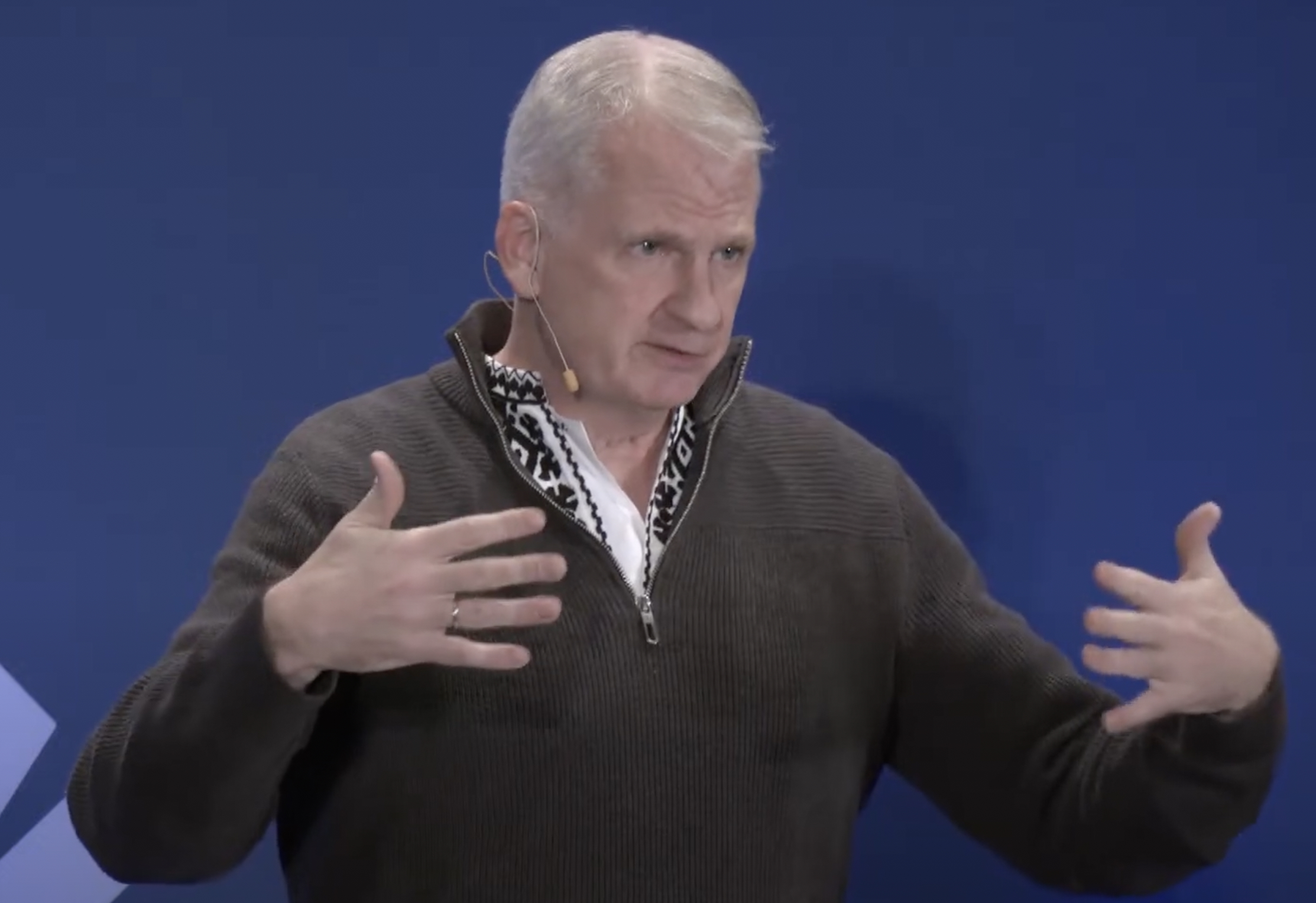
Dr. Timothy Snyder, an American professor of history at Yale, has been much in the news for deciding as “a scholar of fascism” to (variously) “flee,” “escape,” or “depart” the United States for Canada as “a prominent critic…of President Donald Trump.” That certainly sounds bad for the rest of us.
In truth he is on leave from Yale and will begin an appointment at University of Toronto this fall. “A spokesperson for Snyder said he made his decision for personal reasons, and he made it before the election,” Inside Higher Ed reported. In a statement to IHE Snyder said, “The opportunity came at a time when my spouse and I had to address some difficult family matters,” and that he had “no grievance with Yale, no desire to leave the U.S.”
Still, Snyder was asked by the New York Public Library to give the annual Robert B Silvers lecture on April 1, presumably for political symbolism as much as historical pertinence. His title was, “The New Paganism: A Framework for Understanding Our Politics.”
Promising to “deliver an argument too weird for the New York Review of Books,” where he is a longtime contributor, Snyder said he would speak of “the state of our political world,” not in “immediacies,” but with “a bigger argument about what is actually going on.” This includes the loss of rationality; why we seek pain in “negative sum games” (in which “everyone involved ends up being worse off”); and why there is “such a state of futurelessness.”
He hoped to “make the case…by reference to paganism,” specifically the pre-Christian Scandinavians who raided all the way to present-day Ukraine. He said the idea of three states of “nature” (umwelt, a personal experience of one’s environment), had developed in our time to have a “reverse Hegelian” twist, so that aspects of first and second nature have combined “to make something worse.”
First nature might be illustrated, he said, by imagining you were an eighth-century Scandinavian who had an unpredictable interaction with nature through early agriculture, hunting, and raiding. It also was a time of climate change. The Vikings were beginning to raid further afield. Everything in culture was affected, but the people were not changing nature much.
Second nature was modernity, recorded history, culture. This was our reality until recently, and in it we had more control of nature. “Not very many of us” engage in farming, Snyder said, and wild animals have “been pushed to the extreme margins.” The use of hydrocarbons, “the source of power of the industrial revolution,” “gives [that] sense of control.”
“The third nature is the period that we have now,” he said. It “brings together the exhaustion of the second nature and a kind of revival of the first in a more tedious, uninteresting way….”
This, he said, is what he means by “the new paganism.” Nature is not “screened off”; ours is the “nature of the screen itself.” We use hydrocarbons, “but we’re aware that [their] use…doesn’t allow us to control the earth.” Instead, it “involve[s] loss of control,” through climate change and being “addicted” to the digital, which starts in petrochemicals.
Within this third nature, Snyder said he is interested in five categories, the same ones Scandinavian raiders experienced in their time of flux, and which changed in second nature: language, the oracle, sacrifice, charisma, and value.
Language, back when Vikings were great, was celebratory, solemn, but not for control, Snyder said. “It’s the Christians who use [it], especially written language, for control.” More recently in history, literacy even permitted “the people” to use it for democratic purposes.
In our third nature, “it’s as if we’re returning to our pagan attitude….” Erosion of language now, due to digital interactions, creates both a general illiteracy (loss of vocabulary, eg) and a specialized illiteracy that makes it “harder and harder for most of us to read things we don’t want to read.” The kind of reading we might get from scrolling only “works,” he says, “if it’s in accord with things we already think.”
“I think we’re living in a world of the oracle,” just as the Vikings did, Snyder said. “An oracle is an invisible, or mostly invisible, obscure, hidden source of knowledge” that you know how to approach and interface with, but you do not know “deeply” how it works at all. It “sends you off to do things, and sometimes it works and sometimes it doesn’t….” Today’s algorithms do this to us, and their entire purpose is to keep us hooked, he said. “The best definition of your ‘phone’ [which is hardly a phone at all] is an oracle.”
In the pagan world, human and animal sacrifice was an attempt to control the future. The “loss of something of value…is what makes the process meaningful,” Snyder said. “In terms of our politics, in terms of our third nature…the dynamic where sacrifice makes things meaningful to us,” and the way rulers are judged “by how much things are sacrificed to them, is salient to the way things are going now.”
As an example, the Russian invasion of Ukraine (justified by Putin in part by reference to the Rus, the pagan Viking colonists, as a foundational Russian origin story) has cost Russia one million casualties, Snyder said. “I think you can only get to this level of destruction when you have a change in language, when you have a kind of oracle…and when you have a political dynamic of sacrifice.”
In the United States, Snyder said, sacrifice takes the form of “sado-populism,” a shift from the national story that “everyone is going to gain something,” to one in which pain plays a much larger role: “Who gets to hurt less? And who gets to watch other people hurt more?” Abducting graduate students on the street instead of emailing to say their visas have been revoked “is an entirely unnecessary act of terror,” a public performance that emphasizes someone’s suffering.
The American administration, destabilizing and unjustifiable in nearly all its actions, Snyder said, “at its depth comes down to hero worship”—of Putin, Musk, Trump—but in the end we are sacrificing ourselves, “our children, our grandchildren, the possibility of life on earth….”
Snyder paraphrased Newt Gingrich to explain how Trump is thought to have charisma: “Trump for his followers is like a hero out of a Viking saga.” Snyder added, “I believe that that is absolutely correct,” since charismatic leadership, as with the Vikings, does not have to be predictable to form a polity; it is a cult of personality and loyalties. “Predictable” comes with leadership in post-charismatic eras that is empowered by norms and institutions, such as the rule of law. What we are seeing now, he said, is the reversal of that process. Trump’s charisma lies in part in his ability “to take institutions and make…them disappear.”
In terms of value in third nature, Snyder said, enlightenment values have been stripped of humanity (“What might be good?; what might be a future worth having?”) and reduced to a rationality of means and ends.
“Efficiency more and more means, ‘My ability to use you for my purposes,’” Snyder said.
“With that ideology has come terms like free market, and even free speech, which have pushed aside the question of what would actually be good for us, what the virtues might actually be.” One of the virtues being disappeared in the digital age, predating this administration, Snyder said, is humanism itself.
“It helps to have the humanities…the social sciences, and the sciences,” Snyder said. DOGE freezes funds and dismantles agencies, and the administration goes after universities and other institutions.
He wished his audience some sense of joy at the end of his talk, despite its seriousness and occasion, “Because there is a joy in trying to understand difficult things, and we’re going to need to face the difficult things squarely but also…with a bit of joy behind our eyes.”