Lessons on How to Live a Second Life
A noted Canadian broadcast journalist decides to become a London cheesemonger.
January 30, 2026
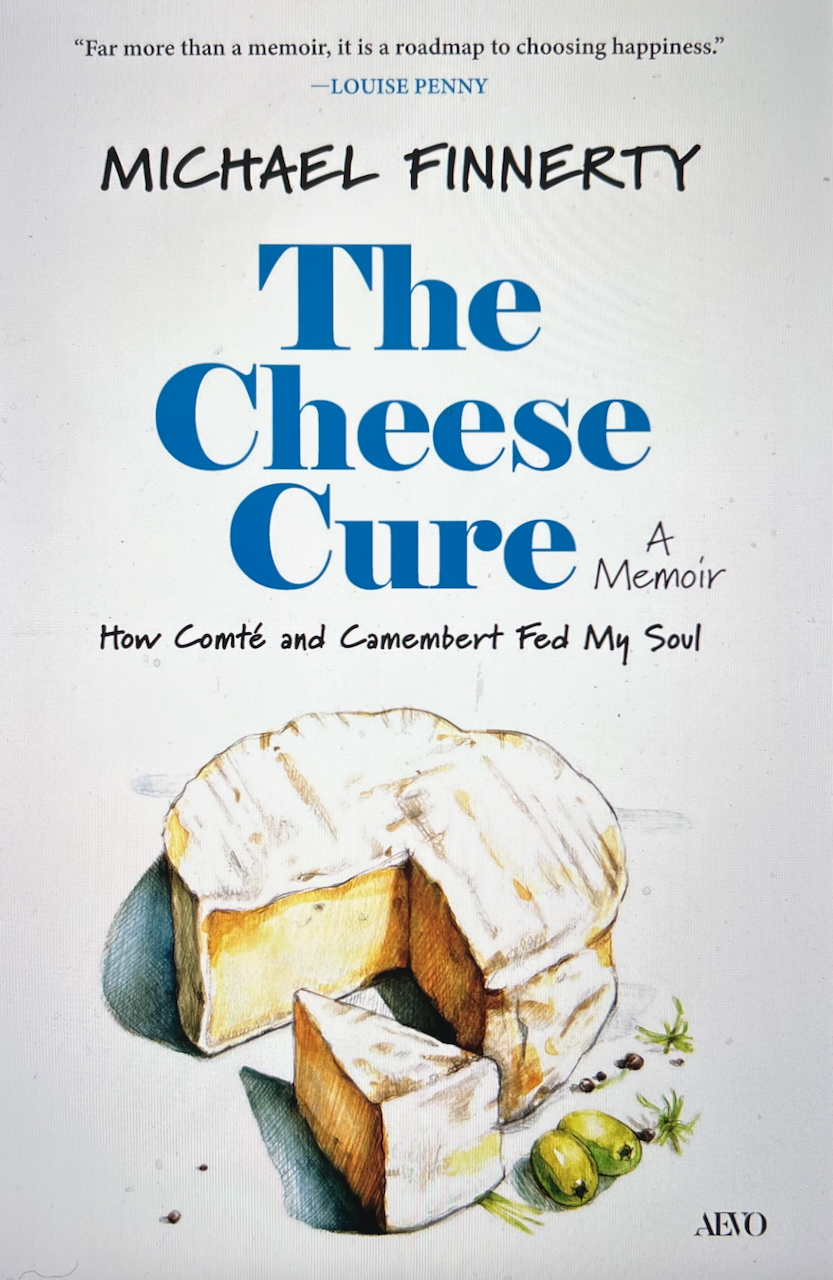
The Cheese Cure: How Comté and Camembert Fed My Soul
Food service is notoriously hard work—long hours on your feet, constant movement in tight quarters, heavy lifting, heat, cold, rush times with high volume, disagreeable customers, boredom, drudgery, exposure to industrial cleansers and filth, slippery surfaces, knives and other sharp or jagged edges—with many opportunities for discomfort, exhaustion, injury, infection, and indignity. I still have scars on my hands from my time as a dishwasher in a small-town, Midwestern diner, 45-plus years ago, and scars on my soul from the owner’s wife playing “New York, New York” eternally on the upright piano in the back room and singing along wistfully, “Start spreadin’ the news / I’m leavin’ today…. These vagabond shoes / Are longing to stray…. These little-town blues / Are meltin’ away….”
Why, one might wonder, beginning The Cheese Cure: How Comté and Camembert Fed My Soul, would a 53-year-old man abandon his life and stable career, move to another continent, and take a job in a food stall in an outdoor market? This memoir is Michael Finnerty’s answer to that question and a tribute to what he gained in doing so. I expected the book to be about a relatively low-stakes gamble: trading, say, a low-level, dead-end desk job for a bit less income but a lot more interest. But that is not the story.
The book is of a genre made for reader-foodies who love the idea of the adventure but can take satisfaction in learning its difficulties from a safe distance.
In 2019 Finnerty thinks hard about his longtime employment in Canada. “And, like so many people around the world, in all sorts of jobs—careers they worked so hard to find, careers their families made great sacrifices for, jobs taken by necessity, jobs that feel like (and maybe genuinely are) the only option—like so many people before me toiling day after day, I think: ‘What exactly is the point?’” (40-1)
He considers what he views as his limited options and eventually decides to move from Canada to take a job as a cheesemonger in the ancient Borough Market in London, a job that requires not just the hard work of food service mixed with retail, but also knowledge equivalent to that of a sommelier’s. He portrays his learning curve there well, especially the drudgery and finickiness of training and actually doing the job. The book is of a genre made for reader-foodies who love the idea of the adventure but can take satisfaction in learning its difficulties from a safe distance. (The genre includes Anthony Bourdain’s work, films such as Burnt, streaming shows such as The Bear, and the film cum series Boiling Point.)
The author says that in applying from an ad for the cheese-stall job, he went searching for reality. He found it, in lifting 90-pound wheels of Beaufort, washing display surfaces with the protein-stripping chemical Topax, squeegeeing floors dry, doing “the cleaning, the scrubbing, the sweeping…the bleaching…clean[ing] the chemical crate and the black bucket… wash[ing] the fridge doors… clean[ing] the basement and the toilet…moving large tables, climbing ladders, moving boxes…manipulating slates [on which cheese is displayed], cutting down through the thick pastes of Cheddars and Alpine chesses with both hands on a knife…rearranging the furniture” (118-19, 130), collecting and counting mouse droppings, talking to customers, attempting the artful, persnickety wrapping of oddly-shaped cheese portions, and walking through nearly 12-hour days. It is work he hopes “will ground me,” he says in his job interview. (94)
As time passes (probation is three months) he comes to know the stall’s processes (everything from closing-time hygiene to running the cash register), rituals (a cow bell is rung when a cheese is cut to a customer’s precise measure), and personalities including his managers, coworkers, customers, and fellow market vendors.
The most interesting parts of the book as it exists are about the cheeses themselves, living beings that arrive from different origins, have different histories, myths, and characters, and yet are ever-changing. Finnerty learns, e.g., how cheeses “like…to spend the night”:
“[T]he Castillon Frais needs to sit in its box unwrapped, underneath some waxed paper but its box needs to be kept in a plastic sheath. Also, it can’t be on an upper shelf too close to the refrigeration fan. Brie de Meaux and Munster stay wrapped in cellophane, but the Brie is under a layer of straw on a top shelf, Munster is in a cardboard box on a lower shelf. Comté sits unwrapped in a cool cupboard, about 10 to 12 [degrees Celsius], and has a quick saline bath before bed. Reblochon needs wrapping in paper, middle shelf, cardboard box. I could go on. Oh, and sometimes they need to have a change of routine depending on how they are feeling, for instance, the Tomme de Chambrouze is mostly kept wrapped in paper but if it’s too moist, wet even, it will want a night unwrapped but lightly covered over. They make Mariah Carey’s rider calling for tall, leafy plants in her dressing room look amateur.” (136)
The tone of the writing often matches Finnerty’s experiences and learning process.
“Munster [not the same as American Muenster cheese] has such an assertive aroma,” he writes, “that it can have a strange effect. Sometimes, when the Munster has been put out unwrapped without me realizing, I can spend half an hour trying to determine who has forgotten to brush their teeth to the point of having such noticeable halitosis. Terrible to have your faith in colleagues shaken like that. […] If you’re looking for an explanation as to why washed-rind cheeses smell like some of the lesser attended-to nooks and crannies of our bodies, or like used socks, it’s due to bacteria, specifically Brevibacterium linens, or Brevibacterium aurantiacum. There is some debate. In any case, they’re harmless and live also on our skin, with a particular fondness for feet.” (46)
The most interesting parts of the book as it exists are about the cheeses themselves, living beings that arrive from different origins, have different histories, myths, and characters, and yet are ever-changing. Finnerty learns, e.g., how cheeses “like…to spend the night.”
Another cheese the stall sells is called “1924,” “a blend of sheep’s and cow’s milk and that means you get a buttery and creamy texture together (Roquefort plus Stilton’s ‘baby’). En bouche [in the mouth], it’s a full-spectrum, umami headrush. It’s salt-forward with a hint of pan-drippings as from a Sunday roast, but the thing that cuts through above all others is a rich mushroom-y flavour. Imagine the earthiest, most lip-smacking mushrooms you’ve ever tasted. That’s what this cheese was packing. To top it all off, it had a singular line of sweetness reminiscent of an Oreo cookie. It was an absolute whammy of a cheese.” (35)
Finnerty’s time on the job provides new metaphors with which to think, such as how he was “sour” in his old life, like certain cheeses, and how his new friends’ personalities match cheeses they sell and often prefer as personal favorites, as if in self-recognition.
“Then there’s a cheese like Sainte-Maure which is constantly throwing curveballs at you for no obvious reason,” he says. “It feels random or worse, spiteful. Sainte-Maure is one of my cheese frenemies. Cheese history tells that the Arab Saracens in the eighth century instructed their captors in how to make it. It is steeped in warfare and deceit.” (122)
“One of the most exciting things about being a cheesemonger is discovery,” he writes (7), an act that he ties to building community and a better understanding of the self and world. These are the wins of his gamble.
The book has longish sections on the effect of the COVID pandemic in his trade, his employment in a high-end London restaurant before he started in as a cheesemonger, and the panic in the market when there is a stabbing attack nearby. These could be dramatized more efficiently and do not fulfill the title’s two promises: cheese and how it saved his soul.
There is another book lurking within this one; what has been left out calls attention to itself. As someone who, like Finnerty, has been lucky or privileged or hard-headed enough to change careers, more than once, I am interested in the particulars of how others manage it, especially when the move is in the direction of living more consciously and purposefully. If readers are to be convinced, say, of the hope for personal agency and positive—even revolutionary—change, the path must be illuminated.
This memoir is not for those particulars. Hardly discussed are the tools needed to change one’s life, as Finnerty does, even if one hopes to simplify it. These tools include money, contacts (the book’s acknowledgements are four pages long), education (he lived for a year with a French host family as a secondary student, and fluency in French proves to be key to his success selling to French nationals in England, which his managers notice and value), and other markers of class and privilege. What is portrayed is Finnerty’s stress and anxiety over not having enough money, whatever that figure is.
In fact, it is only in “Part II” of the book, after a couple of dozen pages, that we learn Finnerty worked for decades as a researcher and reporter, including at The Guardian, and as an international producer at the BBC World Service. He has been near the top of his field (and no doubt compensated accordingly) for 13 years with his own daily morning show at the Canadian Broadcasting Corporation (CBC) in Montreal, when he has his crisis, after going to the movies on a rare day off.
“That stunned Friday-afternoon cinema session leads to an uncomfortable weekend for me. I start to get a pain in the pit of my stomach. I would say butterflies, but it feels more intense. I even feel like I might be sick. If my job as a well-paid, well-regarded radio presenter is robbing me of joy, what am I going to do about it, quit? […] Hell, my face is on billboards and on the side of CBC trucks. What would I do without the presenter’s chair?” (41)
The delay in telling us parallels his not telling his new employer of his ongoing media career in Canada, and that he is only on sabbatical and intends to leave after he has been trained, painstakingly, leaving the business in a hard spot for the holidays, their main money-making time.
Finnerty had also already lived and worked for years in London, and he knew many people there professionally and socially, with whom he reconnects.
“After a few caipirinhas, when I announce…that I am learning to be a cheesemonger, a chorus of friends shouts out ‘Part-time!’, and everyone bursts out laughing. This is a battle I am not going to win in this particular venue. Most of the people at the party went to extraordinary lengths to end up in London and fought their way to getting good, or just decent jobs. They cannot understand why a well-paid journalist would take up a service sector position by choice, working weekends, making less money. One of them tells the story of coming to meet me as I was closing one evening only to find me scrubbing tables and cleaning the floor in a pair of wellington boots. The story has now gone beyond laughter and a look of concern ripples through the faces listening. This is not what success looks like to them, and it is definitely not glamorous. It is a puzzling evolution to a privileged life, eccentric to say the least, possibly unstable.” (282)
He says he had “stretched [his] life’s savings in 1999 and managed to grasp a rung of the [real estate] ladder before prices really exploded,” buying a “cosy ex-council flat in Southwark, a stone’s throw from Borough Tube station,” which he has been using as additional income. When renters vacate his London flat, he is able to live there for his sabbatical and self-search. He also mentions a partner of decades, once, in passing, whom he says in the acknowledgements provides him “the perfect desk” and a “lush garden.”
In terms of “finding one’s joy,” as the positivity movement puts it, how much does this delayed or lurking information about Finnerty’s gamble deflate the book’s promise (“the cure”) for average readers, who might find it difficult to jump from situations due to debt, responsibility to others, disability, or lack of tools?
I suppose my reaction to Finnerty’s personal drama might not have been as strong as it was if he had found his bliss and settled into it. Instead, later chapters include more soul-searching when he does go back to Canada to his old life, after lying by omission when he gives notice to his cheese business manager: “There’s just a bunch of things I have to take care of in Montreal.”
Having “taken the cure,” things go better at the CBC for a time, but his “passion for [the job] continues to wither.” (206) He decides he will quit and go all-in on cheesemongering.
“Leaving definitively is being made possible, should I choose to,” he writes, “by changes I make thanks to lessons learnt over the past year. Gone are many of the luxuries of my former life. Applying mongering budgetary rules now to my presenter’s pay [of a few months] allows me to amass a war chest. It’ll be enough to buy me a couple of years to figure out how to make everything work out. I eat out hardly at all. Coffees are made at home. I keep to my recent, voracious reading habit, meaning my entertainment bill is cut.” (208) This nearly made me spit out my homemade coffee.
In terms of “finding one’s joy,” as the positivity movement puts it, how much does this delayed or lurking information about Finnerty’s gamble deflate the book’s promise (“the cure”) for average readers, who might find it difficult to jump from situations due to debt, responsibility to others, disability, or lack of tools?
He does quit his radio show, in tears, and returns to the cheese stall but begins to hate that too after being asked to serve as a manager. “I have been reintroduced to a person I do not like, myself, under stress and in charge,” he says. (266)
In the end, he finds satisfaction in the balance of a “bi-continental” life, commuting between cheese-selling in London through the winter and a weekly radio essay at the CBC in Montreal the rest of the time. Both jobs are without managerial duties—the actual thing that had been causing him stress, he has learned. Most of us would see this as an early and very fortunate semi-retirement.
I ate a lot more cheese than usual while reading this book, which is testament to Finnerty’s passion for the subject and his ability to sell it on the page and verbally in the market. While reading through New Year’s, I realized I still had half a dozen leftover bits of different cheeses I found before Christmas in a supermarket in Metro East St. Louis, including a Gruyère of some kind, a cheapish brie, a nice cranberry cheddar, and something that approximated Finnerty’s frenemy, the “flavor-forward” Sainte-Maure, a French goat’s cheese. Mine had lost its label, so I cannot say exactly what it was.
“I once built an entire evening around a jar of jalapeño chili jam and a popping Sainte-Maure, just the three of us,” Finnerty writes. “So much pleasure.” (123)
Sometimes we must work with what we have. Late one night I put my mystery cheese on a table water cracker with some gifted jalapeño jam from The Family Garden of New Douglas, Illinois. It was utterly delicious, and a pleasant, strong mustiness bloomed in my nasal passages as I climbed the stairs to get back in bed during the snowstorm. I already have my preferred employment, but I could dream of London, which is lovely at the holidays.