Devotion to Authenticity
November 7, 2025
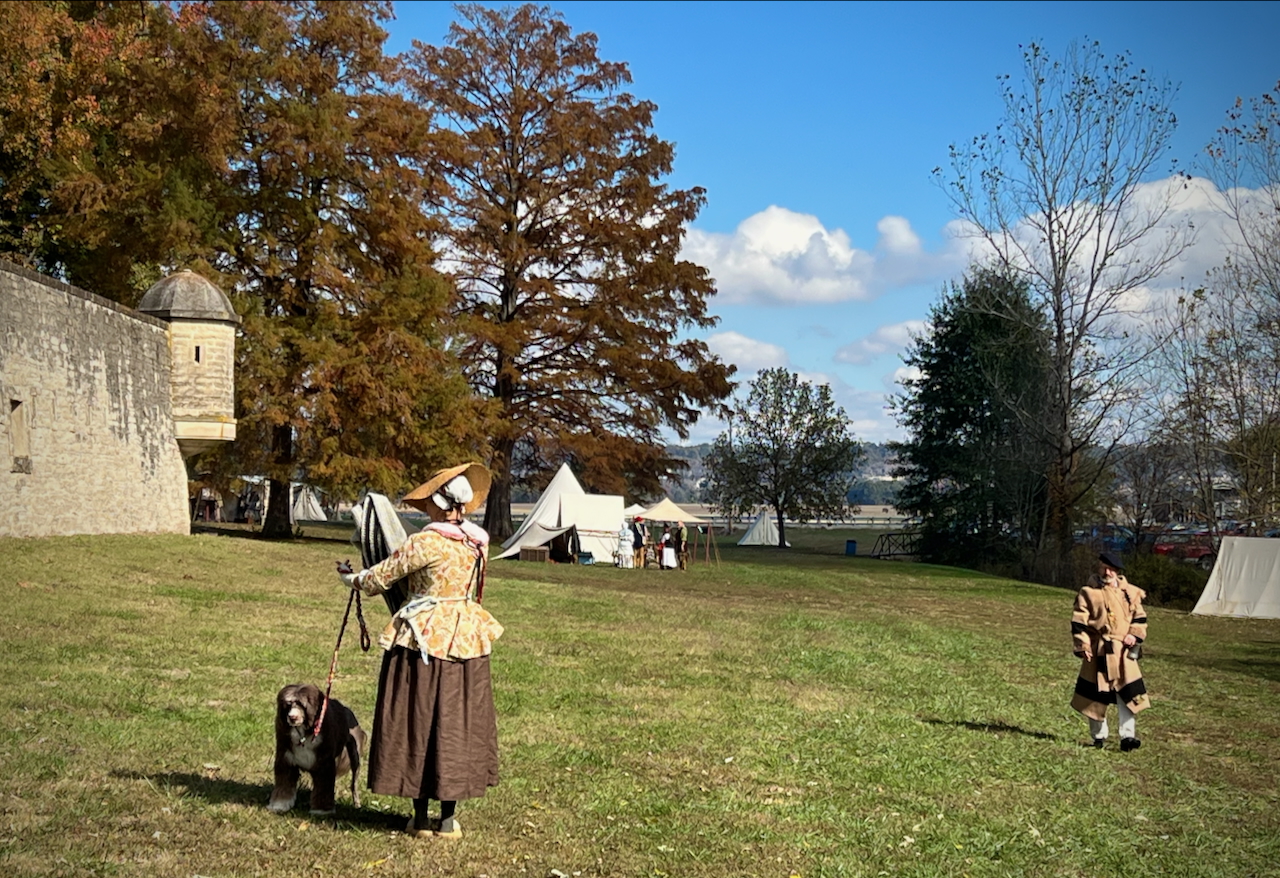
Fort de Chartres (pronounced “Fort Charters,” as Cairo, Illinois, is “Care-oh” and New Madrid, Missouri, is “New Mad-rid”) is a reconstructed French colonial fort, in Illinois, 40 miles due south of the St. Louis Arch. It was built in its durable form in 1753 to govern and house soldiers for Upper Louisiana, the region of New France between the Great Lakes and the Arkansas River.
The massive limestone fort was the last French post to surrender to the British at the end of the French and Indian War. But it was built on a floodplain, so the Mississippi River ruined it in 1772, seven years after the Brits had taken up residence, and it was never used again.
The last time I was there—no, Rory, not during the Treaty of Paris—I might have been six years old. Most of the physical reconstruction was yet to be done, but I treasure memories of tomahawk-throwing on the property, sitting in a voyageur canoe, and watching costumed troops drill. In some way I am still trying to unpack, it helped set up my young mind to think of this part of the Midwest as perpetually colonial and the West as something for the future.
The Fort hosts two “rendezvous” each year. At the bigger one, during the first weekend in June, there are “shooting competitions, military drills, dancing, music, food, and traders of eighteenth-century-style goods. The boom of cannons, the smell of campfires and a parade of colorful uniforms…transport visitors back to the 1700s….”
Last weekend the smaller Winter Rendezvous took place. It was a quieter affair. Dozens, not hundreds, of people were walking around in period costumes or uniforms. White canvas tents and tipis had been set up on two sides of the fort, and some of their occupants sat at campfires, talking under the brilliant leaves in the first really cool days of fall. I was reminded of a Facebook friend who has been a reenactor, on and off, for decades and had brought his wife and then two small boys into the lifestyle too. In their case, it seemed to have drawn the family closer.
“Well, I needed a time period,” a woman at a campfire said to her friends as we passed. “It would be about 1790,” she said, which to her determined a 30-year historical window, as well as the foundations for her reenactor back-story, costume, and activities while at camp.
Inside the walls of the fort, some of the “soldiers” passed on the parade ground in kilts, knee socks, and hats that now look comical. Having spent considerable time in my life sleeping outdoors, I could tell how deep their devotion to authenticity ran. They looked a little dirty and had puffy faces as if they had not slept well.
A short row of tent-shops on the path from the fort’s main gate sold pewter buttons and pins, brand new tomahawks, wrought-iron implements, period costumes sewn in wool and linen, and little whistles, candles, and sweets. The weather was cool enough that the pewter shop had several space heaters running, despite having only three sides.
In the shop next door, a young bride in a linen shift and bonnet was talking to the more seasoned proprietors about freezing through the night in her and her husband’s tent. The older woman told her that getting a long sheet of canvas and hanging it over the bed was key—Life-changing, really, you won’t believe the difference it makes—because it helped block drafts and trap body heat. The younger woman said her husband did not like to feel constrained while he slept. She left it at that, but the implication was that that would not be happening. The older woman smiled, but her face implied she knew something about devotion the younger woman would learn in good time.