And Why Not Look for Mermaids?
September 25, 2025
Carl Linnaeus organized nature for us. Sweden’s chief royal physician, he became the “father of modern taxonomy,” traveling the world classifying and naming its plants and animals. The man was famously logical, methodical, orderly, rational.
And he was desperate for the Royal Swedish Academy of Sciences to organize a hunt for mermaids.
Was it the thrill of hybrid beauty? A quirky fascination with shimmery scales, juxtaposed with soft flesh? A simple refusal to leave any chance untested? Whatever his compulsion, Linnaeus wrote to the Academy in 1749, solemnly introducing “a matter of great scientific curiosity, concerning the elusive creature known as the mermaid.” He said he had “received reports from credible sources regarding sightings of such beings along the Swedish coastline”—which sounded firsthand and scientific but turned out to be a handful of newspaper articles. “I believe it is imperative,” he wrote, “that the Academy launch an expedition to investigate their existence.”
He was one of the founding members of the Academy and had been its first president. Yet on the basis of a few newspaper articles, he was urging a costly, whimsical expedition, convinced it could “not only advance our understanding of the natural world but also bring great prestige to our nation.” While he acknowledged that “many may dismiss the mermaid as a mere fable,” he noted that “should we succeed in capturing or preserving a specimen, it would represent a discovery of immense significance to the natural world.”
It was a different time, you will say, shrugging off his caprice. And it was a different time. The most sober intellectuals were caught up in accounts of merpeople and other strange and wondrous clues to a natural world we think we have figured out. Cotton Mather wrote to the Royal Society of London in 1716, admitting that he had never believed in merpeople until he spoke with “three honest and credible men, coming in a boat from Bilford to Brainford (Connecticut).” They had encountered a triton, they told Mather, and as the triton fled, “they had a full view of him and saw his head, and face, and neck, and shoulders, and arms, and elbows, and breast, and back all of a human shape….[his] lower parts were those of a fish, and colored like a mackerel.”
Ben Franklin printed an account of a sea monster in the May 6, 1736, edition of his Pennsylvania Gazette, “the upper part of whose Body was in the Shape and about the Bigness of a Boy of 12 Years old, with long black Hair; the lower Part resembled a Fish.” In 1769, a Providence newspaper quoted a captain, pilot, and thirty-two crew members of an English ship who all said they had watched “a sea monster, like a man” circle their ship and gaze for a long time at the beautiful female figurehead on their prow.
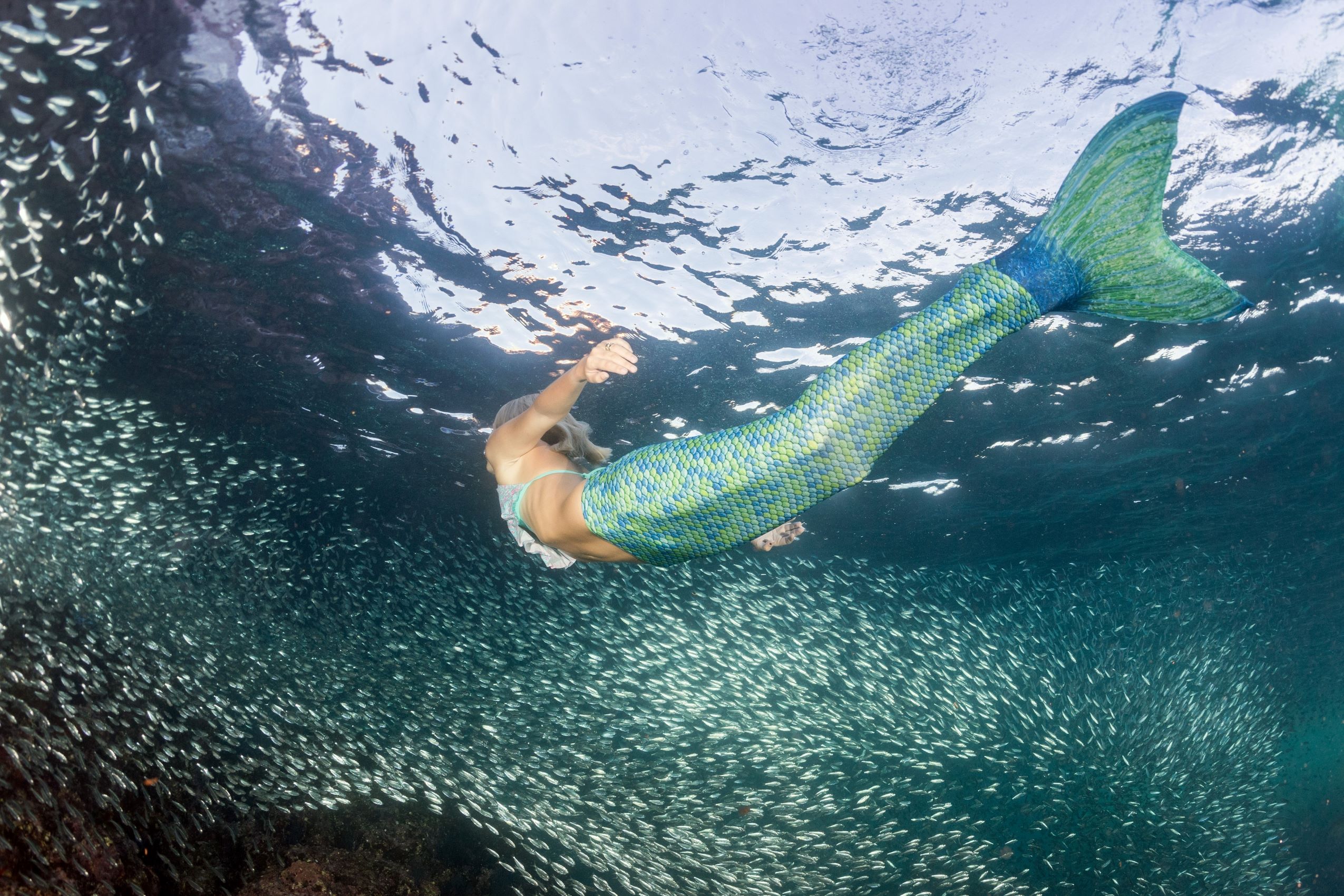
In 1759, Jacques-Fabien Gautier, a French printer famous for his ability to print accurate images of scientific subjects, drew “from life” a creature he had seen at the St. Germains fair: “about two feet long, alive, and very active, sporting about in the vessel of water in which it was kept with great seeming delight and agility.” The skin was “harsh, the ears very large, and the back-parts and tail were covered with scales.” Three centuries earlier, Columbus had reported seeing not one but three mermaids. He, too, had been sorely disappointed that they were not prettier. In lore, mermaids were often seductive, alluring, shapely, with long tresses and silky voices. In real life—what am I saying?! How easy it is to slide into this dim, underwater fantasy. Let me start again: In real-life accounts of purported sightings, the merpeople are not always lovely. A mermaid allegedly spotted near Indonesia in 1943 had the mouth of a carp, as did a mermaid reported on Japan’s Kai Island in 1949.
The Swedish Academy made at least a performative search for Linnaeus’s merpeople—and found no evidence. Undaunted, he and one of his students published a dissertation on the Siren lacertina, The Lizard Siren, in 1766. They listed many mermaid sightings, then many “marvelous animals and amphibians” that might have been confused with mermaids. These creatures were worthy of note, Linnaeus maintained, even though they messed up his neat classification system, because they suggested an ancient link between humans and amphibians.
There are contemporary scientists who agree, noting that if these hybrid creatures have been slippery enough to elude the nets of science, their existence supports an “aquatic ape theory,” with humans evolving from apes who lived by water. As transition, this makes some sense: our large sinus cavities would have helped keep us buoyant; we traded apelike body hair for subcutaneous fat that would keep us warmer in the water; our upright stance would have kept our heads above water; and women are said to smell fishy….
Who knows? The larger scientific consensus is that those who swore so persuasively that they had seen merpeople probably saw manatees, dugongs, seals—any aquatic animal with forelimbs that could look like arms and the ability to move their heads. At sea, all boundaries blur.
Yet merpeople refuse to be dismissed so crisply. They were mentioned in the Talmud. They swim through the folklore of many cultures, showing up as Scottish selkies or Hindu water-serpents or Chilean sea fairies. They have kept Disney afloat. In Israel, sightings of the “Mermaid of Kiryat Yam,” a girl with a dolphin tail who appears only at sunset, have been reported since 2009, when the mayor publicized her existence. Discovery has made two “documentaries” about mermaids, the second so persuasive that the U.S. National Oceanic and Atmospheric Administration (NOAA) felt obliged to issue a statement in 2013: “No evidence of aquatic humanoids has ever been found. Why, then, do they occupy the collective unconscious of nearly all seafaring peoples? That’s a question best left to historians, philosophers, and anthropologists.”
The publicity stunts and box-office lures are easy to dismiss—but why do they work? What is it about a creature half human, half fish, that so intrigues us? The simple fun of wondering? The liminality? Our bodies’ limits sometimes bore us. Imagine the chance to be that graceful underwater, free of rubber suits and hoses. Grafting our humanity onto other creatures has always tempted us—look at centaurs, minotaurs, satyrs, sphinxes. They prove possibility. And they remind us how mysterious and wild the world is, how nature defies even Linnaeus’s tight compartments.
Read more by Jeannette Cooperman here.