The Second Life of African Art in Western Preserves
By Tolu Daniel
November 29, 2025
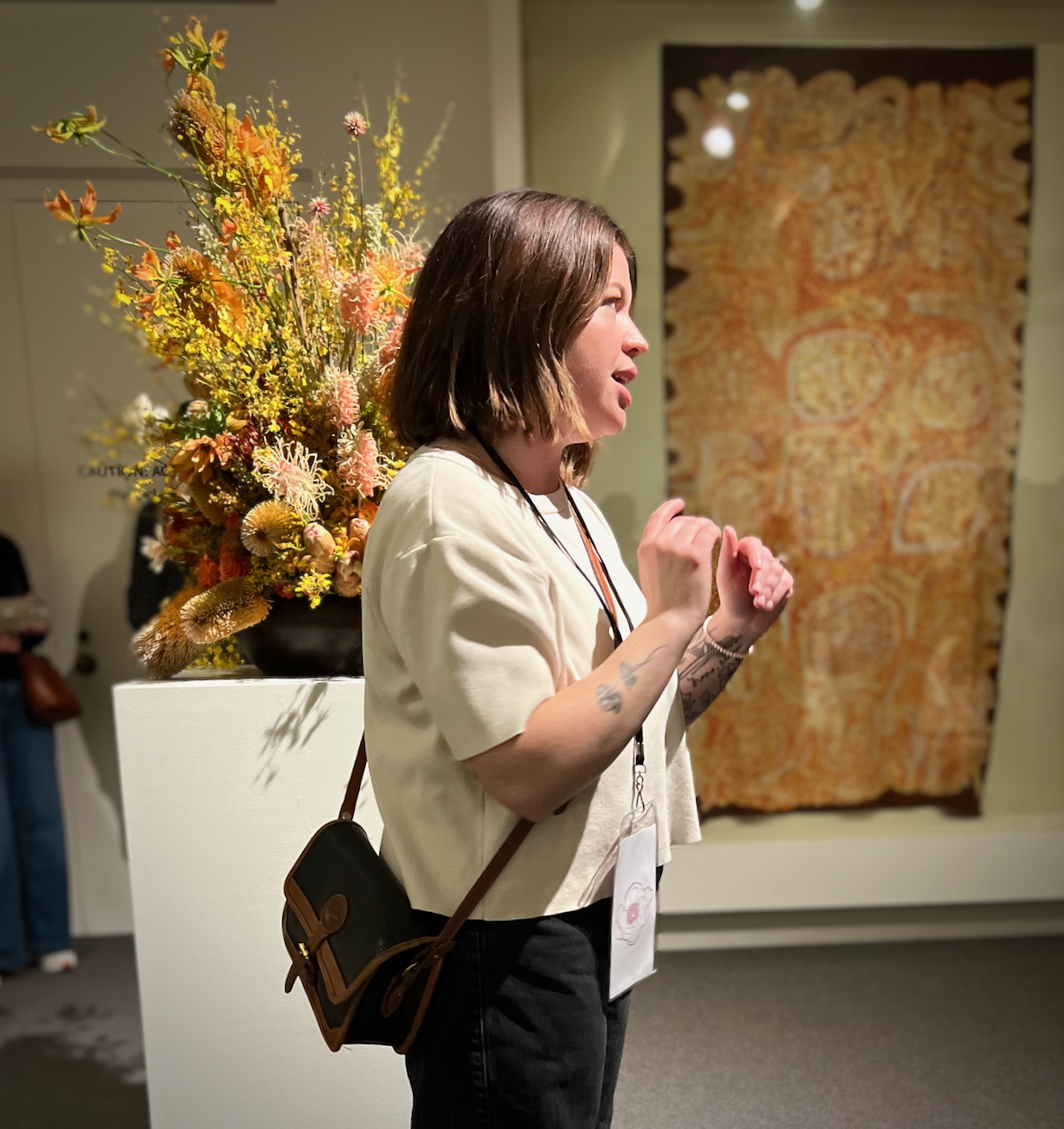
I went to the Saint Louis Art Museum on a cold, indifferent April afternoon a few years ago. I had gone for an event, one of those communal gatherings that promise art, small talk, and a brief reprieve from the demands of graduate life. Yet what stayed with me long after the event ended was not the polite conversations or the curated activities, but the museum itself. The complicated choreography of its halls, the silent hierarchy of its displays, the peculiar feeling of being both visitor and subject. Before my arrival, a friend who had visited the museum earlier texted me with a kind of excited disquiet after I informed him of my plan to visit.
“There’s an exhibition on African art, mostly West African. You should see it.”
I made a mental note to find the exhibition later. On arrival, I walked through the museum in a deliberate drift. I had visited before, each time with others, often with a date or a classmate, often passing the time in a kind of lazy languishing that did not invite any deliberate contemplation of what I was looking at. The architecture itself felt like an invitation to a slow unraveling. One gallery opened into another with a kind of stately ease—European portraits with their powdered solemnity, East Asian ceramics with their precise grace, enormous tapestries from centuries ago depicting mythologies foreign to me. The museum was, in many ways, a map of the world as told by those who had the power to record, preserve, and designate its worth. And yet, everywhere I turned, I felt something tugging at the edge of my consciousness: a kind of awareness of what it means to be inside an institution that long preceded me.
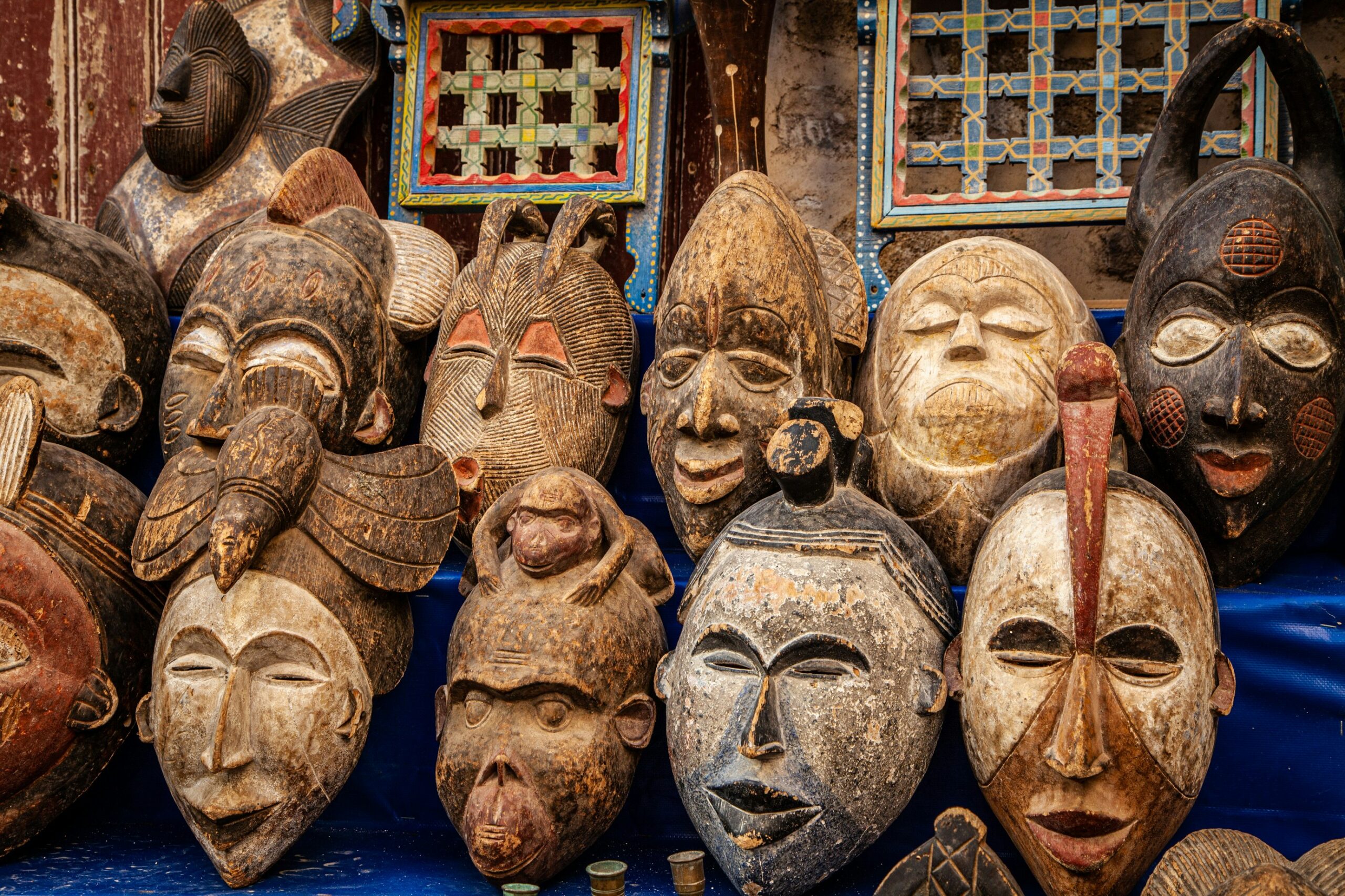
Still, there was pleasure in the wandering. In one hall I stopped before a Renaissance painting, its colors impossibly preserved, its subject impossibly pale, and considered the elaborate brushwork that had survived the centuries. In another, a room of Native American artifacts drew me in with its intricate beadwork and ceremonial regalia. I found myself learning, unlearning, relearning. Museums demand a certain posture of humility, but also of suspicion. You must let yourself be taught while simultaneously interrogating the terms of that education. When I finally entered the gallery dedicated to the African art exhibition, something in me shifted. The room was dimmer than the others, the lighting more dramatic, as though the works required theatricality to signify their importance. In glass cases sat sculptures with elongated bodies, faces carved with sophisticated precision. Masks stared back with quiet authority. Textiles hung on the walls, indigo-dyed, earth-toned, patterned with the visual languages of the Yoruba, Akan, Dogon, Mende peoples. These were objects whose aesthetic logic I instinctively recognized, even if the specific histories were not always mine.
Museums demand a certain posture of humility, but also of suspicion. You must let yourself be taught while simultaneously interrogating the terms of that education.
Yet amid the fascination, there was something else. Because where every other gallery displayed the names of the creators, Monet, Degas, Hasegawa, Rivera, even anonymous medieval artisans with at least a locational attribution, here, the plaques told a different story. “Artist unknown.” “19th century.” “Yoruba peoples.” “Collected by [Name of Patron].” The patterns became predictable: the artist erased, the patron foregrounded; the culture generalized, the donor immortalized. If the rest of the museum felt like a conversation with identifiable voices, this room felt like a hall of whispers, voices deliberately muted, histories intentionally anonymized. What I saw there was not simply the absence of names but an architecture of disappearance. The labels told me nothing about the individuals whose hands had shaped the wood, woven the raffia, forged the bronze. Instead, what was foregrounded were the collectors, the patrons whose generosity to the museum now eclipsed the very people who made the art possible. It struck me, standing there, how easily anonymity becomes a kind of violence. How to be African in the modern museum is to be visible and erased all at once, to be represented through the objects of your ancestors while having their identities stripped away.
I stood before a Yoruba mask whose craftsmanship reminded me of the carved doors in old palaces at Ake in Abeokuta, and yet the plaque refused to name the artist. Instead, it carried in bold font: Gift of the So-and-So Foundation Collection. The museum had inadvertently staged a scene in which the African artist existed only insofar as they contributed to the cultural capital of western collectors. As I moved from piece to piece, I found myself thinking about what it means to be rendered anonymous within institutions that claim to celebrate global artistic heritage. It echoed something the poet Romeo Oriogun once told me during one of our long conversations about poetry: that the history of all poetry is rooted in orature, in the voices of anonymous singers and storytellers whose contributions were later transcribed and canonized, often by those outside the tradition. The irony, of course, is that while world literature is comfortable tracing its origins to Homer or Virgil or Dante, it resists acknowledging the African griots, the praise singers, the storytellers, the custodians of ancestral memory who formed entire civilizations of art without ever requiring the validation of the western archive.
The exhibition reminded me of that tension: the way African creativity is foundational and yet relegated; indispensable and yet uncredited. The museum celebrated the aesthetic value of the works but refused their authors the dignity of recognition. It reproduced the colonial gesture of extraction: take the object, extract the beauty, display the cultural capital, but leave the maker behind. I kept thinking: What does it mean to be African in a world where your artistic lineage is preserved but your name is not? What does it mean to walk through a prestigious institution and see your ancestors’ genius framed as anonymous craft rather than authored art? What does it mean that your culture’s artistic languages are deemed universal, but the people who spoke those languages are disappeared into communal labels like “Benin peoples,” “Ashanti peoples,” “Igbo peoples”?
It is a peculiar ache, this duality of presence and erasure.
As I lingered in the space, I began paying closer attention not merely to the objects but to the curatorial language surrounding them. Museums are, after all, not neutral spaces. They are cultural scripts, carefully composed to guide the visitor’s understanding of value, significance, and authorship. Every line on a wall label is intentional, what is included, what is excluded, what is emphasized, what is concealed. In the European galleries, the language was specific, reverential, almost biographical. “Painted during the artist’s late period as he grappled with personal grief.” “Completed after the artist’s relocation to Venice.” “Restored in 1997 to preserve the original pigments.” Entire lifetimes were distilled into the text.
Where every other gallery displayed the names of the creators, Monet, Degas, Hasegawa, Rivera, even anonymous medieval artisans with at least a locational attribution, here, the plaques told a different story. “Artist unknown.” “19th century.” “Yoruba peoples.” “Collected by [Name of Patron].”
But in the African gallery, the biographical fell away. What remained were vague ethnographic gestures. “Used in ceremonial contexts.” “Representative of funerary traditions.” “From the Ijebu peoples.” The language shifted from the individual to the collective, from the maker to the abstracted community. The implication was subtle but unmistakable: African art was not “art” in the individualized, auteur-driven sense that European art was framed; it was artifact, cultural expression, remnant. Its value lay not in the personality of its creator, but in its supposed “function” within a generalized community. This is the violence that Saidiya Hartman describes when she speaks about the limits of the archive, the way the architecture of documentation is shaped by the power of those who record, not those who are recorded. The African artist becomes, in Hartman’s terms, irrecoverable, not because they did not exist, but because the mechanisms that could have preserved their names refused to recognize them as subjects worthy of preservation. Anonymity here is not accidental; it is engineered.
And yet, I found myself grappling with the complicated truth that many of these traditions did not historically prioritize individual authorship. Some masks were indeed carved by guilds, some textiles woven collectively, some bronzes cast in workshops that passed techniques from generation to generation. But even this fact is often mobilized irresponsibly. Museums flatten it into an excuse: the artists were communal, therefore anonymity is “natural,” they insist when queried. But this rationalization ignores the fact that many artisans did sign their works, many were known by name in their communities, and many others would have been documented if the circumstances of colonial extraction had not intervened. The issue is not communal authorship; it is the refusal of western institutions to search for authorship when it concerns African works, even when the archival trails exist in oral or local histories. I remember standing before a Benin bronze plaque, its surface shimmering under the museum lights. This was not folk art; this was court art—highly skilled, meticulously crafted, produced by artisans working under royal patronage. These bronzes, many of them looted during the 1897 British Punitive Expedition, were never anonymous in their home context. The guilds that made them were renowned. The sculptors were professionals. Their names, had they been recorded, would stand alongside artists from Renaissance Italy in any fair history of global art. Yet in this museum, their authorship was collapsed into a single line: “Benin peoples.” There is a kind of mourning that accompanies such encounters. Not only for the individuals whose names have been lost, but for the epistemologies that sustained them, ways of remembering, ways of recording, ways of honoring, that did not survive colonialism’s appetite for extraction. And I felt, acutely, that the museum was not merely preserving African objects; it was preserving the narrative of African anonymity.
As I moved through the gallery, I began thinking about the broader implications of this for African identity itself. What does it mean for an entire continent to be situated within the western imagination as a place of nameless creativity? To be African, in these institutional contexts, is to be constructed as a cultural producer without a biography, a civilization without credited architects. It reminds me of that portion from James Baldwin’s essay Stranger in the Village, where he writes, “These people cannot be, from the point of view of power, strangers anywhere in the world; they have made the modern world, in effect, even if they do not know it. The most illiterate among them is related, in a way that I am not, to Dante, Shakespeare, Michelangelo, Aeschylus, Da Vinci, Rembrandt, and Racine; the cathedral at Chartres says something to them which it cannot say to me, as indeed would New York’s Empire State Building, should anyone here ever see it. Out of their hymns and dances come Beethoven and Bach. Go back a few centuries and they are in their full glory—but I am in Africa, watching the conquerors arrive.” The African subject then becomes only a passive character in the making of the modern world. Yet for those who refuse to take history at its own words, and can read against the grain, we know that the continent is more than how it is presented. It is not only heritage, but also history. Heritage is collective, aesthetic, performative. It is something you inherit. Whereas history, on the other hand, is authored, linear, personal. It is something you produce. Museums often allow Africans the former but not the latter. Our art is heritage; European art is history. Our works are culture; theirs are achievements.
This distinction shaped something in me as I walked through the space: the realization that the museum was not simply representing African art, it was representing Africa’s imagined place in the world. And that place, historically, has been one of erasure disguised as inclusion. I kept returning to what Oriogun had said about poetry. The idea that the greatest works of world literature were once oral and fluid. That the line between the “anonymous singer” and the “named poet” is a matter of who held the power to record, publish, and canonize. It reminded me that anonymity is not inherently degrading, indeed, many traditions embrace communal authorship as a form of shared identity. The problem arises when anonymity is imposed, not chosen; when it becomes a mechanism of depriving individuals of recognition, or worse, of suggesting that they had no individuality to begin with.
The African exhibit embodied this imposed anonymity. It declared, implicitly, that African creativity was premodern, tribal, functional, outside the western paradigm of the named artist-genius. These objects were preserved, yes, but their makers were denied personhood within the museum’s narrative. And that denial follows Africans even now. It is the same logic that renders African writers peripheral in global conversations about literary innovation unless they are validated by western institutions. It is the same logic that frames African music as rhythmic but not intellectual, African fashion as exotic but not avant-garde, African philosophy as mythic but not rigorous. It is the long shadow of a world that can appreciate African creation but not African creators.
When eventually, I walked out of the gallery, I felt the familiar dissonance of diaspora life, the constant negotiation between pride and discomfort, between the joy of seeing my culture represented and the grief of realizing how incomplete that representation is. In the lobby, I found myself strangely disoriented. I had entered the museum expecting a pleasant cultural outing; I had arrived instead at an encounter with the afterlives of colonialism, the ethics of display, and the precarious position of African subjecthood in western institutions. The contrast between the lively crowd chattering over wine and the quiet ache still ringing in my chest was almost surreal. I felt as though I had glimpsed something underneath the polished surfaces of the museum, an undercurrent of disavowed histories. Perhaps what unsettled me most was the realization that the museum’s approach to African art mirrors the broader diaspora experience: to be African abroad is to be visible and invisible in the same breath. To be celebrated for your cultural contribution while simultaneously being flattened into a singular identity. To be asked to speak for an entire continent even as your individual story is overlooked. The museum’s African gallery was not merely a room, it was a metaphor for the place Africans occupy in global narratives.
I kept thinking: What does it mean to be African in a world where your artistic lineage is preserved but your name is not? What does it mean to walk through a prestigious institution and see your ancestors’ genius framed as anonymous craft rather than authored art?
At the end of the evening, just before I returned home, I watched as other guests began drifting towards the exit, I let the conversations around me dissolve into a low hum. I found myself staring at the tall iron doors that opened onto the museum’s vast front steps. People were filing out in slow procession: a couple holding hands, a mother bending down to zip her child’s jacket, an elderly man pausing to examine a brochure he’d tucked into his pocket. Ordinary departures. But something in me lingered, unwilling to return into the world just yet. I realized I was not only carrying the weight of what I had seen but also the weight of what the museum had not shown me. The African gallery had narrated a story of collective beauty and cultural richness, but not of individual lives. It had rendered African creativity as timeless but also placeless, rooted in tradition but untethered from biography. And that omission, I understood, was not innocent. Museums, for all their grandeur, are institutions built on choices, choices about what to acquire, how to narrate, whom to center, whom to silence. The absence of African names was not a curatorial oversight; it was a continuation of a long-standing logic that positions African art as ethnographic evidence rather than authored work. A logic that sees African creativity through the lens of the communal, the functional, the ceremonial, while framing European art through the lens of individual genius.
As I finally stood up and walked toward the exit, I felt a quiet insistence building in me, a need to think through the implications more deeply. What does it mean to inherit a history that the world has recorded only in fragments? How does one navigate the tension between the pride of cultural representation and the ache of historical erasure? Outside, the air was colder than I expected, and I pulled my coat tighter. The museum loomed behind me, an imposing monument of stone and authority. Yet in my mind, the African gallery had already become something else, a metaphor, a caution, an indictment. The experience reminded me that African existence in western institutions is often mediated through what Hartman calls “the afterlife of slavery”—the persistence of racial hierarchies long after the formal structures have been dismantled. Even when African art is celebrated, it is rarely contextualized in ways that acknowledge African agency. The anonymity of the artists is framed as a cultural trait rather than as a consequence of colonial extraction. And this subtle misrepresentation shapes how Africa is imagined: a continent of beautiful things but disappeared makers. As I walked down the museum steps, I recalled another conversation I had with another writer years ago. We were talking about how African writers often contend with the burden of representing an entire continent, how our work is read less as individual expression and more as cultural fact. He had said something like, “We are always being translated, even to ourselves.” The phrase came back to me now with a kind of sting. That is exactly what the African gallery had done: translated the continent into legible fragments for the consumption of the local St. Louis population, stripping away the specificities of selfhood that make art personal, not merely cultural.
There is something profoundly destabilizing about realizing that your entire continental lineage is framed as anonymous in a space that prides itself on authorship. The museum has biographies for painters from 14th-century Italy, but not for carvers from 19th-century Nigeria. It has historical notes on Japanese potters from obscure villages, but none on the artisans of the Oyo Empire or the master sculptors of Benin. Even when African art predates some of the European works by centuries, it is still positioned as ethnographic rather than artistic. A mask that required decades of apprenticeship, cultural knowledge, and aesthetic philosophy is labeled simply as “mask, wood, pigment.” The plaque does not say “created by an artist in pursuit of beauty.” It says “used in rituals,” as though the function is more important than the maker. This itself is another conversation altogether.
It is an old logic, but its consequences linger.
And yet, I want to be careful. The impulse is not to argue that African art must mimic European notions of authorship to be valued. Nor is it to deny the communal ethos that shaped many African artistic traditions. Rather, the point is that the museum has chosen to interpret African anonymity in a way that aligns with colonial assumptions rather than with the internal logics of African societies. Communal authorship does not erase individual identity. Oral traditions do not negate historical memory. The lack of written signatures does not imply the absence of names. What we are seeing, then, is not the natural anonymity of African art, but the curated anonymity of western institutions. As I walked toward the parking lot, the evening light dimming behind the rows of barren trees shriveled by the winter weather, I felt a kind of renewed clarity. My unease was not simply about the museum’s omissions; it was about how those omissions shape my relationship to my own inheritance. To be African in the diaspora is to constantly negotiate between what you know to be true and what the world insists on believing. It is to see your identity mediated through glass cases, wall labels, and the authoritative voice of the institution. It is to watch your history be curated by others. But more than that, it is to recognize the necessity of reclaiming narratives that have been flattened.
Perhaps that is why the African gallery unsettled me so deeply. And yet, I refuse to accept that anonymity as final. The gallery may not have their names, but the works themselves still bear the signature of human hands, hands that carved, wove, forged, dreamed. Hands that shaped cultural worlds long before museums deemed them worthy of display. Hands that were part of lineages, families, guilds, cities, kingdoms. Hands that belonged to individuals with aspirations, failures, jokes, fears, desires, rhythms, frustrations, human beings whose personhood can be reimagined even when it cannot be recovered. This is where Hartman’s ethic becomes crucial. The work is not merely to mourn the irrecoverable but to imagine into the gaps, to refuse the notion that anonymity signifies absence. To write against erasure even when the archive refuses to speak. To assume the fullness of life where history has left only fragments.
And maybe that is why I walked away from the museum with a renewed sense of responsibility. The task is not to condemn the institution alone but to articulate the worlds that its omissions fail to capture. To insist on naming where names have been lost. To remember that the African gallery is not a tomb but is an invitation to imagine, to reconstruct, to reclaim. It is, in its own haunting way, a reminder of what it means to be African: to be at once represented and disappeared, to inhabit a global space that values your culture’s contributions while eliding your creators, to see your ancestors preserved in glass but denied the dignity of authorship. But it is also a reminder of resilience. That even when names are stripped away, the art remains. The creativity remains. The lineage remains.
As I began the walk back home, walking down the hilly corridors of the location of the museum with the rest of St. Louis’s Forest Park spreading its hand waiting to embrace me, I pause for a moment. The museum stood behind me, silent and monumental, a keeper of beauty and a keeper of erasure. I realized then that the ache I felt was not solely about what had been lost but about what remained possible. The possibility of telling these stories differently. The possibility of critiquing and reshaping the narratives that institutions perpetuate. The possibility of writing into the gaps the museum could not fill.