The Women Artists Who Were Cast Aside
October 25, 2026
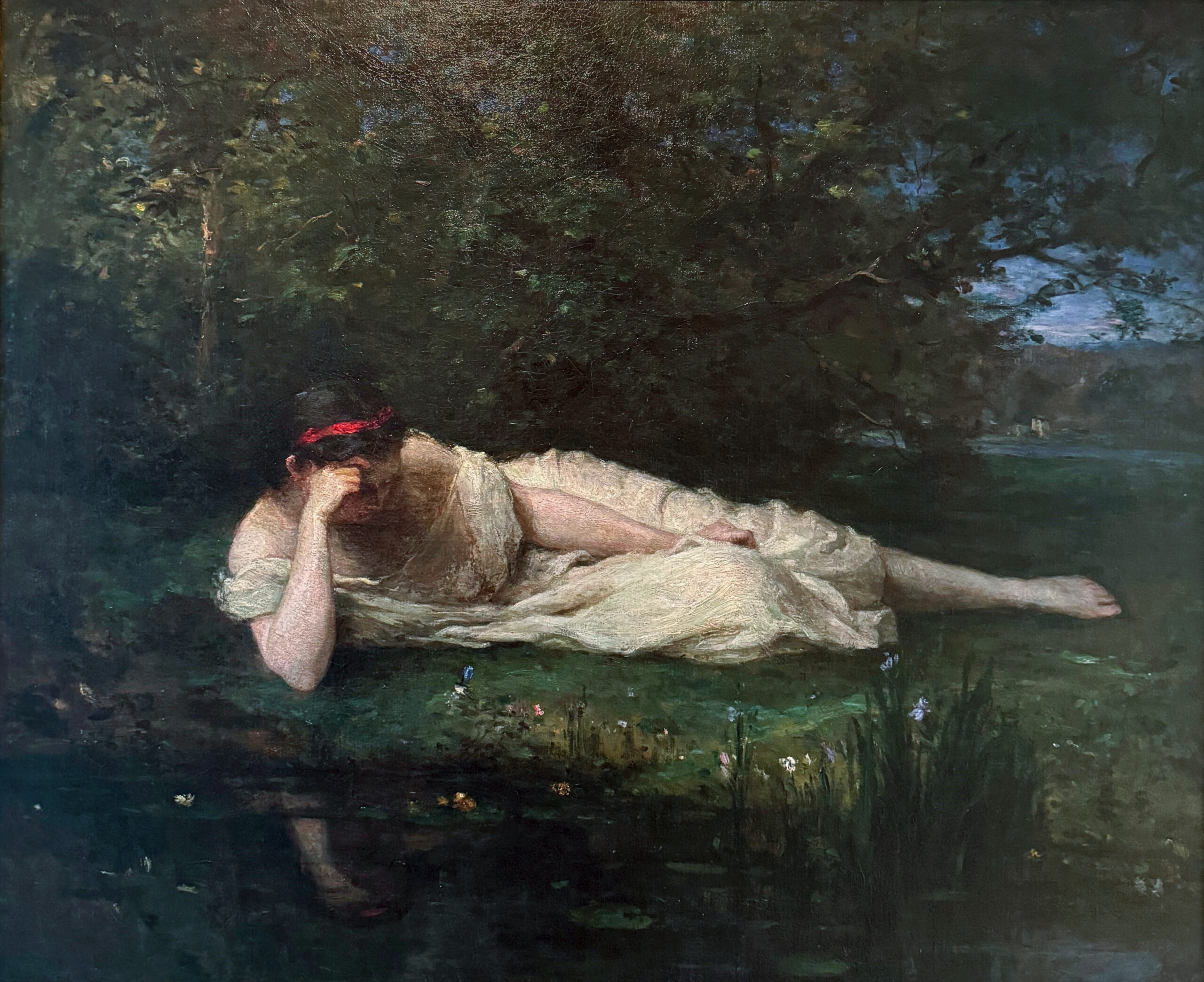
Do not be fooled by the gentleness of the landscapes in Women Impressionists and the Land, a revelatory new exhibit created by Saint Louis Art Museum curator Simon Kelly. The deer at the woods’ edge, the children in the gardens, the sisters in lacy dresses, the ponds rippling above the flutter of tiny mallard feet…. These artists painted what they loved and what they were supposed to love, the two often the same. But they smashed through stone walls to do so.
Even just painting plein-air was bold. Rosa Bonheur, a queer artist whose works’ popularity led the way for the women Impressionists, had to apply every six months for a police permit to wear men’s clothes when painting in the French fields. “Woman is by our civilization consecrated to night,” Berthe Morisot observed, “unless she escapes from it sometimes to those open air afternoons.”
Outside, far from domestic chores and jealous husbands, the women could breathe. They still peopled many of their landscapes with children, sisters, lovers, but there was a freedom in the sunlight and breeze that gave them courage. If they could not yet enter L’Ecole des Beaux-Arts, they would learn from other artists, from one another, and from nature itself. Ecology was a new concept, and artists were beginning to respond.
An expert in nineteenth-century French landscape, Kelly spent four years researching this show, the first ever to focus on the women Impressionists’ landscapes. He arranged for loans from all over Europe—the Musée d’Orsay, the Musée des Beaux Arts de Pau, The Comédie-Française, Musée Marmottan Monet in Paris, National Museum Cardiff, Museum Barberini in Potsdam, Nationalmuseum in Stockholm—as well as from private collections, including that of Morisot’s great-grandson.
The exhibit begins with a blown-up, textured reproduction of Morisot’s Reading. The original would fit inside a breakfast tray, but seeing it that big—the audacity of it—thrilled me. So often women have made themselves small, diminished their own talent. “I don’t think there has ever been a man who treated a woman as an equal,” Morisot bitterly informed her diary in 1890, “and that’s all I would have asked for—I know I am worth as much as they are.”
Berthe and her sister, Edma Morisot-Pontillon, painted together, both studying under Corot. Two of their early landscapes hang side by side, virtually indistinguishable. But Edma, the older sister many critics pronounced more talented, stopped painting when she married. “My passion for painting has not left me,” she later confided to her sister.
Berthe, meanwhile, was calming the anxiety of Corot’s influence, breaking free from traditional techniques. Kelly, who curates modern and contemporary art at SLAM, points to three paintings she made just a few years after that early landscape, all accepted into the Paris Salon. They are looser, fresher, far more abstract. The brushwork is radical, and the suggestion of water in one of her later paintings reminds him of Helen Frankenthaler’s midcentury color fields.
I gaze with envy. Though lucky enough to be born more than a century later than the Impressionists, I have never had the courage to only suggest. What if my work looks messy, wrong, incomplete? So I overdo, overspecify, overwrite or overpaint, and kill the energy. These women, though, followed their own instincts.
Yet the world ignored them. This is the first exhibit in North America to include the work of Edma Morisot-Pontillon. It also includes stunning works by Marie Bracquemond, including her largest and best known canvas, its detail refined and its use of color startling and deft. SLAM just acquired its first Bracquemond. But did you know her name? Most of her work has been secreted in private homes until recently. Her husband, a printmaker, taught her precision by teaching her to etch. But when she began to soften her lines with impressionistic color, he was disgusted and scornful. After years of his belittling, she folded up her easel.
Then there was Louise Abbéma, who had no fear of husbands but still had to paint with secrecy because her partner was the actress Sarah Bernardt. In a painting almost Japanese in its sharp contrasts and delicate colorwork—pale watery greens punctured by a bright red parasol—Abbéma paints herself and Sarah in a rowboat. Sarah bends close to the water to feed the ducks, and to one side swim a pair of black swans, echoing the covert romance. In the foreground are irises, which carried an erotic symbolism at the time.
Monet’s stepdaughter and daughter-in-law, Blanche Hoschedé-Monet, painted alongside him and put her haystack interestingly off center. He influenced her, but who knows in what ways she might have influenced him? Similarly, Monet and Morisot collected each other. “You could argue,” Kelly says, “that her short slashing brushstrokes influenced him.”
Another forgotten artist highlighted in the exhibit is Élodie La Villette, whose painting The Beach of Lohic and the Ile des Souris is a tour de force of photographic realism, yet transcendently luminous, sparkling with a light that feels Impressionist. “She deserves to be better known,” Kelly says with fervor. Her work won awards and was accepted by the Paris Salon, exhibited at the Palace of Fine Arts at the Chicago World’s Fair, and bought by the Musée d’Orsay. But today, many of her paintings remain out of sight in private collections, and many lack clear dates and titles, which has discouraged museums and scholars.
Nineteenth-century critics were liable to pass over any woman artist, and women were left out of the foundational art history textbooks. Attention went to a few “lone geniuses,” men of course, and the women who did comparable work were brushed aside as “derivative.” Until recently, La Villette was classified as a “petit maître,” little master, and as “regional” because, in her sensitivity to ecology, she took the variations of the rough Breton coastline as her subject.
We do, at least, know Mary Cassatt. The last part of the exhibit is given over to her last three decades, when she did much of her painting in the fifty acres of garden at her country estate. Cassatt had no children, Kelly remarked, and I stood a minute breathless, soaking this in. The rapt tenderness in her paintings of mothers and children always stung my heart, making me wish I had become a mother, too. I love that she had access to that tenderness without direct biological experience. I love, too, how politically radical she was, campaigning for women’s suffrage, and how she once pronounced Monet’s Water Lilies “glorified wallpaper.”
One of her hand-painted ceramic vases is in the exhibit, and Kelly hopes more of her ceramics will be discovered. “There have to be more!” he insists under his breath. So much has been cast aside, ignored, lost. A wall-sized photograph as you leave the exhibit shows Cassatt’s estate as it is today, with the water mill where she made her prints. Les Amis de Mary Cassatt are negotiating with the current owner, hoping to make the site what Giverny is for Monet.
The exhibit will run through January 10, 2027, then travel to the Minneapolis Institute of Art.