The Tyranny of Masculinity
How the male preoccupation with strength deforms our politics.
February 28, 2026
A strong man. A strongman.
How did we confuse them?
• • •
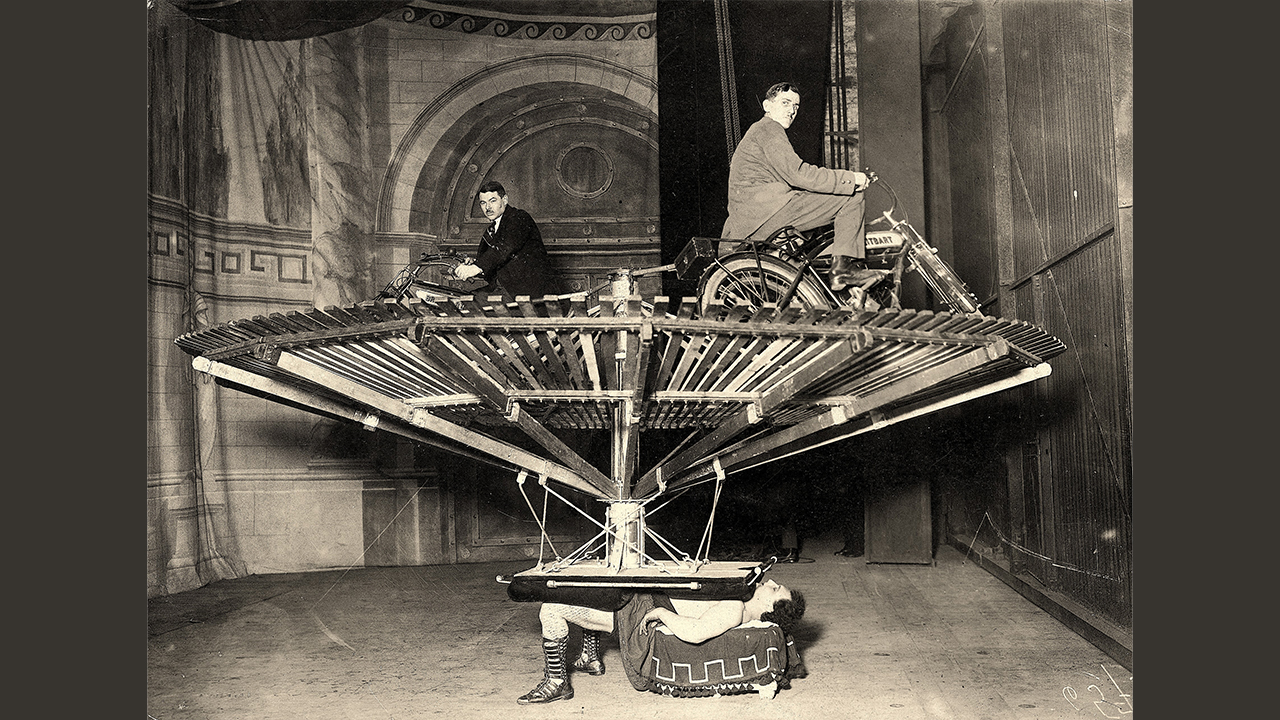
Talking excitedly, New Yorkers file into the Casino Theater. Not until ten-thirty, when everyone is finally seated and quiet, does the curtain rise. Posed on a pedestal center stage is Eugen Sandow, his Prussian skin glowing pale in the limelight, each sinewy muscle defined and implausibly strong. His features are of “somewhat ancient Greek type,” a reporter notes, “but with the clear blue eyes and curling fair hair of the Teuton.” Sandow is pronounced “nearest to physical perfection of any living man.”
At age ten, when Eugen was sickly and weak, his father took him to see the sculpted athletes in the art galleries of Rome and Florence. He made a secret vow. Now here he is climbing his own pedestal—in 1893, amid an obsession with “corporeal perfection among white American men.”
Even Jesus is being remade, abruptly endowed with broad shoulders, thick arms, and a strong jaw. A Baptist minister writes with disgust of paintings in which “Christ is pictured with long hair parted in the center, with light brown beard, large dreamy eyes, and an expression of meekness…almost effeminate.” Others object to the “soft hands gently folded” and blame the medieval “imaginations of worthless monks” for images of a frail, unathletic Jesus. Muscular Christianity has taken hold, and it cannot abide any image that is not brawny and Anglo-Saxon.
• • •
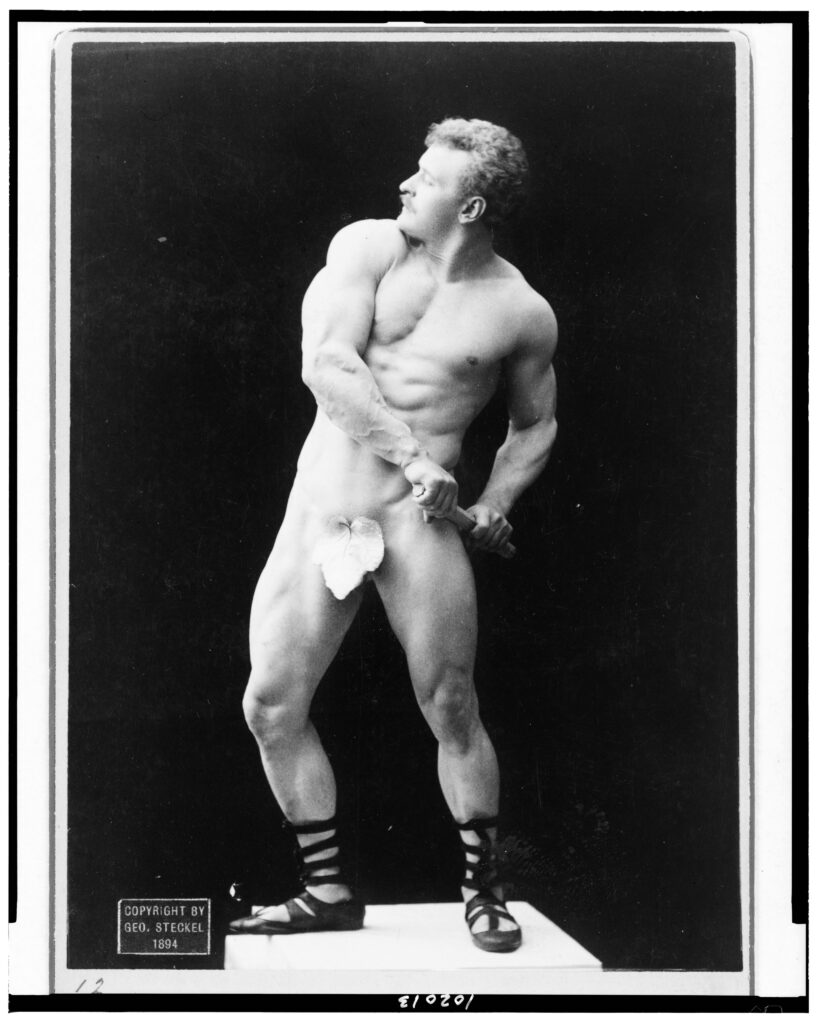
Slide forward forty years. Billed as “the Superman of the Ages,” strongman Zishe Breitbart wears a golden Roman gladiator costume that glints in the sunlight. He whips off his royal blue cape, places the metal brace for two horses in his mouth, and pulls a wagon carrying forty passengers. Or he lies on a bed of nails while holding up a spinning carousel of children. Or he stops a speeding motorcycle, bites through iron chains, tears sheets of solid steel.
The cape is an interesting detail, because a decade later, Joe Shuster and Jerry Siegel will invent the first caped superhero. By the time World War II breaks out, their Man of Steel will be fully formed, ready to fight for “truth, justice, and the American way.”
Both the real strongman and the cartoon superhero are celebrated as ideals of masculinity—the Aryan sort that is in ascendancy. But the joke is on the antisemites: Breitbart, Shuster, and Siegel are all Jews.
Breitbart busts other stereotypes, too. He takes care not to step on worms when he walks on dirt roads. He has a library of two thousand books. He urges people to eat raw veggies and cut back on milk and meat, which prompts accusations of anti-Americanism.
Both the real strongman and the cartoon superhero are celebrated as ideals of masculinity—the Aryan sort that is in ascendancy. But the joke is on the antisemites: Breitbart, Shuster, and Siegel are all Jews.
Now fat-rich milk and red meat have been restored to greatness. Vice President J.D. Vance has defended men’s right to “masculine urges.” Facebook founder Mark Zuckerberg wants more “masculine energy” in the corporate world, “a culture that celebrates the aggression.” Conservative Christians berate pastors for preaching the Beatitudes, saying that notion of Jesus is “weak.” And young men are drawn to Odin, whose son Thor can unleash thunder. (All Jesus did was knock over a few tables.)
Neo-Nazi groups are reforming cults of strength, too, pulling symbols from ancient Rome. Why, I wonder, when men are scared of change, do they turn back to antiquity? Maybe it is so distant that it shines without flaw. Or the togas and marble nudes just do a better job of showing off the male body. Or the rigid hierarchy makes heroism feel more attainable.
• • •
Sandow and Breitbart arrived at times when brawn felt crucial. Today, guys are not pumping iron in order to survive, work, or fight. They are pumping so the rest of us see how strong their will power is, how big their muscles are, how manly they are. And our political sphere mirrors that impulse. We are conflating the male ideal with Whiteness, muscular strength with social power, and masculinity with the ability to knock out anybody you decide is in your way.
A recent philosophical debate depressed me by asking whether Western culture is giving up on the Athenian approach, which values intellect and creativity, for the Spartan emphasis on physical prowess and bodily perfection. “Problem-solving skills appear to be in decline,” British philosopher Jack Symes pointed out. “The share of U.S. adults unable to use mathematical reasoning to assess statements has risen to a high of 35 percent.” That would be between 34 and 36, he wisecracked “for the Americans.” Then he resumed: “In 2022 less than half reported reading a book. New research warns that outsourcing work to AI can result in forgetting how to think ourselves. Meanwhile, we are increasingly health and body-conscious and focus more on external appearance.”
Women always have. But men used to stop with steroids. Now some have chopped off their long, curly eyelashes in order to look “more masculine.” Others are manscaping, a careful depilation said to make the penis look bigger. Last spring’s runways saw menswear baring muscled midriffs and thighs. Rugged climbercore is popular, and outside the military—where they are now verboten, along with soft bellies—beards are thick and full. Men are looksmaxxing with steroids, bonesmashing so their cheekbones grow back bigger. They “are now facing the kind of toxic body politics that women have had to deal with forever,” writes Sam Kriss, and “developing their own hysterias in response.”
The transhumanist speaker in that Athens-Sparta debate was untroubled by all this focus on the body. We have AI to do intellectual work for us, he said dismissively. Our devices already make us smarter than yesterday’s geniuses.
Yet none of that intelligence lives inside us.
My uncle had to memorize poetry in school, and sixty years later, he would set down his pipe, close his eyes, and recite one of those poems. You could feel how he had taken the words in, felt them in bone and flesh, carried them through a windstorm of dying and dividing cells so their meaning could deepen year by year. Keying in a question and reading the bulleted response will not do that for you.
And doing dead lifts will not make you strong in any way that can save us.
• • •
When the curtain drew back to reveal the marvel of Sandow, his rival was the machine. Panicked by these vast new steaming, roaring engines and the mechanistic world view they encouraged, men were gulping patent medicines and doing push-ups, and philosophers were urging vitalism. They spoke of a dynamic, creative life force, a spiritual energy that animated living beings and gave men (especially men) purpose. “Animal spirits,” some called this, stressing that machines had no access.
Today’s influencers, panicked by AI and its ability to mimic or replace us altogether, preach a new vitalism. Often masculine, sometimes misogynist, this energy is wild and brave and noble, a birthright that cannotbe replaced.
Women do not seem as concerned with vitalism. We are, I suspect, too tired to care. But it burns through the manosphere, lighting up that giant, weird umbrella. Between its spokes stretch camo, porn, symbols of ancient Rome, the Christian cross, and AI, the panels polka-dotted with red pills and bordered in black for the maligned incels. The only common denominator beneath that umbrella is a frank hatred of women—though it is often followed by a hatred of all that is not White, Christian, heterosexual, and native-born American.
Men are looksmaxxing with steroids, bonesmashing so their cheekbones grow back bigger. They “are now facing the kind of toxic body politics that women have had to deal with forever,” writes Sam Kriss, and “developing their own hysterias in response.”
Nick Fuentes, for example, insists that anyone not White should either be kicked out of the country or imprisoned; he feels oppressed by Jews, finds homosexuals “demonic,” and says women need to just “shut up.” Men now chant his slogan—“Your body, my choice”—and a good-sized chunk of the young Republicans working in D.C. are said to be part of his Groyper Army (named for a hideous toad mascot big enough to squash Pepe the Frog).
Andrew Tate, a bald, testosterone-charged kickboxer turned influencer, targets boys who are confused about what a man is and scared about their future. He scorns women (we are, he says with disgust, controlled by our emotions) and urges physical prowess, stamina, and money, as much as possible, hustled online. “Only the strong will survive,” he announces. “Weak men crumble under pressure, but warriors rise.”
Men have grown soft, Tate adds, and that is why they are losing. Not because the nature of work has changed, the nature of danger and protection have changed, change itself has sped up, and women have stopped pretending to agree that they are inferior. Those, in his mind, would just be “excuses.”
I expected to be enraged by Tate’s bullshit, but instead, an immense sadness comes over me. This sort of talk succeeds in proportion to a listener’s pain and uncertainty. And this sort of talk comes from pain and uncertainty. Tate talks freely about times his father “beat the fuck out of me.” He was eleven when his parents divorced, and from then on, saw his father only once a year. He praises this absence, explaining that his dad “raised me by not being there,” yet expecting stellar performance.
Influenced by his father’s view of male dominance, Tate insists that women are the property of men and, if raped, bear the responsibility. Which is handy, because he has been charged with rape, human trafficking, and having sex with (also beating) a minor. His brother is also under investigation in three countries, but they were released from house arrest in December, thanks in part to support from Trump administration officials. “It was the culmination of a yearslong effort by Andrew to forge alliances with Mr. Trump’s advisers and family members, including Barron Trump,” The New York Times reports.
Real men hang together. I remember how the boys who sat in the back row in my grade school used to mortify “weaker” (usually smarter and more sensitive) boys by tossing around something they cherished. They also mocked the girls who were beginning to wear bras or bleed. We should have all ignored them.
But do we ignore these guys?
In conversations with adults, most boys shrug off Tate’s theories; they say he is funny. Among themselves, they often crack jokes premised on his ideas. Teachers have watched sweet eleven-year-old boys turn surly and aggressive, both toward female teachers and toward the girls in class.
In a new novel called What Boys Learn, a teenager who has plunged into the manosphere writes on the cover of his notebook, “A good man is a very, very dangerous man who has that under voluntary control.”
• • •
Samson was dangerous. He could kill a thousand men with a fresh donkey’s jawbone. But after Delilah lulled him to sleep in her lap so his hair could be shaved off, he was as weak as a kitten.
Castration anxiety is real.
Maleness is vulnerable.
This notion came as rather a shock to me, raised by Irish Catholic women who deferred automatically to any man. Then one of my college professors, Jesuit scholar Walter J. Ong, pointed out that a male child first has to differentiate himself from the feminine environment of his mother. Later, he will have to choose either to doubt or to trust fatherhood, while his partner serenely carries her proof in utero. Even the “agonistic” tradition, the contests and jousts, tournaments and duels that men have long used to prove their masculinity, is fragile, because it requires constant affirmation. A man must always be winning.
“What we call masculinity is often a hedge against being revealed as a fraud,” writes sociologist Michael Kimmel, “an exaggerated set of activities that keep others from seeing through us, and a frenzied effort to keep at bay those fears within ourselves.”
Even the “agonistic” tradition, the contests and jousts, tournaments and duels that men have long used to prove their masculinity, is fragile, because it requires constant affirmation. A man must always be winning.
Here is how a male journalist describes actors Timothée Chalamet, Mark Eydelshteyn, and Dominic Sessa: “reedy,” “wiry,” “wispy,” “twiggy,” and “feeble,” with “an endearing cutesiness” and “concave chests and noodly arms.” They are “the white boy of the moment,” he says, a counterweight to all the bench-pressing belligerence. (Hulk Hogan tearing his shirt apart at the Republican National Convention, the Secretary of Health posting shirtless workout videos after wolfing down steaks fried in beef tallow, et cetera.) Judging by his adjectives, the journalist is unconvinced. These guys have a growing female fan base, he concedes, but this is probably because “they don’t swallow the frame…but slither through it, cautious to never crowd out their female counterparts.”
They cannot possibly be strong.
A coworker once confided that every time he meets another guy, he instinctively sizes him up to see if he could “take” him. This knocked me for a loop until I caught myself instinctively noticing whether another woman was skinnier and prettier than I (a low bar to clear). We have all been conditioned into angst. Many a guy chooses the restaurant seat that puts his back to the wall, just in case.
“We’ve all noticed the way many men seem constantly on patrol,” writes Phil Christman in The Hedgehog Review. “An American boyhood consists of little else but unorganized combat drills, unwanted invasions of personal territory. It’s all grabs, punches, towel flicks, fake homoerotic aggression…..” And we wonder why so many male friendships still seem casual, jokey, a parallel play that rarely admits to worry or sorrow.
Strongman training—the literal sort—shoots testosterone into the bloodstream, making men feel more aggressive, focused, and powerful. Even the names of the exercises suggest old-fashioned masculine prowess: pumping iron, chain drag, sled drag, keg carry, atlas stone lift, farmers’ walk, tire flip, truck pull….
I am fighting not to add “dumbbell,” because that sort of snide mockery helped get us into this mess in the first place.
“Is this women’s fault?” I ask my husband abruptly. “Did women make men feel so useless, guilty, confused, and resentful that there had to be a backlash?”
Andrew snorts. “Poor us. Ruling the world for centuries, given every possible privilege, and pouting because now we have to share? Please. Sure, it’s hard to give up entitlement. But a man doesn’t whine and blame those he has patronized, demeaned, and taken advantage of when they succeed and he fails.”
He means “a real man.” But there are quite a few competing definitions. Remember those movies when, in a time of danger, the man shushed the woman, overruled her offers to help, and strongarmed her to safety? “Honor is an asserted claim to protect someone,” observes political philosopher Harvey Mansfield. “How can I protect you properly if I can’t tell you what to do?”
Feminism was apparently so scathing, it complicated all efforts to be a man. Which was somehow predicated on being superior to women, just as White identity was predicated on—you see where this is going.
Even hypermasculine men are failing to protect, Christman remarks, by committing violence against women and each other, and by sitting around while women outwork and outworry them. Many have traded relationships for porn; it feels too risky, these days, to guess at Freud’s famous exasperated query: “What do women want?”
Feminism was apparently so scathing, it complicated all efforts to be a man. Which was somehow predicated on being superior to women, just as White identity was predicated on—you see where this is going. Did White men feel backed into such a tight corner that they had to either stay there or come out swinging whatever one swings to prove what is essentially unprovable? Is it frustrated entitlement or nostalgic confusion that makes them shove us backwards, toward the past’s set rites of pain and discipline, its bravado, its reassuring gender hierarchy?
The impulse makes sense, in that the old proving grounds are vanishing. Work with your hands in a traditionally masculine trade? Bots will shove you aside. Blow steam at a pub or a weekly poker game? Drinking is now uncool, and people gamble alone, on screens. Find office work, where once you would be handed a secretary and paid more than any woman who dared apply? Now your boss is a woman. What is left that men can do best? Women crop up everywhere, even in politics, even leading countries (except here, where they never seem to win). Join the military? Instead of a satisfying clash of armor or fog of napalm, today’s fighting often asks only that you press a high-tech button. Marry and father a child? Women have spent the last half century pointing out that you abuse, demean, and take advantage of us; your language is misogynist; you hog space on the couch and mansplain what you do not know, and we have been faking all those orgasms just to assuage an ego we are tired of cosseting.
If a strongman emerges, you can at least follow him.
• • •
In the Views of the Electorate Research Survey after the 2024 election, three-fourths of Republican men and women agreed that “what it means to be a man has changed and I don’t think that has been good for society.” Asked if women “should return to their traditional roles,” 48 percent of Republican men said yes—up from 28 percent two years earlier.
It feels stronger, knowing who you are because a definition has been handed down to you. I get that; I prefer a lot of old-fashioned ways myself. If you are cozily cisgender, life is easier that way.
But definitions change.
Traditional masculinity involved protecting, providing, looking out for the rest of us. Strength meant being ready to kill, making decisions for the group, issuing orders that had to be obeyed, and refusing to give in to fear or sorrow. Stoicism worked beautifully on the frontier; nobody wants the guy leading the wagon train dissolving into tears. Fathers insisting that their sons learn to hunt and kill was a reasonable rite of passage when that was how we survived. Keeping a loaded shotgun leaning against the wall made sense when a threat to your family could be deterred with a loaded shotgun.
The strongman rule we see emerging here and elsewhere is meant to comfort us, but it has more to do with raw power and transactional success than with the old virtues.
Those days are gone. Even I have to rewrite my definition. To me, a strong man was one who gently, with an endearing mix of awkwardness and reverence, cradled a newborn in his big hands and swore to himself that he would die to protect this child. Larger than his ego, he saw what women could do, grinned, and stepped out of their way. He stood on scorched asphalt for four hours, grilling brats for the church picnic. Bound by honor and integrity, he worked to hold family and community together.
But traditional ideas of family are changing, institutions are dissolving, and communities are splintering.
The strongman rule we see emerging here and elsewhere is meant to comfort us, but it has more to do with raw power and transactional success than with the old virtues. The cult of male strength that is seeping from fringe to mainstream relies not on heroic self-sacrifice but on the suppression or ejection of women and people of color. We are getting this strength thing altogether wrong.
• • •
Half a century ago, about 20 percent of all governments worldwide were democracies. Southern Europe changed first, then countries in South America and Asia, and finally you had the collapse of the Berlin Wall and the dissolution of the Soviet Union. There was a fast-spreading insistence on pluralism, free and fair elections, a free press, and a court system independent of whoever held power.
Then all that ground to a halt.
In the past quarter-century, the world has seen a wave of autocratization. According to the latest report, the level of democracy for the average world citizen has dropped back to where it was in 1985, and in terms of economic power, democracy “is at its lowest level in over fifty years.” “The world has fewer democracies than autocracies for the first time in over twenty years.”
• • •
Just as men aspiring to strength are vulnerable, autocracies are inherently fragile: overreliant on personal charisma, thus unstable and unpredictable.
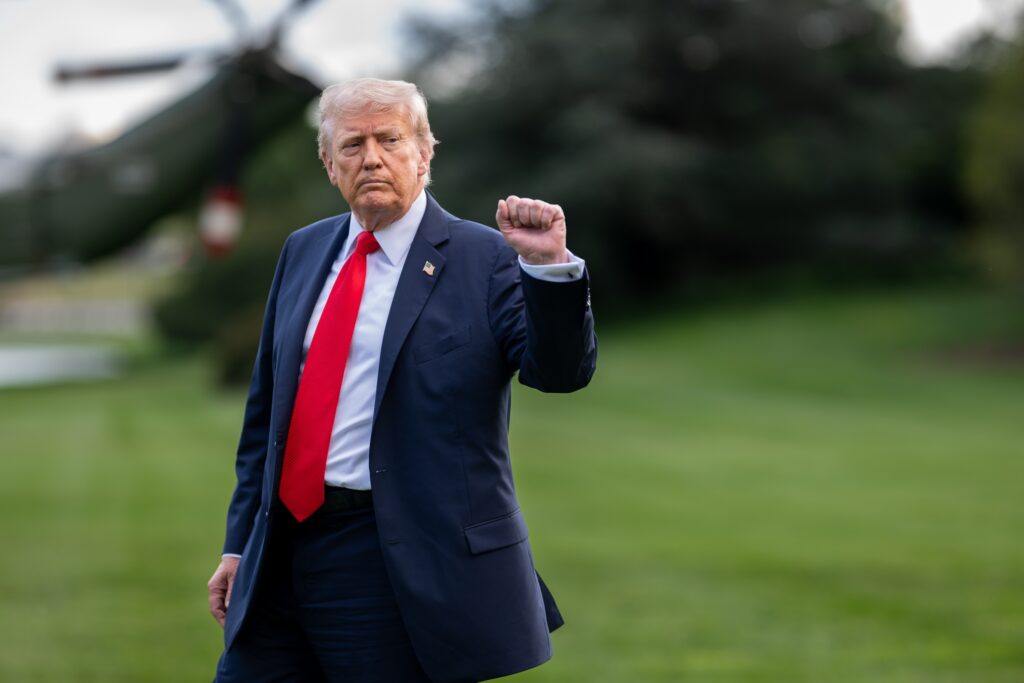
We see Vladimir Putin shirtless, on horseback; drawing a blood sample from a Siberian tiger; deftly stick checking in a hockey game with his inner circle. We watch Donald Trump shove aside his security detail to pump his fist in the air after an assassination attempt. After years bogged down in parties and systems and policies, I can see that there is something bracing about all eyes turning in a single direction, one loud voice issuing orders. These men throb with unchecked power. What their followers forget that they were in fact hoisted up by countless hands in their party’s mosh pit. Sensing trouble ahead, the kingmakers chose to centralize power. Elevating one person as the new hope, they made him as powerful as possible so he could implement all their desired changes.
China went from collective leadership to strongman rule soon after Xi Jinping took power. But Xi did not seize that power singlehandedly, any more than Donald Trump did. His rise “could not have occurred without the consent and active support of the other senior members of China’s ruling elite,” Nimrod Baranovitch points out. They sensed a troublesome factionalism in the party, deadlocked policy-making, an economic slowdown, and growing social unrest. An all-powerful leader could swiftly reverse the trends.
After years bogged down in parties and systems and policies, I can see that there is something bracing about all eyes turning in a single direction, one loud voice issuing orders. These men throb with unchecked power.
All-powerful, though? Autocrats must curry favor with the elites (what irony, when a hatred of the elites is so often what launches them). As for the rest of society, “repression can be expensive,” Kathryn Stoner notes, “and overuse of it can spark further social protests.” Recep Tayyip Erdogan, president of Turkey, has said, “You cannot bring women and men into an equal position; this is against nature.” Viktor Orban, prime minister of Hungary, has said that countries where European and non-Europeans mingle are “no longer nations.” This kind of thinking does not play out without protest.
• • •
With his swagger and bluster, limelight and showmanship, a strongman comes off as unique, a marvel, a quintessence. But when I read about strongmen in other times and cultures, I find a familiar litany. They pop up when people feel precarious, demographically or economically; when too much is changing too fast, and the old anchors are dissolving; when people are uncertain how to make a living, how to find housing, how to protect their cultural heritage or moral beliefs and therefore their own identity. Maybe the population is aging and shrinking, or resources are dwindling. Citizens have begun to distrust distant elites and stodgy, impenetrable institutions. Democracy feels unresponsive, weighted by technocratic layers and corrupted by money. People outside that circle feel slighted, looked down upon, ignored.
Why would you not turn to someone who promised a return to greatness? Especially when that is all your court poets, temple priests, and town criers, your Pravda newspaper or Fox News or algorithms, will tell you?
After the speech Mark Carney, prime minister of Canada, made at Davos, calling out “a rupture in the world order,” Ezra Klein asked Adam Tooze—a Columbia University historian who has earned a reputation for chronicling crisis—exactly what Carney meant by rupture. “The violence, the use of force, the use of threats, the bullying,” he replied. “Thucydides: ‘The powerful do as they will, and the weak must simply accept the circumstances.’ That shift, and the stripping away of the hypocrisy.”
• • •
What if a strongman were strong by my definition, kind and gentle, wise and courageous? Would I be secretly glad for the clarity, the end to the incessant wrangling and stalling and fuss? Democracy is a bit of a mess, and it requires inordinate patience. The current challenges feel so urgent. If a single authoritarian could make changes I liked, and quickly?
I might cave. If, that is, the leader was a Marcus Aurelius type. But this? With so many people suffering as a result, so much deliberate shock and fear, so little regard for civility? I am angry that I have to feel intimidated. Angry that raw power trumps, forgive the verb, everything I value.
This is the real consequence of strongman rule. The anger comes into us.
Back in 2020, social psychologist Fathali Moghaddam wrote about “the tendency for strongman leadership to nurture and accelerate mutual radicalization.” Because these leaders are “categorical thinkers, authoritarian, and ethnocentric,” they perceive the world as divided into “us” versus “them,” and they mobilize supporters by emphasizing the superiority of the ingroup and showing aggression toward the “others.” Thus the two groups drive each other to extreme positions in which they feel “‘we can no longer talk to the other side,’ ‘the gap between us is too far to bridge,’ ‘there is no longer a middle way.’ Each side sees the other side as radical, irrational, incapable of reasoning and compromising. Each side asks, ‘How can they believe those things? How can they think like that? How can they deny the obvious facts?’”
And the strongman stands watching, ready to slosh a little more gasoline on the fire whenever necessary.
“The mobilization achieved by the strongman is through pathological hatred,” Moghaddam continues. “We will do whatever it takes to reject and harm you, even if we suffer in the process.” Once the hatred has done its damage, the mobilization is no longer needed: “After democratic elections the strongman tries his best to end democracy.”
• • •
In that Athens-Sparta debate, social philosopher Sarah Wilson remarked that what we are seeing is not a reinvention of Spartanism, which cared fiercely about the collective, but rather an upsurge of hedonism, vanity, anti-intellectualism, and obsession with the body—all hallmarks of a system about to collapse.
There is dread beneath the obsession, fear beneath the anger. There is a need for a daddy; even the NATO Secretary General plays along. The embarrassing truth is that we all want to be taken care of, looked after in some way. We just cannot agree on what form that should take. Progressives want the government itself to be the strongman (though they would never use the word). The right wants a particular sort of man. And though they would never admit it, I suspect some want exactly what this country was founded to escape: a king.
“I’m the king—I have sold more Boeings than anyone on earth,” Trump said, and again after the Venezuelan operation: “I am the king.” When he announced the end of “congestion pricing” in Manhattan, he concluded his Truth Social post with “LONG LIVE THE KING!” and an AI post showed him in an ermine-trimmed crown and cape. Whenever No Kings protesters squawk, he insists he is joking. But he is slathering the White House with gold, and he wants his graven image on a special coin and his name on, well, everything. He flattered Xi Jinping by calling him “King,” and when Xi protested, “I am not King, I am president,” corrected him: “No, you’re president for life and therefore, you’re King.’” He has repeatedly praised foreign leaders for abolishing term limits and said that we should cancel elections, that we would not need another election, that the election system should be controlled by his party….
There was a reason those social media quips about a royal match between Barron Trump and the Princess Isabella of Denmark (and a year earlier, between Barron and Princess Leonor of Spain) went viral.
• • •
To make sure I am not catastrophizing, I ask an emotionless AI to define “strongman.”
“A leader who centralizes power in himself by weakening institutions, bypassing legal constraints, and claiming a unique ability to embody or save the nation,” Perplexity.ai replies, adding that “strength here is not competence—it’s personal dominance over systems.” Illegality is justified as patriotism. Courts, legislatures, and bureaucracies exist but are subordinated. Criticism of the leader is framed as betrayal of the country. Immigrants are framed as an existential threat.
The embarrassing truth is that we all want to be taken care of, looked after in some way. We just cannot agree on what form that should take. Progressives want the government itself to be the strongman (though they would never use the word). The right wants a particular sort of man.
This is “masculinized, theatrical authority,” the AI continues, with “displays of toughness, dominance, decisiveness.” Compromise is viewed with contempt. Enemies must be publicly humiliated. Laws are applied harshly to opponents; allies are protected.
Strongmen are not villains who seize power, the AI then reminds me. They are invited, because people are afraid. Mussolini was invited by King Victor Emmanuel III to be premier of Italy, and most Italians cheered. Hitler was invited by President Paul von Hindenburg to be chancellor of Germany, and the Nazis—who had grown into the largest party in the Reichstag, though they did not hold an absolute majority—were thrilled.
Quizzed further, the AI assures me that we will not follow other nations’ paths to centralized control and legitimized repression. The fear and instability in the United States are only leading to polarization, it says, and disorder is only causing “institutional stress.”
The AI must have missed the footage of FBI searches and ICE arrests.
When it says the United States has a “strong independent press” and “peaceful acceptance of electoral loss,” I choke on my coffee. The AI assures me that the United States distrusts power, yet corporate leaders and politicians are rolling over like a pack of circus poodles. The AI says that in the United States, “protest is normalized, even when disruptive.” Yet protesters have been killed. The AI says we are safer because there are no personal armies. Are there not?
The United States could tip toward a strongman, the AI says, but only “if institutions are perceived as rigged rather than merely inefficient.”
Rigged. Seems to me I have heard that word used.
“What makes a democracy resilient, invulnerable to strongman rule?” I type.
“Strongmen almost always rely on resource rents (oil, gas, minerals), oligarchic alliances, and state capture of major industries,” the AI replies. Resilience comes from trusted institutions; diversified wealth and equitable distribution; businesses and media thriving independent of the state; citizens who can recognize emotional manipulation and propaganda; a shared identity that is civic, not ethnic.
Do we have any of that anymore? All my life, I have lived in a democracy—a strong one—and if you had told me that someday my stomach would clench in fear for its future, I would have thought you deluded. Yes, I know, Benjamin Franklin said we would only have a republic if we were able to keep it. But the vigilance he was urging never seemed necessary.
Until now.