The Speed Machine and the Rebirth of a Champion
A second look at Lewis Hamilton
November 23, 2025
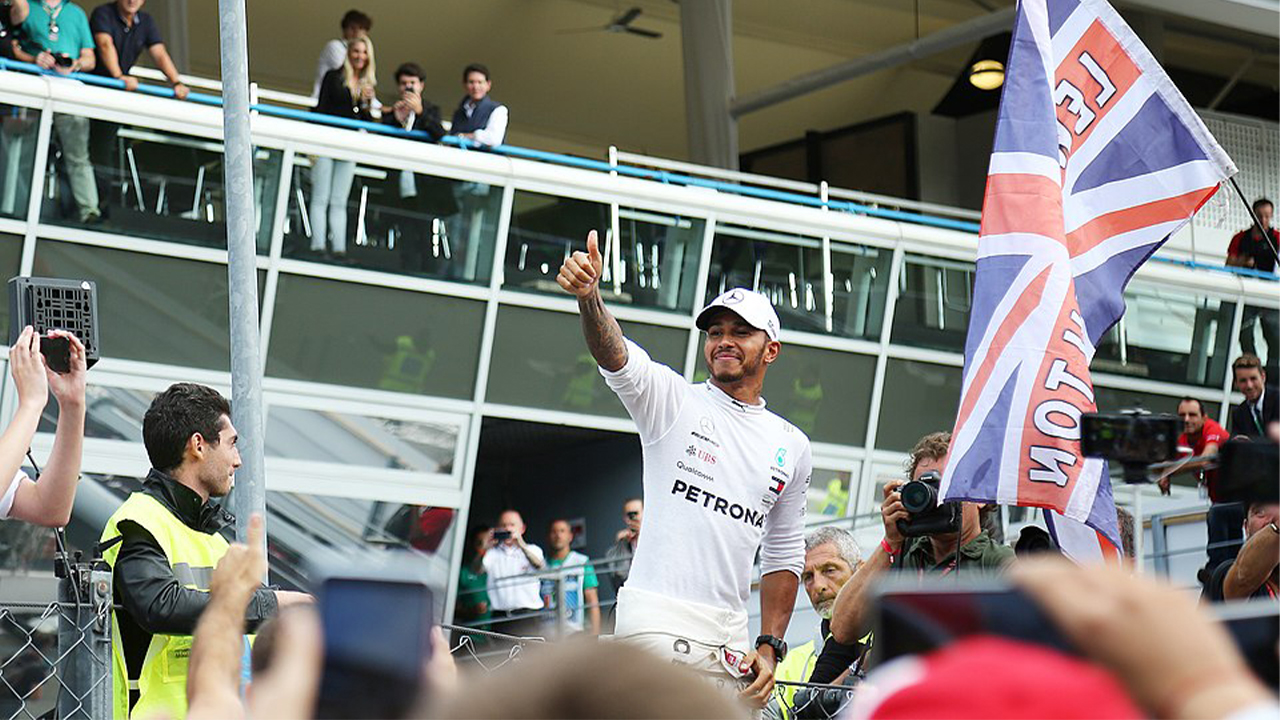
On February 1, 2024, Scuderia Ferrari announced that British Formula One driver Lewis Hamilton would join the team in 2025. The move shook the motorsport world, given both the seven-time champion’s illustrious career with Mercedes AMG Petronas and Ferrari’s iconic team legacy in racing. The news out of Maranello presented a season-long opportunity to reflect on what the end of the Hamilton-Mercedes era would mean within F1, extending across 2024, his final season with the team. For those outside of the pinnacle of motorsport, it may seem difficult to consider why the winningest driver in F1 might fit into an issue on second chances. However, Hamilton’s move to Ferrari signals a second act, a new opportunity to emerge victorious not only on the track but also to continue pushing the limits of what is possible beyond it.
From his F1 debut in 2007, Lewis Hamilton consistently broke records and expectations of what drivers can do. He experienced early success with his first team, McLaren, finishing second in the driver standings his rookie season by one point and winning the championship the following year. When he joined Mercedes in 2013, his dominance continued, fueled by new regulations and a fierce rivalry with teammate, Nico Rosberg. Six World Drivers’ Championships in the next seven seasons followed, showcasing the style and tenacity that drew the attention of “top” celebrities and sporting lists around the world. In his 2010 book, Race, Sport and Politics: The Sporting Black Diaspora, sociologist Ben Carrington writes of Hamilton that, “His impact is such that he is credited with saving Formula One, at least in Britain, after the retirement of Michael Schumacher and the fear that the sport would fade from public view and with it much needed sponsorship money.”1
Here, rehabilitation of one’s image, rather than the body, drives discourses within front offices and fan communities. Hamilton occupies a third option of seconds; he represents the star sporting figure seeking to replicate previous success in a new place, suiting up for a new franchise, a new team that could cement his legacy as the greatest to ever do it.
His status as the first Black F1 driver and champion remains groundbreaking for the sport, a title that has shaped his experience with team personnel, the press, fans around the world, and the governing body of motorsport. “I didn’t feel like I was welcome. I didn’t feel like I was accepted,” he told Vanity Fair in 2022. “God knows how many of these drivers say: ‘This is not what a Formula 1 driver is. That’s not how you behave. This is not how you do it. Tattoos? No! A Formula 1 driver doesn’t have tattoos! A Formula 1 driver doesn’t have a personality—and piercings!’”2 Whereas a young Lewis Hamilton downplayed the role of race and politics in his career, a strategy he says he was encouraged to do to “fit in,”3 he later emerged as a vibrant athlete activist. He spoke out against the FIA’s (Fédération Internationale de l’Automobile, motorsport’s governing body) jewelry policy, its decision to host races in countries with blighted human rights violations, and COVID-19 protocols that endangered teams and drivers. He also settled into an advocacy role, working as an ally for women in the sport and wearing a now-iconic rainbow bedazzled helmet in race locales known for homophobic laws and policies, from Miami to Saudi Arabia. Along the way, he racked up a total of seven driver championships, tying him with racing legend Michael Schumacher for the most in F1. What the driver has meant for the sport on the track is rivalled only by his groundbreaking status off it.
Typically, when we speak of a second chance for athletes, these moments occur for a few different reasons. They are often due to injury, where around-the-clock rehabilitation aims to return players to their previous form. The question of whether they can meet these expectations shapes the discourses that follow their return to the field of play. In a quite different way, second chances for athletes also come at the expense of some publicly known harm, whether a crime that plays out in the courts or the court of public opinion regarding an alleged offense. Here, rehabilitation of one’s image, rather than the body, drives discourses within front offices and fan communities. Hamilton occupies a third option of seconds; he represents the star sporting figure seeking to replicate previous success in a new place, suiting up for a new franchise, a new team that could cement his legacy as the greatest to ever do it. To fully understand this second chance in the context of Hamilton’s life beyond the accolades and awards, we must return to arguably the end of his “first chance.” I apologize in advance to Mercedes and/or Lewis Hamilton fans; we must talk about the end of the 2021 F1 season, specifically the Abu Dhabi Grand Prix.
Going into the late-season battle in Abu Dhabi, Hamilton found himself tied with Red Bull’s Max Verstappen in the points (396.5). Winning that season would either give Hamilton the most championships outright or give Red Bull’s young Dutch driver his first championship ever. The entire season had been a contentious battle between the two, perhaps most vividly seen in the tire marks from Verstappen’s car left across Hamilton’s helmet during a heated collision between the two drivers in Monza. In Brazil, Hamilton started the race last and finished first in dramatic fashion, seemingly building momentum towards an inevitable eighth championship. However, Verstappen refused to back down, even defying his team and race control in Saudi Arabia by brake-checking the British driver after being told to give up his position after violating track rules.
In that final race of 2021, Hamilton’s championship seemed inevitable in the final five laps, leading Verstappen in Abu Dhabi by nearly a dozen seconds. A late safety car led to race director Michael Masi deciding to allow those between Verstappen and Hamilton to unlap themselves. This controversial decision, arguably a questionable interpretation of the rules, gave a clear advantage for Verstappen’s fresher tires. “No, Michael, No! No!” Mercedes team principal Toto Wolff cried to Masi on the radio. Other drivers seem confused by the ruling as they communicated with their teams. You can hear the desperation in Hamilton’s voice on the radio, perhaps thinking of the moment he wished he had pitted, and eventually, a resolved understanding of how things have so often gone for him in life. “I’ve always had a target on my back, since I started racing,” Lewis says.4 The race control decision ultimately meant that the championship would come down to the final lap, 3.2 miles. Verstappen passes Hamilton on fresh tires in turn five and eventually reaches the checkered flag first, a moment completely unlikely until race control intervention. “A new champ was born and a sport was killed the night of the 2021 Abu Dhabi GP,” Sergius Barretto wrote for Autocar Professional.5
In the Netflix Formula 1: Drive to Survive docuseries episode, you can hear the fireworks in the distance, and on the radio, silence from Hamilton’s car. When he eventually exits, he is comforted by fellow driver Sebastian Vettel, his father, and eventually several other drivers. The cameras follow him as he embraces Verstappen and congratulates him following the race, seemingly aware of the optics of being perceived as a bad sport. In a single race, tough lessons about Hamilton, the FIA, and perhaps life itself came into focus—the expectations of sportsmanship, the subjective judgements of regulating bodies, the moments that seem painfully unfair.
When athletes take second chances, they reveal more than a new kit or a fresh start. They remind us of both the difficulty and necessity of starting anew. Stagnation can be stifling, but it is also safe.
An investigation would later determine that Michael Masi had, in fact, violated sporting regulations, and the FIA removed him from his post as race director. However, the damage was done. In Drive to Survive, Wolff says, “It’s clear that this is going to leave some scars.”6 With these wounds, Hamilton went silent and disappeared from the never-ending limelight for a while. Many questioned if he would be able to return to the sport. “In the movie version of the Lewis Hamilton story, he would have returned this season after the painful fiasco at the end of the last and—the bloodied boxer rising from the canvas—dominated every race,” Chris Heath writes. “But it hasn’t worked out like that.”7 He would stay with Mercedes, navigating new specifications and struggling to find the same success. In many ways, the 2022-2024 seasons feel like an interlude, a bridge between Act I and Act II.
“Lewis Hamilton is washed,” a friend told me when I mentioned writing this piece. “Ferrari is going to regret this.” The take felt surprising to me, given that no one labeled Fernando Alonso “washed,” a fellow 40-plus legend whose relevance is hardly questioned in the sport. But perhaps I should not have been surprised. When athletes take second chances, they reveal more than a new kit or a fresh start. They remind us of both the difficulty and necessity of starting anew. Stagnation can be stifling, but it is also safe.
Much is made of the aging athlete. For those of us blessed to reach a certain age, we are constantly reminded in every sporting broadcast or feature that the game is reserved for the young. It is rare to make it through a Los Angeles Lakers broadcast without mentioning Hamilton’s basketball contemporary, LeBron James, who is also 40 years old. However, despite this, Hamilton insists he’s peerless, within his sport or outside of it. “Don’t ever compare me to anybody else. I’m the first and only Black driver that’s ever been in this sport,” he said in an interview. “I’m built different. I’ve been through a lot. I’ve had my own journey. You can’t compare me to another 40-year-old, past or present, Formula One driver in history. Because they are nothing like me. I’m hungry, driven, don’t have a wife and kids. I’m focused on one thing, and that’s winning. That’s my No. 1 priority.”8 There is a defensiveness here, and perhaps rightly so. The second act can leave one vulnerable to attack, to the criticism from those who remain assured they know best. “Lewis, he’s under constant scrutiny,” notes motorsport journalist and commentator Will Buxton. “I think a lot of people are just waiting for that moment when he trips up. Can’t imagine what it’s like to constantly have a camera in your face.”9
Hamilton appears camera-ready on the cover of TIME magazine in March 2025, where he is seen standing in crisp white, in stark contrast to a black stallion behind him, emblematic of the Ferrari logo. “We’re in a time of reimagining the future, reimagining what really dreaming is about,” he tells Sean Gregory.10 On the track, he is donning the iconic red racing suit. Off the track, he is co-chairing the Met Gala. Its 2025 theme, “Superfine: Tailoring Black Style,” a homage to the Black dandy, feels especially fitting for Hamilton, given both his investment in the world of fashion and the lore of the dandy as someone constantly aware of others’ expectations, yet evading them in an act of defiance and dress. “I’ve always welcomed the negativity,” Hamilton told TIME. “I never, ever reply to any of the older, ultimately, white men who have commented on my career and what they think I should be doing. How you show up, how you present yourself, how you perform slowly dispels that.”11
The second act can leave one vulnerable to attack, to the criticism from those who remain assured they know best. “Lewis, he’s under constant scrutiny,” notes motorsport journalist and commentator Will Buxton. “I think a lot of people are just waiting for that moment when he trips up. Can’t imagine what it’s like to constantly have a camera in your face.”
Hamilton and other athletes of his caliber remind us that it is never too late to suit up for a second act. The driver told TIME, “Honestly, I thought all my firsts were done. Your first car, your first crash, your first date, first day of school. The excitement I got by the idea of, ‘This is my first time in the red suit, the first time in the Ferrari.’ Wow. Honestly, I’ve never been so excited.”12 So far, it has not been easy in Act II—the fiery hopes following a sprint victory in Shanghai during the second week of the 2025 season have mostly been extinguished by exasperation in the races that followed. Hamilton’s voice is often weary on the radio; the preseason excitement traded for vexation. It is a keen reminder of the high-risk, high-reward tensions of these late-career firsts, but it is also an opportunity to reframe this as merely track evolution. In motorsport, it refers to the debris swiped from the track by cars and the rubber that builds up on the racing line—the black scuffs you see across the track that accumulate as practice and qualifying events make their mark. It makes the track faster for drivers, shifts race strategy, and helps build fast laps. It is also about the innovation inherent to the sport as technology changes the approach to cars and tracks. For Lewis Hamilton, I wonder if all of these moments from before—the wins, the critics, the policies, the glory—converge, marking the track ahead and clearing it to perhaps build towards something faster and greater in the races that remain.
1 Ben Carrington, Race, Sport and Politics: The Sporting Black Diaspora (Sage, 2010), 157.
2 Chris Heath, “Lewis Hamilton: The F1 Superstar on Racism, His Future, and the Shocker That Cost Him a Championship,” Vanity Fair, August 8, 2022, para. 2, https://www.vanityfair.com/style/2022/08/cover-story-lewis-hamilton-never-quits.
3 Heath, “Lewis Hamilton: The F1 Superstar on Racism, His Future, and the Shocker That Cost Him a Championship,” para. 23.
4 “Hard Racing,” Formula 1: Drive to Survive, produced by James Gay-Rees and Paul Martin, directed by Martin Webb, n.d., on Netflix.
5 Sergius Barretto, “Opinion: That’s Entertainment,” Autocar India, December 14, 2021, para. 1, https://www.autocarindia.com/car-news/opinion-thats-entertainment-422955.
6 “Hard Racing.”
7 Heath, “Lewis Hamilton: The F1 Superstar on Racism, His Future, and the Shocker That Cost Him a Championship,” para. 75.
8 Sean Gregory, “How Lewis Hamilton Finally Got His Ferrari Red,” TIME, February 27, 2025, https://time.com/7261784/lewis-hamilton-ferrari-f1-interview/.
9 “Gloves Are Off,” Formula 1:Drive to Survive, produced by James Gay-Rees and Paul Martin, directed by Martin Webb, n.d., on Netflix.
10 Gregory, “How Lewis Hamilton Finally Got His Ferrari Red.”
11 Gregory, “How Lewis Hamilton Finally Got His Ferrari Red.”
12 Gregory, “How Lewis Hamilton Finally Got His Ferrari Red, para. 6.”