Unforgetting Fannie Hurst
A distinguished literary scholar recounts the career of a writer whose name is remembered but little else
August 31, 2025
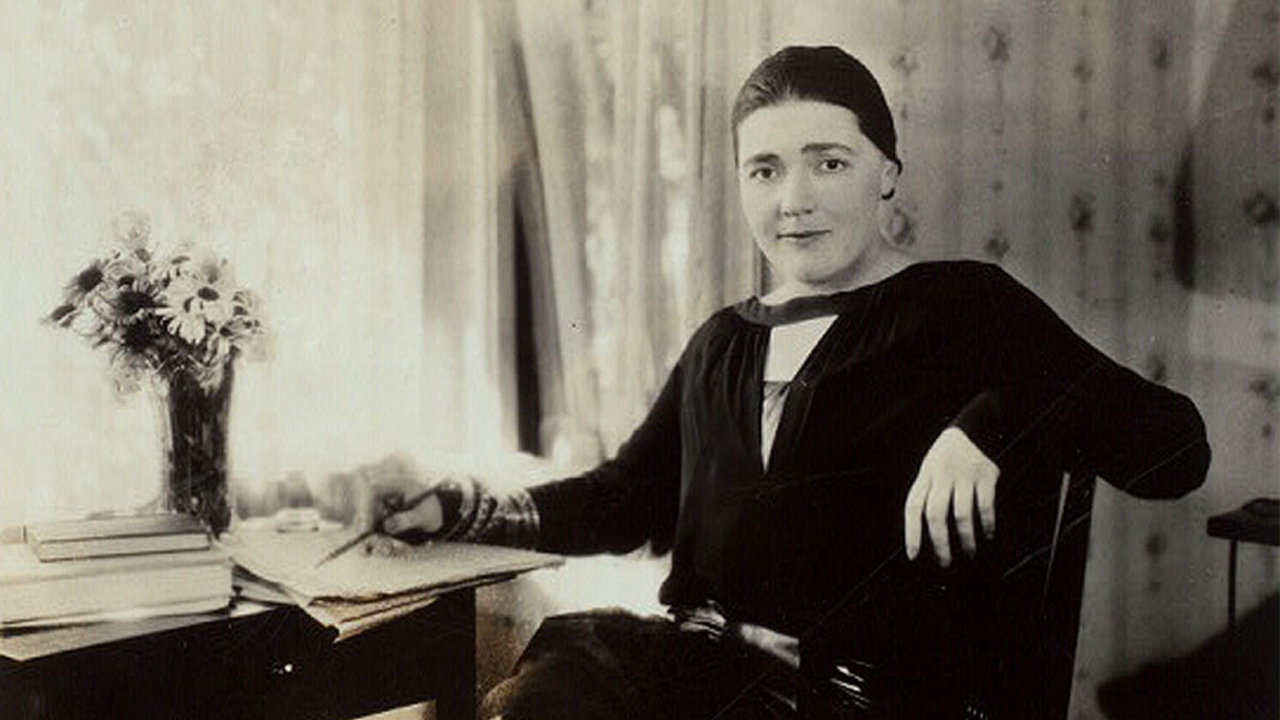
Author’s note: In April, I was formally installed as the Fannie Hurst Professor of Creative Writing at Washington University in St. Louis. The ceremony was not painful—it fulfilled the fantasy of overhearing the airbrushed memories spoken at one’s own funeral—but it required research into Hurst’s busy life and work, about which I knew little. What follows is an account, taken from my installation address, of what I learned.
Fannie Hurst’s 1958 autobiography, the modestly named Anatomy of Me, begins with a caution against its own rhyming title. “The chasms in the path of the autobiographer,” her first sentence reads, “lead to pitfalls of egotism and egoism.” Quickly shifting gears and figures of speech, she then customizes, through a domesticating simile, a proclamation of Julius Caesar’s she may have learned as a student at Washington University: “The autobiography of I saw, I did, I came, I went lifts from the pages of memory as easily as a cake from its greased pan.” Yet despite her warning against the convenient pitfalls of moi-writing, it is accurate to say that at WashU, Fannie Hurst, c’est moi and c’est nous: she is me and us, inescapably. She is in all of us, having formed many of us, notably those of us who have taught, studied, or read in the vicinity of the WashU English department.
It is Hurst’s name and original million-dollar bequest behind the Hurst Lounge on the second floor of Duncker Hall, the room surveilled by four angels where pretty much everyone in the literary business has, at one time or another, come to sell a book or win a job since the 1970s. It is her stamp on the visiting Hurst professorships that have, for half a century, drawn hundreds of good writers and critics to St. Louis, presenting a visiting history of Anglophone letters in progress. It is the books of her personal library—one half of these went to WashU, the other to Brandeis, the home of another Hurst Lounge—that help fill the shelves in the English department’s main office. And it is her life-size, somewhat ghostly portrait, all pale gown and calla lily, that commands a wall in Mary Jo Bang’s office on Duncker’s first floor, a blockbusting realist novelist visiting a remarkable avant-garde poet. Yet despite Hurst’s us-making ubiquity, a vanishing number of people, on campus or elsewhere, remember her own writerly legacy, eighteen novels, eight story collections, five plays, and countless articles deep. Though the competition includes the likes of John Gardner and Tennessee Williams, she may be the most broadly influential American writer ever to have attended WashU, and definitely the least appreciated.
For most of the early twentieth century, from the early twenties to the early sixties, Fannie Hurst ranked among the best-paid, best-publicized, most prolific, and most outspoken author-activists in the United States. Her hundreds of short stories outearned everyone’s but F. Scott Fitzgerald, who namechecked her snidely and jealously in his debut novel, the collegiate Gothic classic This Side of Paradise (1920). Her bestselling novels, translated into fourteen different languages, were the subjects of Hollywood bidding wars, from Lummox (1923), to Back Street (1931), to the racial passing spectacle Imitation of Life (1933), made into hit films in both 1934 and 1959. Her companionate marriage to the Russian émigré pianist Jacques Danielson—she kept her name, her apartment, and her own social schedule—contributed a new feminist term to the American language: the “Fannie Hurst marriage.” Her public speaking and fundraising for the New Deal were powerful enough to win her places on the National Housing Committee and at the Roosevelts’ private dining table. More than once, she joked that she had slept in every bedroom at the White House—with the possible exception of the President’s and the First Lady’s.
Though the competition includes the likes of John Gardner and Tennessee Williams, she may be the most broadly influential American writer ever to have attended WashU, and definitely the least appreciated.
In the years surrounding her death at 79 in 1968, however, with the New Deal transformed into an embattled Great Society and sentimental tolerance installed as institutional modernism’s fattest target, Hurst’s reputation plummeted, and she became the butt of not-great, not-unmisogynist jokes. The theme song of Mel Brooks’s 1970 film The Twelve Chairs, for example, a parody of Russian realism and Soviet cynicism, contains these immortal lines: “Hope for the best, expect the worst. / You could be Tolstoy or Fannie Hurst.” Hurst, who never wanted children, had no living relatives left to challenge her demotion to high culture’s vulgar American opposite, and few living critics have volunteered since. New modernist canons and syllabi, increasingly democratized since the 1990s, have opened to almost every modern with a manuscript besides her. In what follows, I will thus try to tell part of her story as she wrote and lived it. Fannie Hurst, c’est elle: that is her and hers, a story worth telling. As we will see, Hurst’s biographical story is, in its best-known chapter writ large, the creation and reception of Imitation of Life, the drama of the non-African American African Americanist. Restoring her to memory, then, invites me to address the white elephant in the room whenever I and other non-Black professors address Black writing: the question of our own racial identity when we teach or study a racial literature, a question that everyone concerned wonders about, but some are too polite to ask.
Fannie Hurst, who never made perfect peace with her inelegant given name, was born on a farm in Ohio in 1885 and raised a St. Louis city kid. She spent her first conscious years as a writer in a still-standing frame house on Cates Avenue, just north of what’s now the Delmar Divine on the Delmar Divide. Her parents, Samuel and Rose Hurst, were German-descended Jews armored by their American patriotism and vocal distaste for the freshly arrived, less assimilated East European Jews she eventually made a literary specialty. Dashes of Yiddish were spoken at home, but when Fannie asked about the principles of her family’s ancient faith, she was sent off to the public library to do her own research. Samuel, at the height of his career, entered that most St. Louisy of businesses and ran a shoe factory, Standard Heel and Counter, ascending to a higher rank than Tennessee Williams’s father, a mere division manager at International Shoe on Washington Avenue. From the lofty perspective of New York’s Central Park West, the mature Fannie liked to describe her girlhood as a Midwestern idyll of tedious ease, a still photo “tucked,” she explained, into the drowsy, premodern “world of phony security which antedated the World Wars.” But the truth was less comfortably sleepy.
Hurst’s excellent biographer Brooke Kroeger discovered that her family moved to the solid house on Cates Avenue only with Samuel’s success at Standard Heel, an event of Fannie’s late adolescence. Before then, there were displacements to at least eleven boarding houses, two major business failures, and continuous exposure to the alternating booms and panics of a pre-regulated Gilded Age capitalism. Fannie’s autobiography, condensing her family’s many moves into one adventure in group living, offers a tribute to a single innkeeper, a Mrs. Cleveland, whose husband’s library included a translation of Plutarch’s Lives. It was a book recommended to Jewish tenants, Hurst recounts, on the faulty assumption that its Greek Middle Platonist author “had never heard of Christianity.”
Restoring her to memory invites me to address the white elephant in the room whenever I and other non-Black professors address Black writing: the question of our own racial identity when we teach or study a racial literature, a question that everyone concerned wonders about, but some are too polite to ask.
Fannie took greater pleasure in nineteenth-century European novels, including Dickens’s David Copperfield (1850) and Balzac’s Père Goriot (1835), their romantic realism a lifelong touchstone despite her experiments in hyper-metaphorization and syntactical fragmentation—modernist ruptures she sprinkled lightly into potboiling social melodramas. She never admitted that Dickens’s childhood crash landing from comfort to poverty was itself a reference point, but her fifty-plus years of narrative fiction, often focused on laboring women, the kind that could be found in the smaller rooms at Mrs. Cleveland’s, told a different story. What she later cast as novel-building episodes of immersive slumming were encouraged by the prospect of supplemental pay. Weeks spent pulling shifts beside immigrant girls in shoe factories, garment sweatshops, and cheap cafeterias, the settings of her best adult writing, were not, at first, strictly adventures in ethnography.
Into some of the flushest years for the Hursts came Washington University, which Fannie finally chose because her mother could not stand the thought of her leaving St. Louis for the pioneering journalism school at the University of Missouri in Columbia. At twenty, Fannie joined WashU’s class of 1909, the first to enjoy the Gothic-style quad around Brookings Hall, originally built for the World’s Fair. She was one of just twenty women in a first-year cohort of 109 students at a time when only ten percent of eligible American women enrolled in college anywhere. Her father, writing the tuition checks, agreed with his willful, striving daughter that “knowledge is power” but did his best to make her see her exceptionality as a latent hazard. “That Washington University,” he grumbled, “is an old maid’s nest.”
Fannie took refuge in the just-opened, all-White women’s dormitory in McMillan Hall, these days, perhaps a little too fittingly, the site of WashU’s Women, Gender, and Sexuality Studies and African and African American Studies departments. She roomed on the top floor of the four-story Gothic tower she labeled the “test tube,” where she looked down methodically at a campus she planned to conquer with her typewriter. Her favorite English classes were encouraging, especially a lecture on the Major Elizabethan Poets that inspired a masque in blank verse. But she compiled a B minus average overall and thought herself “[m]ore conspicuous than distinguished” as a student. Her distinctive talent, as she then saw it, lay in drama as well as poetry and fiction. In her final year, she created a two-act operetta for WashU’s senior class show, The Official Chaperone, based on the unheroic subject of the troubles had in securing lenient monitors for school dances. (Think Footloose, roughly, but for mid-American Edwardians.) More substantial than the operetta itself were the student protests it generated. The cast and their supporters—Fannie, never shy, gave herself the lead role—“demanded the right to appear onstage in ballet costumes,” Brooke Kroeger reports. The administration and “scandalized parents objected,” and in the end the young actresses were made to retreat into “stiffened skirts.” This incident of gendered restriction assisted in Hurst’s recruitment as a first-wave feminist. By 1915, six years after graduation, she was informing reporters that the two great movements “sweeping the working classes to freedom” were socialism and women’s liberation. Despite her open delight in her growing affluence, the advances of the New Woman and the New Worker—she had been both—were never separable in her imagination.
By the same year, Hurst’s agents were boasting, at times sincerely, that she was the best-paid magazine writer in the nation. Running away to New York in 1910 under cover of attending graduate courses at Columbia, she began writing six or more hours a day and selling plot-driven stories of tenement yards, department store clerks, and picturesque strains between first and second immigrant generations. As sensitively summarized by William Dean Howells, the Dean of American literary realism, her short fiction, snapped up by Cosmopolitan and The Saturday Evening Post, explored “Hebraic comedy” to plumb “depths of true and beautiful feeling.” One of the first stories Fannie placed in a national magazine, “Romance en Casserole,” published in Cavalier in 1912, was typical in both its blunt quotidian detail (i.e., the casserole) and mawkish, Dickensian plot (i.e., the romance). Aggie, a young Manhattan waitress skilled at balancing plates while escaping from male customer’s wandering hands, must choose between two marriage proposals, one from a steadily employed bore, the other from a handsome but seemingly broke social worker who is in truth a wealthy freelance intellectual on a Jacob Riis-style field trip to document how the other half lives. Making what she assumes is the safe choice of money over love, Aggie fails to notice when her Rockefeller in rags, walking off in dejection, climbs into a waiting limousine stashed around the corner. In her practical calculation, she has unknowingly rejected her suitor’s upright life of luxury, not to mention the preferred identity of her creator, one Fannie Hurst, who aspired to become the precise artistic equivalent of a compassionate social worker with a chauffeured ride. Hurst’s vehicle to fame and fortune, she later reflected, was “the “anonymous mass” of toiling women, flowing along Broadway “like slow molasses,” who, “if killed in a plane crash, were designated as ‘and others.’” She would give them individual if common names, these Miss Smiths and Jones and Cohens, but she would not condemn them to dreams of indistinction. They too could think and be rich in preferred ambits of desire. To cite another, somewhat different artist of the working class, lyricist Jon King of the Gang of Four, Fannie unmasked the distilled wisdom of women on the eight-hour clock: To hell with poverty!
From the lofty perspective of New York’s Central Park West, the mature Fannie liked to describe her girlhood as a Midwestern idyll of tedious ease, a still photo “tucked,” she explained, into the drowsy, premodern “world of phony security which antedated the World Wars.” But the truth was less comfortably sleepy.
From one angle, at our hundred-year distance, Hurst’s schmaltzy naturalism makes her a kind of art monster in reverse: not a great avant-gardist with noxious politics and a track record of abuse, but a respectably woke voice, responsibly raised for some of the right intersectional causes, with an unforgivably corny style. From another, equally telling angle, however, Hurst’s work nowadays looks like some of the most cannily effective proletarian literature ever produced in the United States. Her audience was composed, in no small part, by the crowds she wrote about, the millions of young, unmarried American women, many the children of new citizens, who joined the urban workforce in the decades after 1910. Her fiction found its lucrative groove in “bleeding with and for” the single working girl, Hurst testified, and that working girl shelled out for her in turn. Unlike the consciously Marxist, party-approved varieties of proletarian writing that galvanized American literary debates during the Great Depression, Hurst’s version was as popular as it was populist. Of and for actually existing wage-earning women, frank in its depiction of chosen pleasures and everyday sexual harassment, her stuff was eagerly consumed by the massive proletarian audience the editors of The New Masses mostly only dreamed of.
Hurst, a salon semi-socialist rather than a wordy Communist in the company of Richard Wright or Lillian Hellman, understood this irony well. And so, revealingly, did Leon Trotsky, the most literary of the Russian Bolsheviks who made proletarian art the global watchword of the early twentieth-century cultural left. Hurst, received by Trotsky for a private interview outside Moscow in 1924, the year of Lenin’s death, discovered that the single book on his neat desk was a copy of her ambitious new novel, Lummox. It traced the basement-to-grave saga of Bertha, an inarticulate Baltic cleaning woman born on the New York waterfront and raped by her WASPy employer’s effete poetic son, her graceful inner life belying the clumsiness of Hurst’s title. “I am a great admirer of your work,” Trotsky told Hurst in the broken English he had learned when exiled to Fannie’s territory of the Lower East Side. “Lummox,” he managed to pronounce, “I know so well I can recite most of it from memory.” She shifted uncomfortably after he launched, with near-photographic accuracy, into the meat of an early chapter. Was it right, “he interrupted himself to ask. ‘I don’t know,’” Hurst confessed, “you will have to let me hold the book” to see for sure. Trotsky, at least, was not about to confine his modern English intake to the Great Men of 1922 or to lesser Cubo-futurists of the factory floor. To his exacting mind, then mainly turned to running the Red Army, Hurst’s egalitarian sentimentality, the usual sin condemned in “scribbling women,” only enhanced her virtues as a memorable proletarian author. Strange as it seems, the leader of the Soviet Left Opposition was captivated and impressed by what literary critic Jane Tompkins later termed “sentimental power,” the monumental effort of sentimental fiction to reorganize culture—in Hurst’s case, modern, urban working-class culture—in women’s interests. Some women’s interests, anyway.
To our best knowledge, Trotsky neglected to memorize a single page of Hurst’s novel Imitation of Life, published in the Great Depression year of 1933. But it remains her best-remembered, an enduring contribution to American racial fantasy, and I would not be surprised if it was the one title by Hurst you had heard of before reading this piece. Like Harriet Beecher Stowe’s Uncle Tom’s Cabin (1852), its prototype in maudlin agitation, Imitation of Life is a galling, do-gooding paradox, at once resolutely progressive, paternalistically racist, and gapingly open to anti-racist revisions. Stowe’s novel, the little something that sparked the Civil War, bred tenacious stereotypes and ugly minstrel shows, but just as many abolitionist tracts and Black literary classics, for and against and both. Hurst’s Imitation generated no social cataclysms, but plenty of studio movies, popular telenovelas, postmodern drag shows, late-career REM singles, and proliferating Black parodies in all genres, caustic and absurd.
The Harvard critic and filmmaker Henry Louis Gates, Jr., tracing intertextual chains instead of hybrid DNA results, has insisted that Imitation of Life is “a part of the African American canon,” maybe the most compelling White-authored “Black novel” ever written. In the form of its 1959 Hollywood film version, he notes, no text “was more important to me as a ‘colored’ child growing up in West Virginia.” Multiple memoirs and interviews find Gates relishing the memory of his relatives gathered around the TV whenever Imitation, remade by German director Douglas Sirk as a Technicolor, Civil Rights-tinged soap opera, appeared on the “Late Late Show.” Everyone in the family circle still awake when the movie ended found themselves “boo-hooing all over the place” when the notorious Peola, the light-complexioned, racially passing daughter of dark-skinned Delilah, finally returns to Blackness by crashing her mother’s funeral. “I’m sorry, Mama…, I did love you,” cries Peola, embracing the casket, authentically but too late. Importantly, this version of the scene does not appear in Hurst’s original novel, which instead abandons Peola in race- and mother-denying turpitude and indulges in the empty-headed, would-be Black dialect that infects every utterance by and about Delilah, Hurst’s awkward redemption of the distorted figure of Aunt Jemima. “Ain’t gonna miss no trick when ’Lilah rides to heaven,” reads one of Hurst’s less embarrassing outbreaks. She casts Delilah as the novel’s presiding working artist, but White tears are the ones jerked here. Like the New Deal reforms Hurst touted while polishing Imitation’s drafts, these tears melt the assumption that her renditions of proletarian solidarity justly valued Black women’s labor and invention.
Even so, Gates’s definition of Imitation of Life as a cog in the African American canon is not just gilding the magnolia and surrendering to privileged Black nostalgia for the ironic best of segregation. Black literature takes its identity not from the biological or social being of its authors, Gates argued, tilting against the remains of the Black Arts Movement, but from its intent to build a tradition of text-on-text commentary. It becomes Black, so to speak, in its status as grist for later Black books, and in its intent to comment, or make that “signify,” overtly or otherwise, on such books previously linked by textually demonstrable interchanges. By both tokens, its inspirations and its upshots, Hurst’s melodrama applies for admission into the school of Douglass, Du Bois, and Dove.
Her father, writing the tuition checks, agreed with his willful, striving daughter that “knowledge is power” but did his best to make her see her exceptionality as a latent hazard. “That Washington University,” he grumbled, “is an old maid’s nest.”
An NAACP board member and the most prominent White writer to volunteer as an ally of the Harlem Renaissance, Fannie helped to pay Zora Neale Hurston’s Barnard tuition and briefly employed her as a literary secretary. The two spitballed some of Imitation’s plot while Hurston drove them up to Niagara Falls, a women-on-the-road adventure that’s been compared variously to the travels of Huck and Jim and Thelma and Louise. Hurston—she and Hurst are shelved back-to-back, spines touching, in WashU’s Olin Library—responded with private defenses of the published novel. Her public engagements were more conflicted, including her playfully anthropological 1942 “Story in Harlem Slang,” in whose glossary “Peola” is defined as a general noun for “a very white Negro girl.” Langston Hughes, another Harlem friend of Hurst’s, met Invitation with a typically cagey blend of graciousness and satire. He informed Fannie that the initial, 1935 film rendering of Imitation was “the first serious treatment of the Negro problem in America,” and then rewrote it as the comic target of his short 1938 play Limitations of Life. In Hughes’s lampoon, the racial tables are turned, and a “pretty blond maid” waits on a grand Black lady clad in the rather Hurstian attire of a “trailing evening gown, with tiara and large Metropolitan Opera program.” The most pointed post-Imitation of all, Toni Morrison’s 1970 debut novel, The Bluest Eye, features a protagonist named Pecola—one “c” note more than Peola—who is haunted by Hurst’s text along with her hunger for clipped White features and sapphire eyes. “Pecola? Wasn’t that the name of the girl in Imitation of Life?,” asks a new neighbor who meaningfully arrives with her “long brown hair braided into two lynch ropes.” Morrison’s book draws Hurst into its Black Ohio world to demonstrate Imitation’s antagonism to Black life. Talking back to Hurston and Hughes’s responses in the bargain, it signifies on the Great White Black American Novel to suggest that signifying should stick to less deathly material.
I did not read a word of Imitation of Life before Henry Louis Gates landed temporarily at Duke to teach a graduate course on Black women’s fiction. When I am asked, by myself and others, to account for my own hope to speak to African American literature, names other than Hurst’s rush in, Gates’s high on the list. But despite the unforgiveable inflections of Imitation of Life, I think she knew this much: that all of us Americans are forever locked in interracial exchanges, heated and enlightened, freeing and wounding and frequently unequal, and that we and our country are the combined stuff these exchanges are made of. Her perception leads me to this closing judgment: the flood of white ally literature that supplied the racial reckoning of 2020 gets what counts wrong. Robin DiAngelo’s White Fragility (2018), for one, a book which appears to misdate the Emancipation Proclamation, grasps that White liberal guilt is itself a form of White indulgence, a self-regarding emotional set that “protects racial inequality.” Her identity-sealing prescriptivism, however, proceeds on the assumption that the beginning of anti-racist wisdom for White Americans is admitting that interracial experience has had no real effect on their self-constitution; whiteness alone rules there. But this is just not so: Gates saw this; Fannie Hurst saw this; even the least redeemable characters in Imitation of Life see this; and I have seen it again and again, or so I pray. Hurst was in part what the genius of Black American expression made her, and so are you and I, whoever you are. African American literature is, among other, local and global things, the common matter of American literature, American life, and American selves. One of our shared obligations as custodians of a profoundly threatened, still necessary multiracial democracy, forever delayed but always becoming, is to join Hurst in cultivating that fact.