Of American Frogs and Pirates
By Chris King
August 8, 2025

When I saw the advertisement for a frog jumping contest, I knew I had to be there, but I did not know what to expect. I could not help but anthropomorphize the event in my mind, picturing two frogs alerted to jump from a still position, with the distance of their one prompted jump being recorded as their score. I wandered up on the competition just as the first heat was getting underway, and it was nothing like a human long-jump competition. The handlers of the competing frogs were not seasoned adults with complex strategies for teaching a frog to jump from a dead sit upon a prompt. The frog handlers were children. Their contribution to training their frogs appeared to be getting their frogs to the competition alive.
The first heat was for the smallest frogs—and toads; organizers agreed upfront to accept toads as well as frogs, though the event’s promotional materials (and the rest of my story) mention only frogs. The rules of the game stipulated that competing frogs be placed in the middle of a tarp with a long rope encircling them to demark the finish line. It was not a frog jump competition, but rather a frog race, and a frog race in the round, as the first frog to cross the finish rope in any direction on the compass whatsoever was judged the winner. A man (never identified by name, role, or relationship to the competition) was working a squirt bottle, periodically blasting each of the frogs in the rump, as if to encourage forward motion.
In the end, I saw three frog races, three heats for increasing sizes of frog, though the largest category should not be imagined as enormous bullfrogs, but still rather small critters. (No species was ever identified by organizer or handler; and, though I am very fond of frogs, I see all frogs as frogs without any discerning eye for distinct species.) The three races were won in three different ways, with the winning frogs departing in three different directions. There was the steady workhorse, or rather workfrog, who established an early lead and then just gradually moved toward ineluctable victory. There was the frog that advanced rapidly to the finish line and then sat on it without crossing it for most of the competition while its two competitors advanced, until the frontrunner finally leapt to victory. And then there was the frog who did not seem to have any drive or direction whatsoever for most of the race but then suddenly pogoed over the finish line, in two quick hops, going from last to first.
As a surprise, we were told there would be a fourth race where the winners of the three previous heats (named, in increasing size: Freddy, Jerry, and Lollihop) competed for the final trophy. There was an edgy guy—not the quiet man wielding the squirt bottle, but another organizer—who had been running his mouth, trying to stoke up some buzz around the competition and to spark some fun. After the first heat, he encouraged onlookers to root on their favorite frog or—and herein emerges the edge—to heckle or ridicule the frog they wished to see lose.
This wag got me into the spirit of things, so after the announcement of the surprise fourth all-winners competition, I announced a $5 wager that the largest frog would not win, and the loudmouth who had been encouraging us to heckle the frogs we wanted to see lose took me up on my bet. I should have run a more robust book on my wager because, as soon as the all-winners competition was opened, the littlest frog, Freddy, in a flurry of instant and nimble hops, jumped across the finish rope, flew off the tarp, and almost disappeared into the parking lot.
Yes—the parking lot. Though a frog jumping competition has the aura of a state fair or summer camp, this race was staged on a sidewalk in a strip mall because it was part of an event at a craft beer bar that rents one of the storefronts in that strip mall. That craft beer bar is the Sinkhole in Bloomington, Indiana, a college town that is home to the flagship campus of Indiana University. The Sinkhole is situated, appropriately for its sagging name, at the very bottom of Bloomington, and the campus sits at the top. Though nothing in this small town is very far from anything else, the Sinkhole is securely off campus, away from collegiate action, and very much a townie bar.
I discovered the Sinkhole one day after hiking the B-Line Trail, an urban hiking trail that follows an old railway line, from its top to bottom. The B-Line Trail happens to end on the east-west street (Winslow) at the south end of town where the Sinkhole is located, just a few blocks to the east. My phone’s map program showed me this when I got to the trail’s end and reasonably wondered where I could get a good cold beer.
The first time I wandered into the Sinkhole, it happened to be Father’s Day. My daughter just graduated from Indiana University in May 2025 and has lived in Bloomington for the past four years. Though I was visiting her on Father’s Day, the timing was a coincidence, since I take the somewhat obnoxious view that holidays are a fiction of the calendar and every day is, say, Valentine’s Day if you are a lover or Father’s Day if you are a father.
Father’s Day was important to how my relationship with the Sinkhole developed, however, because right after I traipsed into the bar off the trail that first day and ordered a delicious beer, a Sinkhole regular came in behind me named Frank, as the bartender greeted him. The bartender immediately said to Frank, “You must be wondering why I have a PA set up on a Sunday when we never do music on Sundays. Well, it’s Father’s Day, so I figured we can do an open mic for dad jokes.”
Frank said, “Yeah? My dad died during an armed robbery where he was committing the armed robbery. Is that funny?”
The bartender said, “No, Frank, that’s not funny at all. I’m sorry to hear that. What are you drinking?”
Of course, I turned to Frank, who had a profound New Jersey accent, and started telling him my mobster stories, and the next thing you knew, I was a regular at the Sinkhole whenever I was visiting Bloomington to see my daughter.
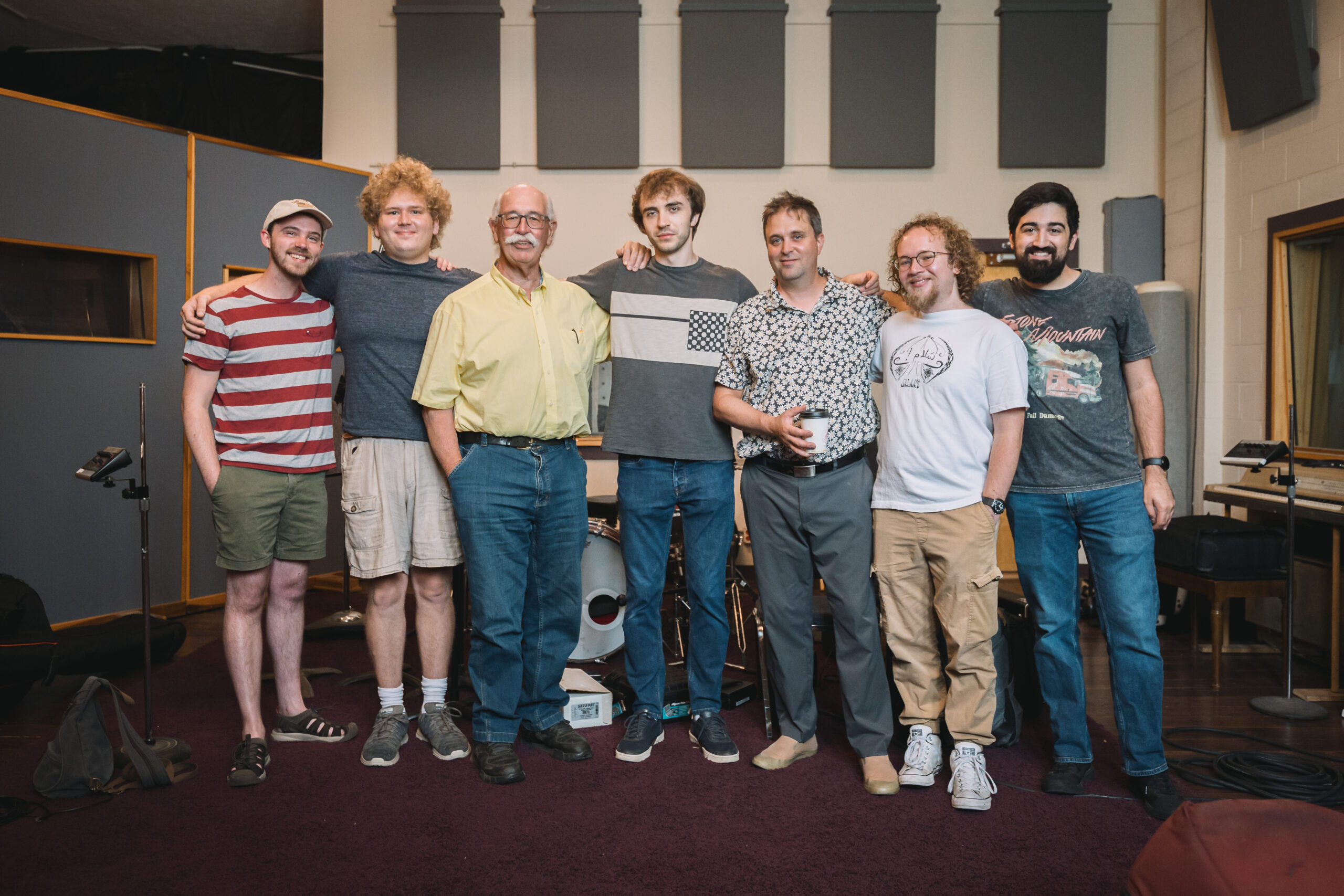
The frog jumping competition was just one element of a larger festival at the Sinkhole that included live entertainment. After the victorious frog was crowned and the handlers of all the winning frogs were awarded prizes, a band agreeably titled American Pirates took the stage and started playing tuneful and smart American roots music. Their own songs were nuanced and clever. When they played a Bob Dylan cover, it was a deep cut—“Jokerman” off Infidels (1983). They really won my heart, though, when they asked if there were “any shape-note singers in the house,” and there were, and they came forward to sing some old hymn with the band, finding the proper notes with the shapes of their mouths.
The Bloomington campus of Indiana University is home to the largest and one of the best music schools in the country. Bloomington is blessed with talented musicians. Forget the current students, who will go on to entertain the world when they leave town, but mostly cluster on campus. I am talking about the alumni of the music school who find it hard to leave this livable, liberal college town, surrounded by rolling hills and rivers. They include countless talented musicians of every stripe. I was not surprised to see that the edgy guy who encouraged us to heckle the frogs we hated (and took me up on my $5 bet) was the frontman of American Pirates.
This guy mostly played a beaten-up little piano, but he moved around to other instruments in front of a crack backing band. At one point, he made a reference to when he was “at the music school,” which came as no surprise. When I talked to him after their performance and told him that I might want to write something about my experience of the day, he said he had studied harpsichord but would prefer I leave that out because he wanted “to look more mysterious.” But he talked about going to the music school while he was performing, and the American Pirates’ Bandcamp page outs him as a harpsichordist, so I dishonor his wishes here.
This talented musician and frog heckler, one Aaron Jones, hails from Springfield, Missouri, where he once saw a frog jumping competition, which gave him the idea to organize one at the Sinkhole as part of a festival that included his band’s musical performance. Missouri, of course, claims as a native son Mark Twain, whose first breakthrough story was about a jumping frog in California. I am sure that is why they were jumping frogs in Springfield, Missouri, and why the notion of a frog jump tickled my fancy, as a transplanted Missouri man and Mark Twain fan.
The experience of watching the frog races sent me back to my Twain, to “The Celebrated Jumping Frog of Calaveras County,” where I was surprised to see what an odd and unspectacular story first made Twain’s name. I was amused, given my attempt to run a gambling book at our frog races, to be reminded that Twain was really writing about a chronic gambler, not a dedicated frog handler, and the story pivots on sabotage when the hero of the story’s pet jumping frog gets weighted down by buckshot and thereby loses the competition at the heart of the story.
No such shenanigan was at play in our frog races. Admittedly, the man with the squirt gun was in a position to favor any frog over its competitors by directing all of his water blasts at that one frog’s rump, though I am not sure I ever saw a clear correlation between a frog being blasted from behind by water and actually moving toward victory. I have no reason to believe the guy with the squirt gun was in cahoots with his fellow organizer who bet against me. At any rate, I won the wager, so any conspiracy to propel the bigger frog to victory—the thing that I was betting against— failed, as the smallest frog, Freddy, bounded to the most effortless win of the day.
My wager attracted the attention of my competition, so to speak, another writer covering the event, Dave Askins, who asked for my name and to clarify the bet that I had wagered. IU-Bloomington also has an excellent media school, and the town does pretty well for local publications. This man reports for his own impressive online journalism enterprise, the B Square Bulletin, and wanted me to know that he was covering the frog jumping competition, not as a feature story, but as sports news.
“Aren’t the frogs athletes?” he asked.
I did want him to know that I never collected on my winning bet, as I thought it would be in poor taste, given that I was betting against the singer of the band and would rather he keep my $5 as a tip.
I mentioned this to the singer of the band himself, the frog heckler, the American Pirate, Aaron Jones. And he confirmed his existence as a musician when he said that it was a good thing that I was not going to collect on my $5 bet. “I’m broke,” he said, then walked off in search of a free band beer.