Jungle Warfare in the Western Hemisphere and Big Stick Foreign Policy
The United States muscles up and the “Green Hell” of Panama returns.
February 28, 2026
If your country’s borders have deserts, mountains, or jungles, you must train your army to fight in them. Likewise, if you intend to fight in other people’s countries—as an empire, an ally, or one of the world’s policemen—your troops must be able to function in the harsh landscapes there.
Recently, the bellicosely renamed US Department of War made two connected moves. In December 2025, “The Army shuttered its largest command [US Army Forces Command, or FORSCOM, as most called it] to activate in its place a new organization focused on soldiers’ efforts in the Western Hemisphere”: the US Army Western Hemisphere Command.
And in August 2025, the long-defunct US “Jungle Warfare” school in Panama (formally, the Jungle Operations Training Center, or JOTC) was restarted after 25 years, as the Combined Jungle Operations Training Course (CJOTC), or Jungle Operations Training Course-Panama (JOTC-P).
The original JOTC ran from 1953 until 1999, when its home, Fort Sherman, on Panama’s Atlantic side, was handed over to Panama, according to the Panama Canal Treaty of 1977. Army jungle warfare courses moved to Hawaii. The Marines also have had a jungle course, in northern Okinawa, since 1958, and small numbers of US troops have been trained in foreign militaries’ jungle schools, such as ones in Brazil or the Philippines.
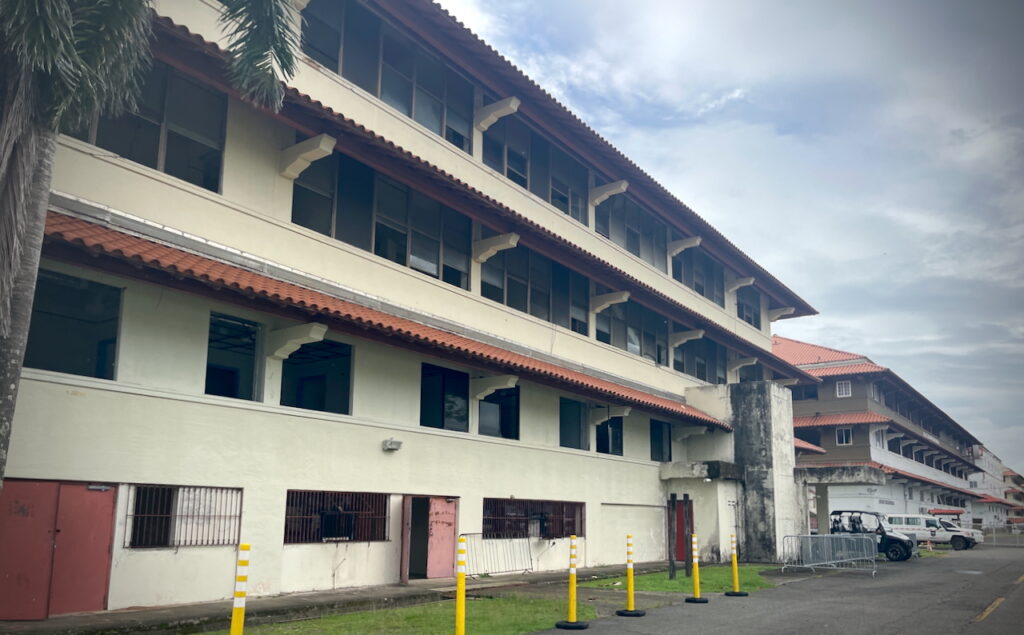
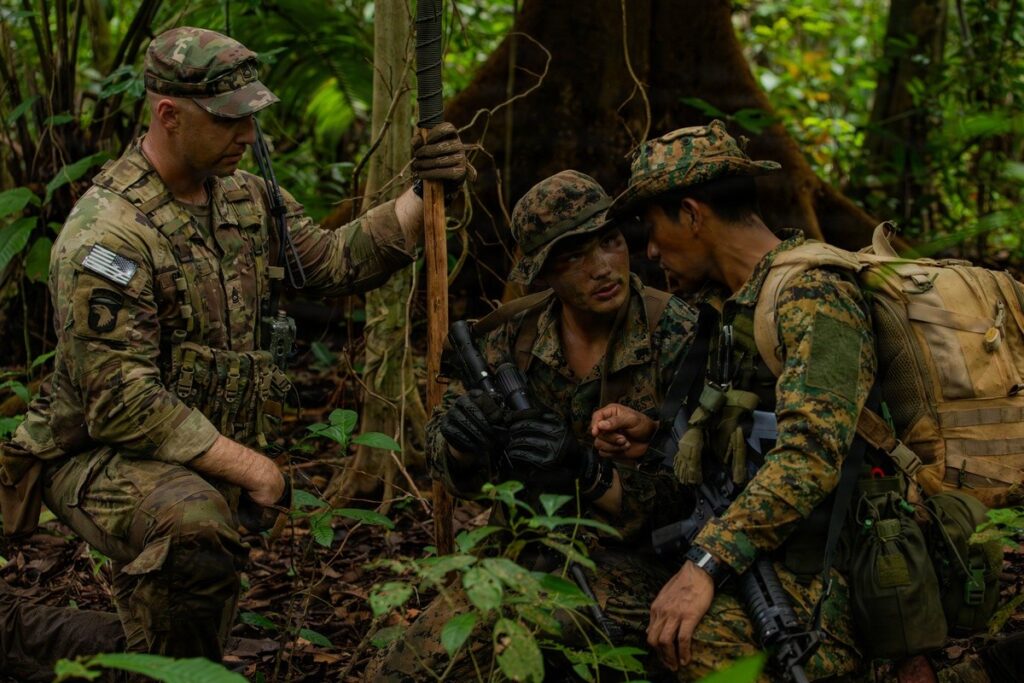
CJOTC/JOTC-P was said to be (re)opening because Panama offers more rigorous training, with its triple-canopy jungle full of hazards and hardships, and because the terrain better represents the continental Americas. But according to the US Army, “The course is about…unity between nations…. Each service member…is expected to work alongside international [Panamanian] counterparts throughout the course [and] the course’s [cadre] is balanced between U.S. and Panamanian service members…. Together, the two countries continue to build the interoperability and trust essential to strengthening regional security and responding effectively to future challenges.”
It is odd to hear Panama’s military being praised now as an equal partner with the United States. For many years those in the US military often spoke of the Panamanian army in the way that, a generation earlier, they spoke of the ARVN (the South Vietnamese army): Patronizingly, belittlingly, and condemnatorily.
The course is in three phases over 18 days. Phase One, led by Panamanian cadre, teaches “jungle survival fundamentals.” Phase Two, led by Americans, teaches small-unit tactics in that environment. Phase Three is field-exercise missions, and the “Green Mile” obstacle course known as the “Green Hell,” back in the day. (By extension, the course itself was sometimes called this.)
It is odd to hear Panama’s military being praised now as an equal partner with the United States. For many years those in the US military often spoke of the Panamanian army in the way that, a generation earlier, they spoke of the ARVN (the South Vietnamese army): Patronizingly, belittlingly, and condemnatorily.
In truth, one of the main purposes of the jungle course is likely to signal “heightened military presence” near the Canal during tensions with China, which “has been aggressive in establishing a toehold in Latin America” through soft power. Two days ago, Panama canceled key port contracts for a Hong Kong conglomerate and gave the work, at least for now, to Danish and Swiss-based companies instead. Panama also “threatened [the conglomerate’s] employees with criminal prosecution if they defied orders to leave,” NBC reported.
In a time of big-stick energy by the Trump administration—the decapitation of Venezuela’s government and reconfiguring of its oil industry, airstrikes on small boats in the Caribbean, the effective blockade of Cuba, and hemispheric threats against Colombia, Greenland, Mexico, and Canada—this was a win for Panama with the United States, but that is an increasingly mixed bet. President Trump said more than a year ago that the Canal Treaty was a “rip-off” and that he was thinking about “taking back” the Canal, in part to deny China economic and political opportunities in the region. “But the risks of Latin America getting caught in a US-China vise are not insignificant,” says Monica de Bolle at the website of the Peterson Institute for International Economics.
• • •
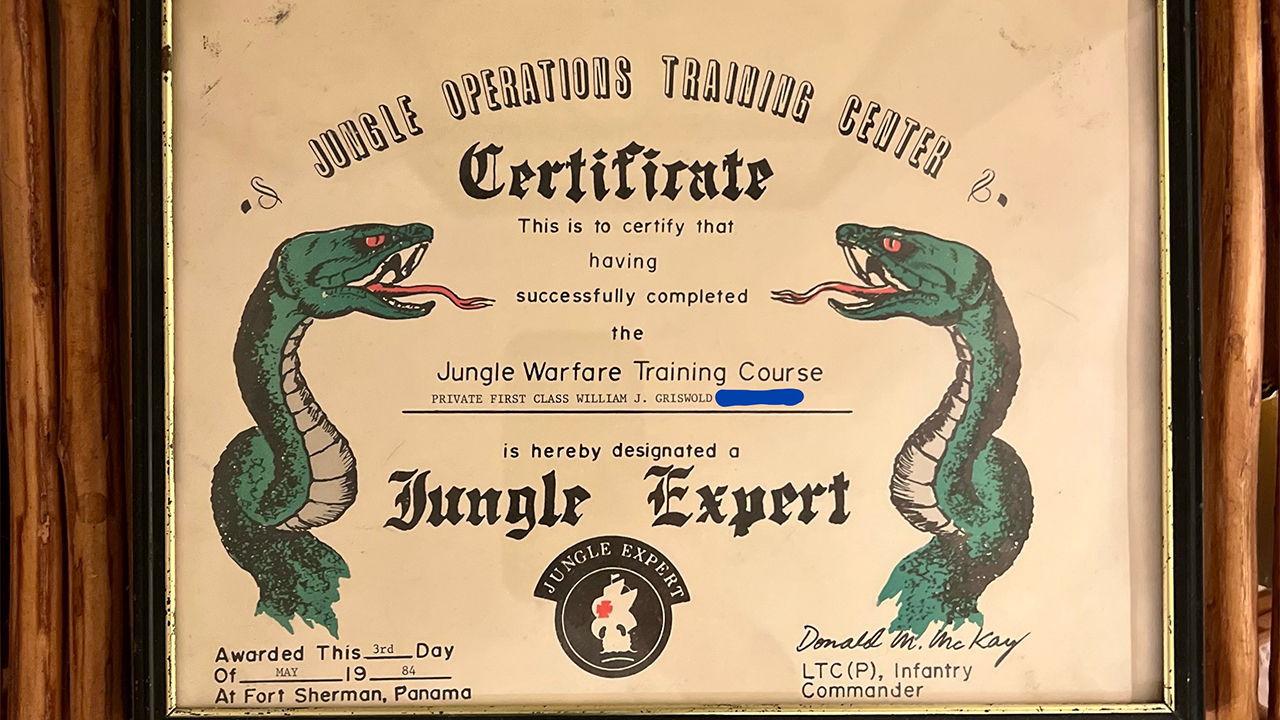
Back when I attended the original Jungle Operations Training Center, in the spring of 1984, it was run entirely by US Army cadre, and the Russians were the bad guys. We were told a Russian trawler offshore was monitoring and trying to disrupt our radio communications on field exercises, and the outlined figures on paper targets at army rifle ranges wore Warsaw Pact helmets. “Plus ça change, plus c’est la même chose,” as the first industrial-colonial power in Panama says. But the rigors of the Panamanian landscape and its climate have proved difficult for all foreign comers for 525 years.
Several of my friends and I, stationed at a combat engineer battalion at Fort Campbell, Kentucky, were chosen that spring by our hard-charging young lieutenant for the four-week JOTC engineer course, which I think was the longest version available.
I wrote once, here: “I remember landing at what was then Omar Torrijos airport, in a chartered jet from the United States, clutching our weapons between our knees, and being surprised at what were then Guardia Nacional forces patrolling in and out of the terminal with full-auto rifles with rounds in their magazines and probably chambers, unlike ours. No U.S. airport I had ever seen looked like that then. We were hustled onto army deuce-and-a-halfs in the middle of the night and sped across the isthmus on the sole highway, supposedly to keep our visibility and anti-U.S. sentiment down.” Loud, diesel-belching landing craft took us over some body of water—Gatún Lake, which supplies the Canal’s locks with water; or Limon Bay, between the city of Colón and “Fuerte Sherman”; or down the Chagres River—to Fort Sherman.
In a time of big-stick energy by the Trump administration—the decapitation of Venezuela’s government and reconfiguring of its oil industry, airstrikes on small boats in the Caribbean, the effective blockade of Cuba, and hemispheric threats against Colombia, Greenland, Mexico, and Canada—this was a win for Panama with the United States, but that is an increasingly mixed bet.
It was my first exposure to the tropics. Hundreds of land crabs clicked across a coral tidal flat behind the barracks; coatimundis grazed in herds, their long ringed tails standing up straight together. The heat, humidity, and smells of vegetal rotting and the sea were overpowering. It was the first time I, a kid from the lower Midwest, saw indigeneity, in the persons of the Cuña [now Guna], from the San Blas Islands, who staffed Fort Sherman’s mess facilities.
Panama had fire ants and killer bees, still unknown in the States then; mosquitoes that had eaten conquistadors and cared little about army bug juice that was 100 percent DEET; and Bushmaster snakes, scorpions, vampire bats, and Chagas’ Disease.
It is hard to compare miseries, especially when you are a young bullethead and think everything new and rigorous is exciting. We arrived at the start of April and began training and operations. On Easter weekend a soldier in the course had a heat stroke during a long patrol in the jungle, far from any road. The canopy was so thick a helicopter could not get a jungle penetrator down to us for his extraction, so we took turns carrying him out as a team on a litter through the dark, slippery hills, getting punctured by Black Palm spines and having heat exhaustion ourselves.
A week later I was helping to chop out a landing zone on a hilltop and was so exhausted and slimy with sweat that my machete bounced off a sapling and chipped my tibia. I was medevacked—the view from the Blackhawk of the lights of the canal and cities was beautiful—and spent time in Gorgas Hospital, pumped full of antibiotics to prevent gas gangrene.
After a few days I finished the course, including the Green Mile, which included a rappel down a cliff, a (simulated) wounded-man carry down Devil’s Beach, a swim across the Chagres River with a poncho raft, a traverse of a ravine on wire ropes, a climb up another cliff on cargo netting—and then the actual obstacle course. Someone said recently online that a platoon had to finish the Mile within a specified time or else everyone failed and had to do it again. I do not remember that, but it sounds reasonable.
A 33-year army combat veteran who also went through JOTC in the 1980s told me he remembers the stinging caterpillars, the “forest of fungus” that grew in the groin, a display jar with a soldier’s toe or thumb in it after a Fer-de-lance bite, and how the jungle canopy makes terrain look level from the air, “But you get down there, and the hills are wet and soggy, and the first thing you grab is a Black Palm that impales your hands.
“In a jungle environment, you’re not just fighting an enemy, you’re also fighting the environment,” he said. “Tech [in modern warfare] gives us, or our adversaries, an advantage, but some of those advantages don’t apply” in the jungle.
A vet who served in the 193d Infantry Brigade in Panama and went through JOTC in that period told me he remembers how cadre said not to wear clothing with any starch in it, because organisms would feed on it and eat your uniform overnight. He remembers stepping accidentally on a 15- to 20-foot black snake, he claims, while walking point in a land navigation class, and at night hearing the growl of jaguar, followed by the squeal of a wild pig.
“One of our guys accidentally wandered into a killer bee nest and looked like the Elephant Man, man!” he exclaimed. Every class seems to have had one of those souls.
Another vet who did JOTC twice in the late 1970s, first as a Ranger and the second time as Special Forces, told me, “The night compass navigation course was a trip, literally….” Students navigated a cliffside route in the day then returned to do it again that night, using the same waypoints, but now in the “pitch-black dark, the heavy, dense jungle, working through the course, moving from [marker] stake to stake, slowly and methodically, as you do.”
It was my first exposure to the tropics. Hundreds of land crabs clicked across a coral tidal flat behind the barracks; coatimundis grazed in herds, their long ringed tails standing up straight together. The heat, humidity, and smells of vegetal rotting and the sea were overpowering.
“One of the cadre moved the last stake from its previous location, approximately 20 feet from the cliffside’s edge, to about three feet from the edge,” the man told me. “I found the stake, logged the markings, and decided to eat a mouthful of granola before heading [back] on the reverse azimuth.
“[T]he man who started 30 minutes after me caught up and walked past me, looking for the stake [and] tripped over it and went over the cliff and landed in the Atlantic. I looked over the edge and saw him being pulled into an inflatable patrol boat. They deposited him back on the rocks, and [he] climbed up [and] had to start over…. During the morning briefing where they announce the night’s results, we learned that six of our class went over the cliff.”
• • •
Graduates of JOTC in that era received a paper certificate and were authorized to wear a “Jungle Expert” patch in bright colors (for dress uniforms) or olive drab and black (for battle dress uniforms, or BDUs). The patch, based on “insignia…originally approved for the Caribbean Defense Command on May 3, 1944 [and] re-designated for United States Army Forces Southern Command,” showed a galleon in full sail.
“The galleon is symbolic of the Caribbean area,” an army webpage says of the insignia. “This type of ship is usually associated with the Caribbean area since it predominated during the Spanish regime. The blue background represents the color of the Caribbean Sea. The cross [on the galleon’s sail] was the insignia of Columbus, the first explorer to land in the Caribbean area.”
More recently, online, veterans have been calling the old JOTC patch’s design “the ship of shame,” even as they lament not being able to wear it. Its authorized use ended even during my short years in the army, I think, but I always got the feeling that the decision had to with the wording of “Jungle Expert,” not any politically-correct reason. Simply because one has earned a jungle expert patch does not mean that one is an expert in jungle matters. It is somewhat embarrassing to wear a field jacket to Starbucks now and see the barista begin formulating her question.
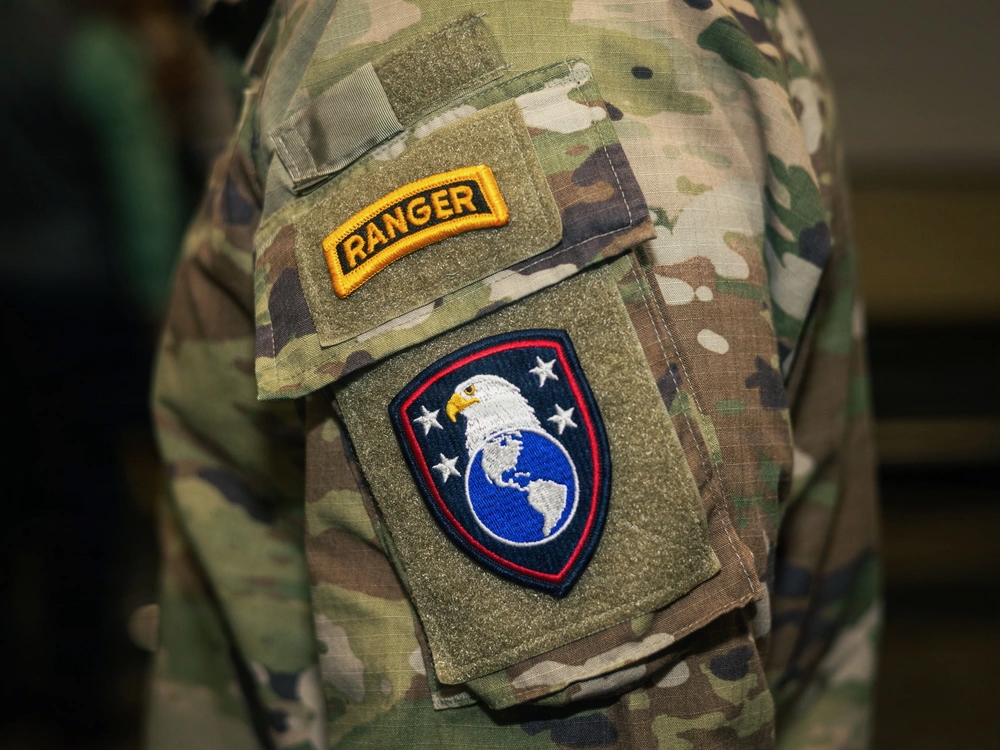
Graduates of CJOTC/JOTC-P, at what is now called Aeronaval Base Cristóbal Colón, will get a “tab,” a small, arc-shaped patch that goes over the unit patch on the upper left arm, that says, simply, “Jungle.”
Since the new course opened, most attendees have been Marines, Task & Purpose reports. The first large class of soldiers just finished a few days ago, which marks the course’s full functionality and intentions for the future.
• • •
That first time I went to Panama as a soldier, in 1984, the US Army School of the Americas (SOA) was still in business there. SOA was not to be confused with the Jungle Operations Training Center in the period I have described, though it too was concerned with hemispheric cooperation and influence, and may have had some common roots and pedagogy.
A brief for Congress in 1994, archived on the webpage of the Federation of American Scientists, says, “The School of the Americas teaches a variety of courses relating to US Army doctrine, from basic patrolling techniques to the Command and General Staff Course…. The School of the Americas is charged…with the mission of developing and conducting instruction for the armed forces of Latin America, using the most doctrinally sound, relevant, and cost-effective training programs possible. [T]he School will promote military professionalism, foster cooperation among the multinational military forces in Latin America, and expand Latin American armed forces’ knowledge of United States customs and traditions. The school [will teach] joint and combined operations, special operations and civil military operations, noncommissioned officer professional development, and resource management.”
Simply because one has earned a jungle expert patch does not mean that one is an expert in jungle matters. It is somewhat embarrassing to wear a field jacket to Starbucks now and see the barista begin formulating her question.
But for many years during its time in Panama (1946-1984), SOA was referred to as “The School of the Assassins” and “The School for Dictators,” due to its graduates using their training (including on topics such as torture) on their own people. A demon’s gallery of “Notable Graduates”—dictators, death squad leaders, and mass murderers—is shown here at Wikipedia.
By the time I returned to Panama in 1985, to be stationed there for a year, SOA had been expelled and was moved to Fort Benning, Georgia. After much media and Congressional attention in the 1990s and early 2000s, it was taken out of the Army’s command and put directly in the Department of Defense. It changed its name in 2001 to The Western Hemisphere Institute for Security Cooperation (WHINSEC).
In 2002, “critics such as U.S. Army Maj. Joe Blair, a former director of instruction at the school [said] there is little difference between the institute and the School of the Americas. ‘There are no substantive changes besides the name,’ Blair testified…. ‘They teach the identical courses that I taught, and changed the course names and use the same manuals,’” SFGATE reported.
Now, “As part of the US Army’s restructuring initiated in December 2025, the Western Hemisphere Institute for Security Cooperation (WHINSEC) is aligning with the newly created United States Army Western Hemisphere Command (USAWHC),” Wikipedia says. “This shift integrates regional security training, education, and partnerships under a single four-star command designed to enhance theater security cooperation and operational focus across the hemisphere.”
For many years during its time in Panama (1946-1984), SOA was referred to as “The School of the Assassins” and “The School for Dictators,” due to its graduates using their training (including on topics such as torture) on their own people. A demon’s gallery of “Notable Graduates”—dictators, death squad leaders, and mass murderers—on display at Wikipedia.
US culture has been preoccupied for many years with various strains of macho (yet often sneaky) beliefs about armed state power. We have propagated them internationally, and they have manifested among us—at our borders, in our 100-mile “border zones,” in our cities, and beyond. Even our police look like the Panamanian soldiers and paramilitaries I saw in the Torrijos airport and in front of banks and businesses in Panama City in 1984.
One must be careful about spheres of influence; the nation that claims one becomes the center of its methods.
• • •
The US Army Western Hemisphere Command “is standing up at a time of increased military activity in the Western Hemisphere under President Donald Trump’s second administration,” Stars and Stripes says. “That includes increased operations along the U.S. Southern Border, National Guard deployments in U.S. cities and a buildup of military forces…in the Caribbean Sea with lethal strikes against alleged drug-trafficking boats. However, Army officials said the restructuring does not imply the Army will have more [or] less involvement in those missions.
“‘Western Hemisphere Command was designed and built not with any particular crisis in mind,’ [an] Army official said. ‘It was built as a way to say, “Hey, this is a priority theater.” We want to compete with other aspiring powers in our hemisphere and make sure that we’re secure.’”
In the preface to the Department of War’s “2026 National Defense Strategy: Restoring Peace Through Strength for a New Golden Age of America,” Secretary of War Pete Hegseth says, “Previous administrations squandered our military advantages and the lives, goodwill, and resources of our people in grandiose nation-building projects and selfcongratulatory [sic] pledges to uphold cloud-castle abstractions like the rules-based international order. […] President Trump has decisively changed that, courageously putting Americans first to truly make America great once again. Under his leadership, the United States has the world’s strongest, most lethal, and most capable military—indeed, the most powerful military that this world has ever seen. […] We will defend the Homeland and ensure that our interests in the Western Hemisphere are protected. We will deter China in the Indo-Pacific through strength, not confrontation.”
“American interests are…under threat throughout the Western Hemisphere,” the document goes on to say. “As early as the 19th century, our predecessors recognized that the United States must take a more powerful, leading role in hemispheric affairs in order to safeguard our nation’s own economic and national security. It was this insight that gave rise to the Monroe Doctrine and subsequent [Theodore] Roosevelt Corollary. But the wisdom of this approach was lost [and] we have seen adversaries’ influence grow from Greenland in the Arctic to the Gulf of America, the Panama Canal, and locations farther south. This not only threatens US access to key terrain throughout the hemisphere; it also leaves the Americas less stable and secure, undermining both U.S. interests and those of our regional partners.” (9)
US culture has been preoccupied for many years with various strains of macho (yet often sneaky) beliefs about armed state power. We have propagated them internationally, and they have manifested among us—at our borders, in our 100-mile “border zones,” in our cities, and beyond. Even our police look like the Panamanian soldiers and paramilitaries I saw in the Torrijos airport and in front of banks and businesses in Panama City in 1984.
As Monica de Bolle writes, “Interestingly, China’s third policy paper on Latin America and the Caribbean [released December 10, 2025] echoes the US legacies of the 20th century, namely President Franklin D. Roosevelt’s…Good Neighbor Policy (1933–45) and President John F. Kennedy’s…Alliance for Progress (1961–69), while the ‘Trump Corollary’ contained in the NSS reverts to the ‘big stick’ diplomacy of President Theodore Roosevelt…and the ‘Roosevelt Corollary’ of 1904: ‘In the Western Hemisphere the adherence of the United States to the Monroe Doctrine may force the United States…to the exercise of an international police power.’ In the current context, the ‘exercise of an international police power’ by the United States aims primarily at pushing China out of the region, to the potential detriment of countries that have come to rely on Chinese investments over the past few decades.”
Some portion of all this is playing out in Panama’s ports and jungles this month.
“The jungle is a little bit of an equalizer,” one of my correspondents told me. That appears to be the official US position. We will see. In any case, it promises to be a hot time in the western hemisphere for a while.