How Tough Should Journalists (or Any of Us) Be?
February 8, 2026
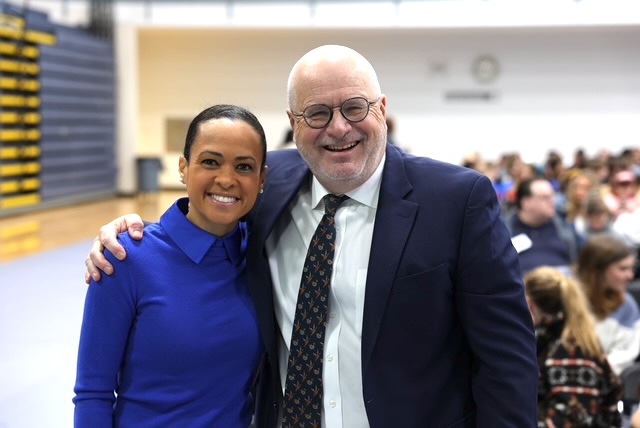
How should journalists cover controversial topics in this tumultuous time? ABC News anchor Linsey Davis came to St. Louis in late January to have that conversation, in public, with John Krull, director of the Pulliam School of Journalism and a nationally syndicated columnist. The event was geared toward students at Saint Louis University, but John had let me know; he and I both did our graduate work in SLU’s department of American studies, which presented the event. Like its curriculum, the current department chair pointed out, journalism involves power, culture, history, and the American experience.
Davis led ABC’s coverage of the 2024 presidential debates, and she detailed her routine preparation, researching everything she can find and figuring out what answers she can anticipate. She then asks the expected questions—so she can counter each answer with a harder-hitting follow-up.
She also described the ways she diffuses conflict, asking tough questions softly. She will pull a quote from someone’s past or from one of their adversaries and ask for their response. Or she might open, “What your critics are saying is that…” or “What do you say to those who….” Instantly, the direct confrontation melts into a calmer, speculative one.
I was nodding; you figure out that approach fast when you have to interview someone who can easily shut you down, kick you out, avoid the question. But why do I forget those skills when I am arguing politics with a friend or launching into a tricky topic with a neighbor or casual acquaintance? My husband usually kicks my shins in warning, preferring to cancel the launch. But I blunder on, because I think we all need to keep talking to one another, and because silence feels even tenser than conflict.
Now it occurs to me that instead of tiptoeing in by dropping phrases that will signal my own stance—then nervously awaiting a coded response—I could simply soften my questions. Instead of freezing or inflaming those everyday conversations, I might receive fuller, more genuine responses. Yet I never thought to transfer the skills. Too relaxed off duty, I guess? But these are not times in which one can relax.
Asked if she has ever had someone surprise her during an interview, Davis chuckled. “You know Little Wayne? That was the only time someone has ever walked out on an interview I’ve done.” First, she asked Lil Wayne how he planned to celebrate his thirtieth birthday, and he said, “I might go to Mars.” Then he asked her what Black Lives Matter was. Though she knew he knew, she had no choice but to begin explaining—and he got upset and walked out.
Davis was too polite to speculate about influences on his mental state. Instead, she asked John if he had ever been knocked off course.
“Yeah, on live radio,” he said. He had been interviewing a state legislator who was a chief advocate for gun rights and the Second Amendment. “I asked what I thought was a natural follow-up: ‘Okay, how far does that go? Will you say individuals should have the right to own nuclear weapons?’ I was expecting him to say, ‘Well, no’—but in fact he said, ‘Well, yes.’”
Davis laughed in sympathy. “How’d you follow up?”
“I said, ‘Could you explain your reason, and how that is going to make everyone safer?’”
The point, they quickly reminded us, is not to persuade or condemn. “As a journalist,” John said, “part of what you are doing is suspending moral judgement for a while.”
“Yes,” Davis said. “Help me to understand—”
“—why you killed this person,” John picked up. “What was going through your head.”
Again, I wondered: why have I stopped doing that in private life? I was able to sit for hours with the South Side Rapist and stay curious, calm, receptive. Only on the long drive home did the nausea overwhelm me. So how did that curiosity and empathy, so easy to summon at work even for aberration, vanish from my private life?
As though reading my mind, the next questioner refers to the recent ICE shooting in Minneapolis: “How are we to discuss events when the government simply ignores or rejects factual evidence?”
“There was a time when we could say, ‘Trust but verify,’” Davis replied. “Now you can’t just blankly trust.” We have moved too far from a consensus about reality, morality, and the rule and role of law. “In that scenario,” she continued, “it was fortunate on the side of truth that there was video and we could all see for ourselves. So there’s less burden on me. I can present to you, and you can decide what you see.”
John leaned forward to add, “Just because there are people out there who don’t acknowledge the truth doesn’t mean that the truth doesn’t exist, and it doesn’t matter.”
Another student asked how the fragmentation of media and the loss of trust in journalism affects our democratic process.
“That is something that keeps me up at nights,” Davis admitted. But she quickly pointed out that during Covid, broadcast news had record viewership. “They weren’t relying on social media. They wanted to hear from a trusted news source.” She repeated what an NYU professor once told her: “‘People watch the news for one reason: is my world safe?’”
“But as far as the erosion of democracy as the result of a lack of trust in media,” she continued, “I think that’s really scary. And really deliberate.”
Erasing trust is a fast way to chaos, she said, “and this is not new. This has been the way of it—I’m choosing my words carefully because I don’t want to draw false parallels, but in other periods of history when there were bad intentions, one of the first groups to be attacked was the media. Then at some point, things recalibrated, and there was trust again, and it went back to a certain homeostasis.”
John managed to find a little more hope: “Part of the reason audiences are so much more fragmented now is because there are so many more of us speaking. Under the old system, there were a lot of voices that weren’t heard…. When I started, if you did not have a substantial fortune, there was no way you could be a publisher or own a TV station. Even the stuff that discourages us right now—the horrible incident in Minnesota—who knows how that would have played out if people didn’t have phones.” Every one of us is now a reporter.
Another student question: “What do you do to take care of your own mental health?”
The journalist sitting next to me whispered, “That’s the most Gen Z question I’ve ever heard,” and I laughed and agreed. We never even thought about our mental health. In my years at an alt newsweekly, we worked crazy long hours and drank and cussed and cultivated a cynical, bleak humor in lieu of yoga and meditation apps.
Listening to Davis and John talk about the casualties in front-line reporters’ lives, though—the divorces, the alcoholism, the trauma—I had to admit the danger of romanticizing that toughness. But I wish young people could throw themselves into work for a few years before they start worrying about balance and me-time. All that comes later, as people grow seasoned, learn to prioritize, start families. But I will never regret the intensity of those years, when what we were doing mattered far more than comfort or calm.
Granted, it is not fair to expect young people to pour their time and energy into a job that could be yanked away the following week. Our overwork was cheerful because it happened in a context of hope. The environment was not so obviously in peril; you could save up and buy a house; watchdogging your government might test your patience, but it did not test your sanity.
So, yes, expecting young people to throw themselves into a journalism now precarious and suspect is not fair. But we need them to do it anyway. Journalism cannot afford to lose the old toughness, the dogged self-sacrifice, the stubborn hope—funny how that word keeps recurring—in a better future.