Boris the Armenian Woodworker
December 18, 2025
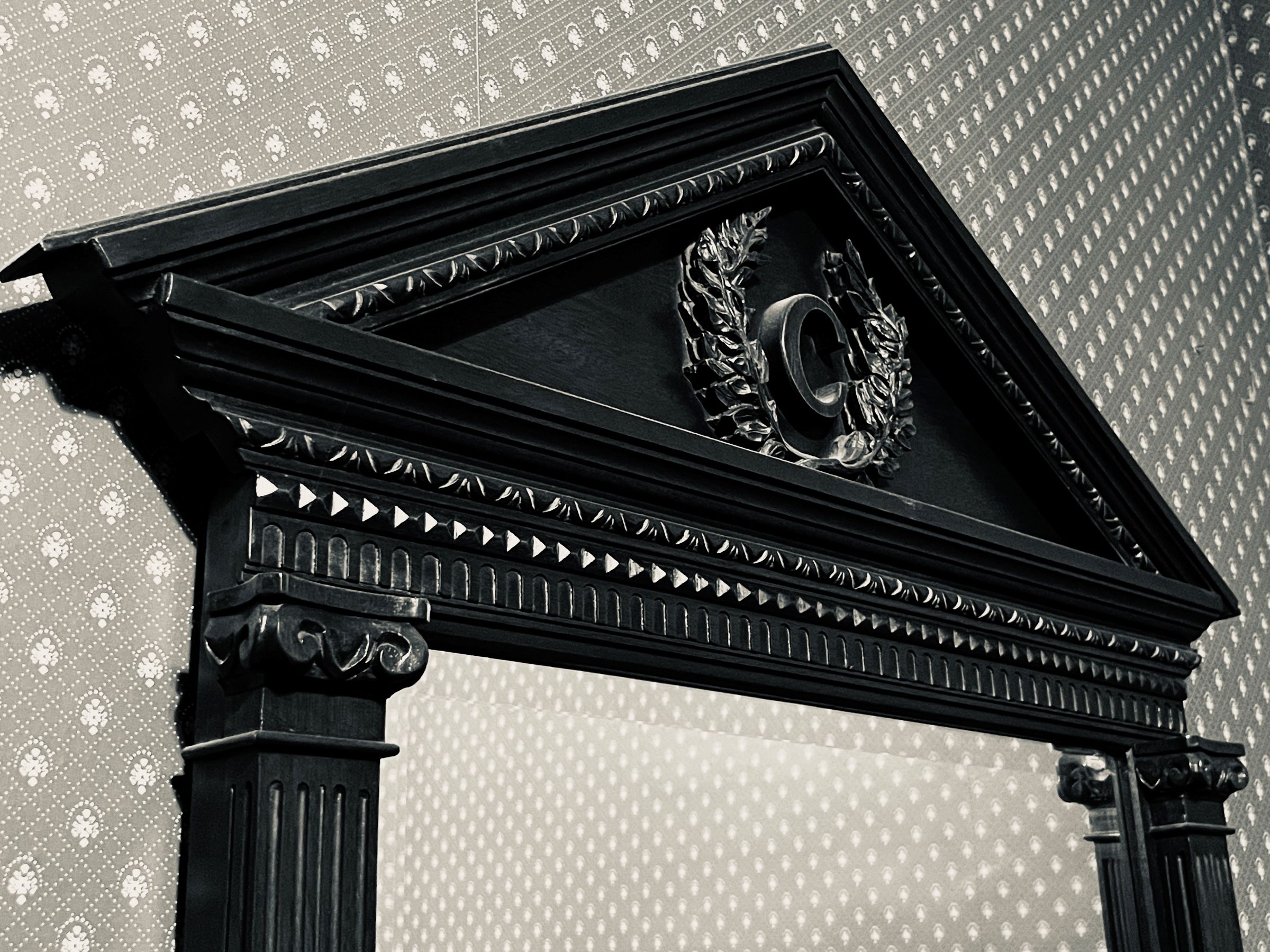
The mirror is carved from a single piece of—mahogany or cherry? I cannot remember. Yet I look at it every day: its columned sides and pediment top, and our shared initial carved into the center. A lovelier mirror is hard for me to imagine; this one suits us perfectly. And it was made by a dear friend.
When we first met Boris Khechoyan, then a quiet, self-contained young man, my husband pried his entire life story from him. How he was Armenian, but had lived in Azerbaijan. How neighbors who had always been kind, with food shared among the homes and celebrations together, went cold overnight, then flamed into a murderous rage. Boris came here as a refugee. He was now working for a St. Louis furniture company whose fast, supposedly efficient but to him slapdash methods hurt his soul. He liked dovetailed joints, not wood stuck together with thin glue….
We came to know his intelligent and gracious wife Irina and their lively, adorable young son and daughter. Boris carved winged lions to cover the stupid ovals on our sofa that had been filled with puffs of ugly fabric. He had clever, creative ideas about any problem you presented—ideas that were his own, not copied or googled or taken passively from AI.
At first his foreignness and amazing talent made him a bit of a caricature to us: when friends asked who had done such exquisite work, we said solemnly, “Boris the Armenian Woodworker,” as though he were a character in some allegory or fairytale. But once he became a friend, we could no longer simplify him. We answered with his full name and a bit of his story, eager for others to appreciate this remarkable man.
Going to their home was a treat—Irina would cook a Babette’s feast, warming hearts and tummies into ease, and Boris would show us the crib he carved for his son—more elaborately intricate than any royal baby’s crib in any century—or the thronelike altar chair he carved for the archbishop in preparation for a papal visit—or the lighter works that captured the sway of trees so well, the wood lost its solidity. As a gift, he made me a tiny square box, heavily patterned, in which I still place my wedding ring.
When we marveled—how did he make these works of art when he worked long hours every day at that job he hated?—Boris said, a bit haughtily, “If you are organized, you can do everything easily. Then you are not wasting time.” Other people went to bars, he added. He went to his basement and carved until 3 a.m. If he was engrossed in a project, he drank sweet tea and ate sour cream and kept going all night. “I could do simple things and make my life easier,” he conceded. “But I would not be happy.”
Boris was teaching their kids to have the same discipline. Little Alice was only six, and Yuri was eight, yet when he asked them to do something, he asked only once. He wanted them to pay attention and respond. If they ignored him, he did whatever it was himself—with a quiet determination that was probably worse for the kids than being yelled at.
Sadly, we no longer see the Khechoyans; they moved to California some years ago. But I think of them quite often, and the other day I found a little piece I wrote about Boris in St. Louis Magazine, and a wave of admiration and warmth flooded me. So much of what he used to say has stuck. His blunt critiques of our culture, for example: “In Europe, people try to buy the best quality. Here, everything is made in China and people try to buy the cheapest possible.” Back home, he added, “we never thought about becoming rich suddenly. Here it’s all money, become rich as soon as you can.” And American food! All those chemicals and empty calories! Our food seemed as insubstantial to him as that glued-together furniture, incapable of nourishing the body, just as that furniture failed to nurture the spirit.
The lack of real hospitality here also pained Boris; he had found it harder than he expected to make good friends here, or to simply relax and be social in a group. “People can live in one house their whole life and not know their neighbors,” he blurted. “To be locked in your own box and just live only your own life—to me, they are killing something inside themselves. They are killing inside a good soul.”
Childrearing also appalled him. “Do these parents not even like their children?” he wanted to know. As soon as the kids grew up even a little, the parents said, “Goodbye, leave me alone, just go, I have my own life.” And all that fuss about how to have a happy marriage amused him. The real answer was both easy and hard at once, he said, and very simple: “To be happily married, become a good person yourself.”
Boris taught me a great deal about determination. Faced with a challenge at 3 a.m. in his basement workshop, he would say, “Well, let’s try it. Who is stronger, me or the wood?” He was feisty, but endlessly patient, with a Zen ability to relax into alertness. “If you hold your tool too hard,” he would say, “you are wasting your power. I use my breathing. I send my energy through my hand to my tool. This way, I can work all night.”
And when he finally emerged from the workshop, he could play. He was funny, mischievous, sarcastic—but never hurtful, always kind. He and Irina were piecing together a life, scrimping on every purchase. Yet they gave us exquisite gifts: crystal glasses we still use on special occasions; a coffee-table book of works of Russian art. “People say, ‘You are generous,’” he remarked once. “But money spent for a gift is nothing compared to how you feel all the time because you make somebody happy.” When Boris helped you, he thanked you for the privilege. This was not a man who kept score of favors traded.
The same generosity showed when he began teaching: “I hide nothing from them,” he said of his students. “I say, ‘If you become better than me, I will be happy.’” By then he had met plenty of people interested only in their own advancement. “If you are greedy, you don’t talk with people, your eyes are moving all the time, your scowl is hard. I am open, I want to give you everything I know.” That said, Boris also grew wary, living here. “I am keeping a distance all the time,” he admitted. “People can talk a lot, they can talk very good, they can talk sweet. But the words are not friends with what they do.
“But if someone has good energy,” he added, grinning at us, “he can come close.”
By then, we felt honored even to know him. Now, I wonder: are the Khechoyans on some ICE list? The kids would be old enough now to see what is happening and be terrified. Boris and Irina would remember how people turned on them in Azerbaijan. How they fled to the U.S. to build a life in safety and freedom. How they never dreamed this could happen here.