Melania Trump, International Woman of Mystery
The First Lady writes a book about being cool when some like it hot.
By Gerald Early
July 31, 2025
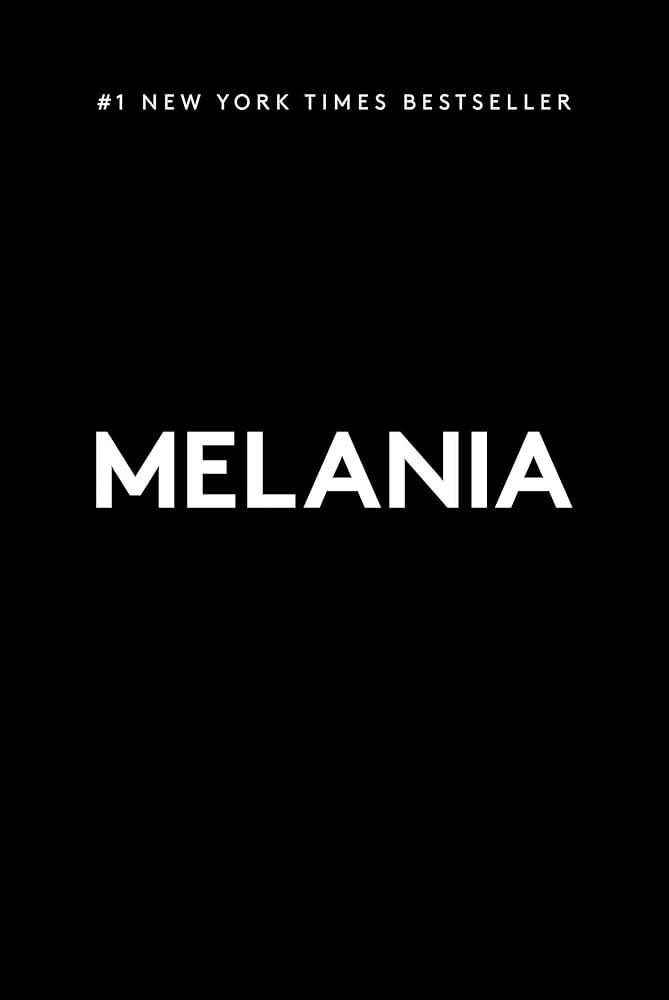
Melania
1. “As First Lady, I eventually found a natural rhythm”1
“The role of the First Lady encompasses a wide range of responsibilities,” writes Melania Trump in Melania, “Beyond family duties, the First Lady oversees approximately one hundred White House staff, including housekeepers, plumbers, engineers, chefs, florists, and carpenters. She plans and hosts all annual White House events, such as the Easter Egg Roll, Thanksgiving and Christmas gatherings, and visits from foreign dignitaries. She often travels with the president, which involves meticulous planning between the First Lady’s and the West Wing staff. Additionally, the Office of the First Lady manages her own schedule, initiatives, and travel. There are also unforeseen events—national tragedies, natural disasters, and global incidents—that require immediate and compassionate responses.” (88-89)
As Kate Bennett, one of Melania Trump’s biographers, put it, “Being first lady of the United States is … a terrible job. The role is undefined, often unfulfilling, and unpaid. … A first lady is expected to be smart, but not too outspoken about her views; kind and empathetic, but not syrupy or weak; aligned with a cause, but not one that is too polarizing or off-putting; supportive of the president, but not a Stepford wife; traditional, but not old-fashioned.” (Kate Bennett, Free, Melania: The Unauthorized Biography, Flatiron Books, 2019, 1) The job symbolically is being the national hostess, the nation’s big sister, den mother, cultural cheerleader, advice dispenser, reassuring conscience, and dedicated preservationist. It is sort of like being an old-fashioned preacher’s wife for the entire nation. For many, the First Lady may be an ornament on the hood of the president’s favorite car, but it is an ornament that must justify, amplify, and burnish itself.
“In 1999, when asked what kind of First Lady I would be if Donald became president,” Melania writes, “I said I would be very traditional, like Jackie Kennedy.” (76) That Jackie Kennedy was her ideal of her First Lady is hardly surprising, as Kennedy was the most beautiful, glamorous, and stylish of any First Lady of the twentieth century. She was young, still having children while she was First Lady, and touched with a sort of cosmopolitanism. And she was the nation’s First Widow when her husband had his head blown apart on a public street in front of her eyes. Eleanor Roosevelt, beloved by Black folk for her stance on civil rights, may have been the most liberal activist of all First Ladies, but Kennedy was a myth who transcended politics. Of course Melania, the gorgeous model, would want to emulate Kennedy, would want to embody the idea of the First Lady as an international icon, like Kennedy, who was able to speak another language. Indeed, better than Kennedy in this regard, as English is not Melania’s native tongue. Melania, the Slovenian fashion model, would be only the second First Lady in our history to be foreign-born.
Did she want to be First Lady? “Relatively early in her relationship with Trump,” writes Melania Trump biographer Mary Jordan, “a reporter asked her if she’d like to be first lady. ‘I think every woman, every girl would. Yes, I would, why not?’ she said. ‘I will put all my energy in it, and I will support my man.’” (Mary Jordan, The Art of Her Deal: The Untold Story of Melania Trump, Simon & Schuster, 2020, 128) It was even better than being Sophia Loren, another woman Melania admired while growing up and was often told she resembled.
After Trump won in 2016, Melania did not move into the White House until June 11, 2017, nearly five months after Trump took office. In her absence, Trump’s daughter Ivanka, was such a presence that many thought that she had usurped the office of First Lady. Melania downplayed this in her book: “During the first half of 2017, I split time between New York, Washington, and Mar-a-Lago, managing my duties as First Lady and supporting my husband’s administration.” (89) Melania stayed in New York so that Barron, her and Donald’s son, would not have to change schools in mid-academic year. Fair enough. But the security costs for Melania and Barron remaining in New York were placed conservatively by the New York Police Department at $125,000 per day. (Jordan, The Art of Her Deal, 36) There were protestors outside of Trump Tower, aggrieved by what she was costing taxpayers by remaining in New York and insisting that Trump pay for it. Barron’s arrival at school every day was a nightmare for the parents of his schoolmates. Whether Melania was troubled by this is unclear. She did not seem to be unduly concerned. The biggest criticism of her is that she can be detached to the point of seeming cold.
There were rumors that her marriage was on the rocks, so insistent and persistent that Trump’s inner circle was demanding that she get down to Washington to at least, on the surface, put an end to them. So let us say that Melania’s account of the delay rings a bit disingenuous or forthcoming. There was something a bit Greta Garbo-like in Melania’s initial stand-offishness about being First Lady. She even told reporters at first to stop calling her “First Lady.” (Jordan, The Art of Her Deal, 32) But she did truly want the job. In elementary school, some of Melania’s friends called her Jackie Kennedy because she wore high heels, not for special occasions only as the other girls did, but every day. Finally, in the summer of 2017, she had her chance to be her version of Jackie Kennedy.
2. “I have never been one to sit idly by, even with the comfort of a successful husband by my side.”2
Her book design itself seems an exercise in branding. Only the word “Melania” on the cover. Nothing else, indicating not just fame but a sort of stardom, a woman known by only one name like singers Madonna and Beyoncé or, more fitting here, models Iman and Twiggy. Or a First Lady like Jackie, who may have been the only post-World War II president’s wife who could have published an autobiography with the same design and gotten away with it. One-third of this short book is made up of photographs of Melania, appropriate, I suppose, for a book about a model, but perhaps also a way for her to hide in plain sight, so to speak, to avoid having to talk about things she does not wish to talk about.
The timing of the publication of Melania seems odd. It was released in October 2024, just before the election. Indeed, the last chapter is about the attempted assassination of Trump in Butler, Pennsylvania, which happened on July 13, 2024. The repressed nature of this book argues against it being a true autobiography or memoir. That was unavoidable as Donald Trump was running for the presidency again. How much could the former First Lady reveal about the foreign leaders she met, or Trump’s revolving inner circle of advisors and Cabinet secretaries or the Republican leadership, which both endorsed and sabotaged the brash businessman simultaneously? So, the book is not really candid as much as it is strategic or, shall we say, pointed, even aimed, at staking out Melania Trump’s positions and demonstrating her obstinate control over her own narrative, an obstinacy more than justified by the peculiar difficulties of being “the political spouse,” where the demand for privacy is an inevitable, even predictable, form of resistance. All of this was calculated as her appeal to the voters.
Yet this is not what is called “the campaign book.” After all, she is not running for office, and it is not entirely clear if she wants to be First Lady again, although becoming First Lady had to be something like the pinnacle of her own strivings against obscurity. But the book is clearly meant to aid her husband’s chances.
It is the Pilgrim’s Progress in America as the land of opportunity, where one carries one’s ambitions rather than one’s sins upon one’s back. It is a tale of how she went from being Melanija Knavs to Melania Knauss to Melania Trump, the Americanization of Melania.
There is no mention in Melania of Stormy Daniels, Karen McDougal, the Access Hollywood tape (which nearly destroyed Trump’s candidacy in 2016, a candidacy that was rescued, in part, by Melania’s statement of her continued support of her husband), or E. Jean Carroll. There is no mention of pre-nuptial agreements or how she re-negotiated hers with Trump while she was delaying her arrival as First Lady in 2017, at a time when her bargaining position was at its strongest. (She did not want Barron to be an afterthought in Trump’s will, considered less than his other children.) What is absent in the book reveals, unsurprisingly, her loyalty to Trump and to Trump World, and her devotion to the protection and advancement of her son. A tell-all book of any sort, even the modest sort, would not do her or her son any good. It is said that Trump trusts Melania’s opinion above anyone else’s in his orbit, quite possibly because he admires how perfectly well she understands and defends her self-interest.
Her memoir opens with her arrival in America on August 27, 1996, at the age of 26, to continue her career as a model. The opening section concludes with her obtaining citizenship in July 2006. So, she frames her story as the immigrant coming to America to seek her fortune like, say, Arnold Schwarzenegger. It is the Pilgrim’s Progress in America as the land of opportunity, where one carries one’s ambitions rather than one’s sins upon one’s back. It is a tale of how she went from being Melanija Knavs to Melania Knauss to Melania Trump, the Americanization of Melania.
She had been a successful, though not a top or super, model in both Milan and Paris. Her success came through her mother, a pattern designer and seamstress with artistic, rather than purely craft-oriented, inclinations, who dressed Melania and her sister up and had them modeling clothes as children. Melania took to commercial modeling. She had the looks, the poise, and the drive for it, as it is incredibly hard work. She talks in her memoir constantly about her “work ethic.” She, like fellow immigrant Schwarzenegger, was hungry. Federico Pignatelli, who owned Pier59 Studios in New York and was the first person Melania contacted when she arrived in the United States, said of the Eastern European women who went into modeling, “They were very disciplined; they really wanted to make money, and they were working very hard.” About Melania, he said, “[She] was not one of these models that would just talk and talk and talk. She would only talk when she really had something to say.” (Quoted in Jordan, The Art of Her Deal, 93)
Melania herself writes about modeling: “Models were often invited to parties and clubs by groups of men, promising work, money, or connections. It was common for agents to extend invitations for trips, dinners, or parties, emphasizing the importance of networking in the industry. While others indulged in a lifestyle of excess, I stayed focused on my goals and ambitions. I witnessed the harmful effects that drugs and excessive drinking had on young women around me, and I refused to be swayed from my path, remaining singularly intent on my career goals.” (30) The sleaze beneath the glitz of glamor businesses is enough to make a person think that glamor comes at a very high cost. People who represent our fantasies get rewarded, but pay a price as well. The industry of modeling could, in some respects, be seen as a kind of trafficking of women. Rich, lecherous old men and young callow playboys collect models in the way that Hollywood moguls collect starlets. Melania had negotiated living in cities by herself, where she had to learn enough of the language to get by. She was determined not to get used and abused by the modeling industry, chewed up and spat out like an expensive whore discarded by her pimp.
One-third of this short book is made up of photographs of Melania, appropriate, I suppose, for a book about a model, but perhaps also a way for her to hide in plain sight, so to speak, to avoid having to talk about things she does not wish to talk about.
In the late 1990s, Trump, by then having recovered from some reverses and back on top again in the business world, and always at ease with sleaze, was a “modelizer,” a guy always hanging around models, wanting to be seen with them. Not for sex so much as for publicity. He was working his brand. It was at a party that Melania met Donald Trump in 1998. She and Trump clicked, despite the fact that he was 24 years older or maybe because of it. In 1999, she was working for Trump’s modeling agency. (She does not mention this last fact in her memoir.) Around 2000, she moved into Trump Tower. He proposed marriage in 2004, and they married in 2005. A year later, Barron was born.
Despite her drive, intelligence (she had been an architecture and design student in a highly selective school), and asceticism (she does not even mention having a boyfriend, let alone having had sex before meeting Trump), and her success as a model (she was plastered all over New York in a 1999 ad for Concord Watch called “Be Late”), she was dismissed as a mere gold-digger. But she gave a sharp, smart, and now famous reply when asked would she be with her husband if he were not rich: “If I weren’t beautiful, do you think he’d be with me?” (Jordan, The Art of Her Deal, 28) All marriages are transactional. They always have been. Are not all marriages arranged? In our highly individualized culture, you simply do the arranging yourself instead of having someone else do it.
Her memoir provides some details about some of the projects she did during Trump’s first term, including her signal initiative, Be Best, launched in May 2018, meant to address, among other things, online bullying of children and opioid addiction. She was annoyed that critics “questioned the grammar” of the title of her project, “suggesting alternatives like ‘Be Your Best’ or ‘Be The Best.’” It was a way to show that they did not take it seriously. Melania might have been imitating the name of the Concord Watch advertising campaign “Be Late,” which was so highly praised in the advertising world, and that made her face one of the most seen in New York for a time. She may have thought it was effective branding. Also, articles like “a” and “the” are not used in the Slovenian language. And it was not unusual for Melanie to drop them as a non-native speaker of English. (Jordan, The Art of Her Deal, 9) So, “Be Best” may have sounded pleasing to her as something a non-native speaker might say.
In the memoir, she distinguishes herself from Trump by supporting legalized, unrestricted abortion and denouncing the separation of children from families who came into the country illegally. This, of course, is important in demonstrating her independence. This seems authentic or makes her authentic. On the other hand, she is chary of trans athletes playing in women’s sports; (158) and not so sure that the 2020 election was on the up-and-up (161-163). She clearly thought that the mainstream media was unfair to her husband. (161) She speaks about the ways she was “canceled” because of being married to Trump. (169-171), some of which seem petty and vindictive, such as her bank canceling her account for no reason. Perhaps she summed it up best when she said, “It’s not always pleasant, of course, but I know what is right and what is wrong and what is true and not true.” (Quoted in Bennett, Free, Melania, 194)
She truly seems a tough-minded, inner-directed, intelligent woman who wants to be humane. And who also wanted to be rich and important. For Trump fans and those interested in the history of First Ladies, Melania is a must-read, although it may also be disappointing. It did not disappoint me, as I rather enjoyed her construction of herself as the international woman of mystery and hard work, of craft and integrity, the admirable career girl and principled but driven manhunter, the expensively clothed, impressive leader, and the rich bitch. The repression in the book is her cool. And some like it cool. For myself, though, Mrs. Trump has a better, richer, more complex book within her, more worthy of her gifts and more worthy of history. I hope one day she writes that one, if only for her own sake.
1 Melania Trump, Melania, 100.
2 Ibid, 60.