A Visit to the Jesuits’ Lakota Museum
How good and evil confront each other in our complicated history.
By G. F. Fuller
February 28, 2026
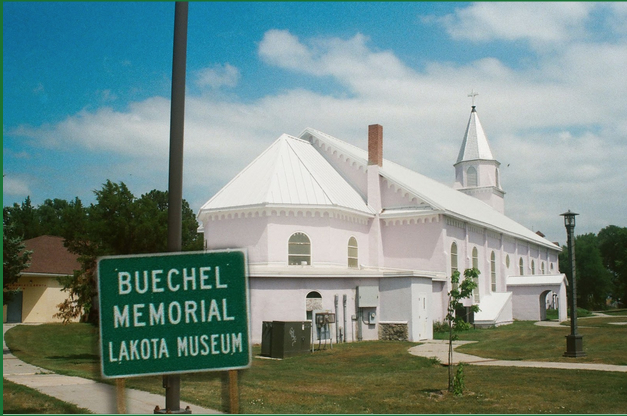
“It’s complicated,” the museum curator says; he keeps saying it’s complicated. At times, he picks sides: praises the Jesuits for the good they have done, throws them under the bus for the evil. He also points back to the government in Washington, the policies that drove this place’s history.
Harold Compton has a soft, boxy face and wears thin rectangular frames. A feathery quaff of grey-white-black hair settles upon his head. He enumerates good experiences, bad experiences… He was not beaten. But he was not allowed to speak his own language.
The history of the Catholic boarding school upon which the museum stands. He keeps saying it is complex, which I know it is. But faced with all that complexity, I wonder about him. As he guides me through the Jesuit-owned Buechel Memorial Lakota Museum on South Dakota’s Rosebud Sioux Indian Reservation, I wonder whom he might blame; whom he might hate; what he might think is the truly right thing to do; if he thinks history works in a grand arc that ends in justice. He used to believe in something like that.
Harold is a good guide, a very energetic, charismatic, speed-talking man who does not seem to like silence all that much. He explains, elucidates, but in what he does not say, or says tacitly and with ambivalence, he inspires that angst about history, the grand arc, the passing of time, that comes to haunt Christians, ambivalent/lapsed Christians, and non-Christians alike. That among the competing and overlapping versions and visions, one of them might actually be right. Then there would really be some reason, some universal and righteous good, and then there really would be a hell.
He was raised an altar boy. Now he comes to mass now and then, but comes more often to the light blue wooden church to escape the heat on the campus of Saint Francis Mission Indian School just north of the Nebraska border. The church has AC. And murals of White people. And a poster that says abortion is not the Native way. And a life-sized statue of Jesus dying on the cross for our sins, which he thinks is too big on account of it scares the kids.
“It’s a complex place,” he goes on, citing the graduates who report they were provided for, educated, and taught discipline. “I have these two extremes,” he says. On the one hand, the priests who committed their lives to helping the reservation community; the organization which offers free wheelchairs, sobriety, and carpentry lessons. On the other, the stories—found through lawsuits and letters and living people—of theft, assimilation, abuse. Father Fagan, who was sorry for the sins of his past, the lives he scandalized. Father Chapman who emerged from the basement with little girls and their torn underwear.
The afternoon heat, the slight but boiling breeze, the immense quiet of a poor reservation town. “With the controversies and the boarding school,” Harold says as we exit the church next to the museum, “it’s surprising how peaceful this place is.”
When The Washington Post probed the history of America’s Indian boarding schools, investigators found that from the 1940s to the early 2000s, there was consistently at least one individual accused of sexual abuse working at St. Francis Mission. For a stretch of almost two decades, there were six. “So few things seem normal,” one missionary observed in 1973. (By then, there were six in a town which at the turn of that decade numbered just 300 residents.) “People do not even pretend to want to change or improve a situation, but just laugh it off as ‘the way we do it here.’” The letter continues: “Sometimes it is contradictory and painfully wasteful of manpower and funds. Perhaps there is much yet to be learned.”
The afternoon heat, the slight but boiling breeze, the immense quiet of a poor reservation town. “With the controversies and the boarding school,” Harold says as we exit the church next to the museum, “it’s surprising how peaceful this place is.” And indeed, through those white wooden doors, the grounds of the Jesuit mission are flat and silent. What else, I wanted to reply as we left those machine-cooled walls, could it have been—but peaceful?
When Harold greets visitors at the museum, he prefaces with “it’s complex.” He makes sure to inform them that the artifacts here are held “in a good way.” No grave digging; no battlefield pillages; these were things given to the priests. And someday, he says, without elucidating a day, they will be given back to the tribe. “Held in trust” is the phrasing he uses.
The collection of Indian mannequins, moccasins adorned with colored beads, war bonnets with streams of hair and feathers, and all these vintage ethnographic black-and-white photos: they come collected, cataloged, conserved by a German Jesuit who rarely gave reasons for why he did what he did. Like the artifacts, Father Buechel counted baptisms, communions, confessions. Beginning at the turn of the nineteenth century, he itemized Native words on notecards, plants in a herbarium, traditional stories, portraits, even the reasons why and when the mission was failing. But seldom did he log his own motivations. “His purpose is implicit,” observe two theologians who wrote about the man’s legacy as of 2007, “done as it were as an act of faith…”
In my tour, I learned from Harold that Johnny Cash once came to the Rosebud reservation to play in the boarding school gymnasium. And I learned that White people—motorcyclists/gardeners from Idaho, translators/illustrators from the Czech Republic, and perhaps an assortment of blondes/beauties from Europe (who may or may not flirt with Harold)—come to Indian Country to seek things they cannot acquire on their own, or among their own, or in their own. Sobriety, a spiritual journey, Johnny Cash’s guitar: all religious pilgrimages, pursuits of faith, in some way or another.
The collection of Indian mannequins, moccasins adorned with colored beads, war bonnets with streams of hair and feathers, and all these vintage ethnographic black-and-white photos: they come collected, cataloged, conserved by a German Jesuit who rarely gave reasons for why he did what he did.
Many many years ago, the Lakota emerged from Wind Cave in the Black Hills in what is now South Dakota (and the forest of Mount Rushmore). The buffalo were there to greet them. From their land and their roots in it, they derived the meaning of everything. They were a large, powerful tribe with a wide range on the Great Plains. When foreigners arrived, not long ago, there came trade and war, promises and treaties, efforts aimed at extermination or forced acculturation. Settlers, along with the American government, encroached upon their territory and confined them to reservations.
Lakota peoples are often portrayed in a distant, unrecoverable past, pictured in war bonnets, and viewed as—in Harold’s words—“the epitome of Indians.” The history of the Lakota, however, is still very much in motion. A trip to Rosebud puts the past in perspective: the 1877 theft of the sacred Black Hills, along with massive swaths of Lakota land, was not so long ago; neither was the 1890 massacre of some 300 men, women, and children at Wounded Knee; and neither was the forced education of Native children in government boarding schools, which only officially ended in 1969.
How one interprets the meaning of the Buechel Memorial Lakota Museum, the theologians Bucko and Koppedrayer write, depends upon “whether one saw salvation or destruction in the mission’s project.” The items were indeed given to Buechel, but were pulled from their context, encased in a past. Still, in the present, they are here, and although Harold finds the ownership of the collection strange, (“all the time, very strange”), he is at peace with it, “because it exists.” Those scholars write of an “expanse of blue beading” which “carries and refracts images and objects through so many reflections that any fixed standpoint is challenged…” The museum and its history, they suggest, is like that.
To cope with all that complexity, he prays. At Bear Butte, where the clouds and grey mist shroud the summit. At the top of Quick Bear’s grass mountain: at the edge of the trees overlooking miles of undulating sand hills; where Harold can see far out into the dunes. And in the cool, bright, somewhat stale-smelling wooden pews of the boarding school’s Catholic church.
Lakota peoples are often portrayed in a distant, unrecoverable past, pictured in war bonnets, and viewed as—in Harold’s words—“the epitome of Indians.” The history of the Lakota, however, is still very much in motion.
Harold never mentioned who or what he prayed to, and I never asked. His father, who had no use for Catholics, would say, “God is the blood that runs through all of us.”
“I pray to be at peace with the past,” Harold tells me. “Otherwise, it’ll make your head spin.” He tries, in the expansive sense of the words time and history, to focus himself on the present. Because that word history, he says, can overwhelm you.
But his job is one rooted in the past. Of his people. And not of his people. Of the Jesuits, too.
He sometimes sits back and wonders: how in the hell did they get these huge boarding schools? And when he asks that question, it seems he is searching for something more than a history lesson. The answer to why the Jesuits run this Lakota Museum may be a fact of destiny, or of irony, or of government policy. Months after the summer in which I visited him, Harold retired from the mission’s museum. He had spent six years there. “That’s a special place,” he recalls. “To put it mildly, that’s a special place.” Nearing seventy years old, he now spends his time working from home for a foundation that works to retain lands in Indian ownership and management.