A Historic Vice President Tells How She Played Her Party’s Gambit
Kamala Harris uses the micro-memoir to memorialize her big moment
November 22, 2025
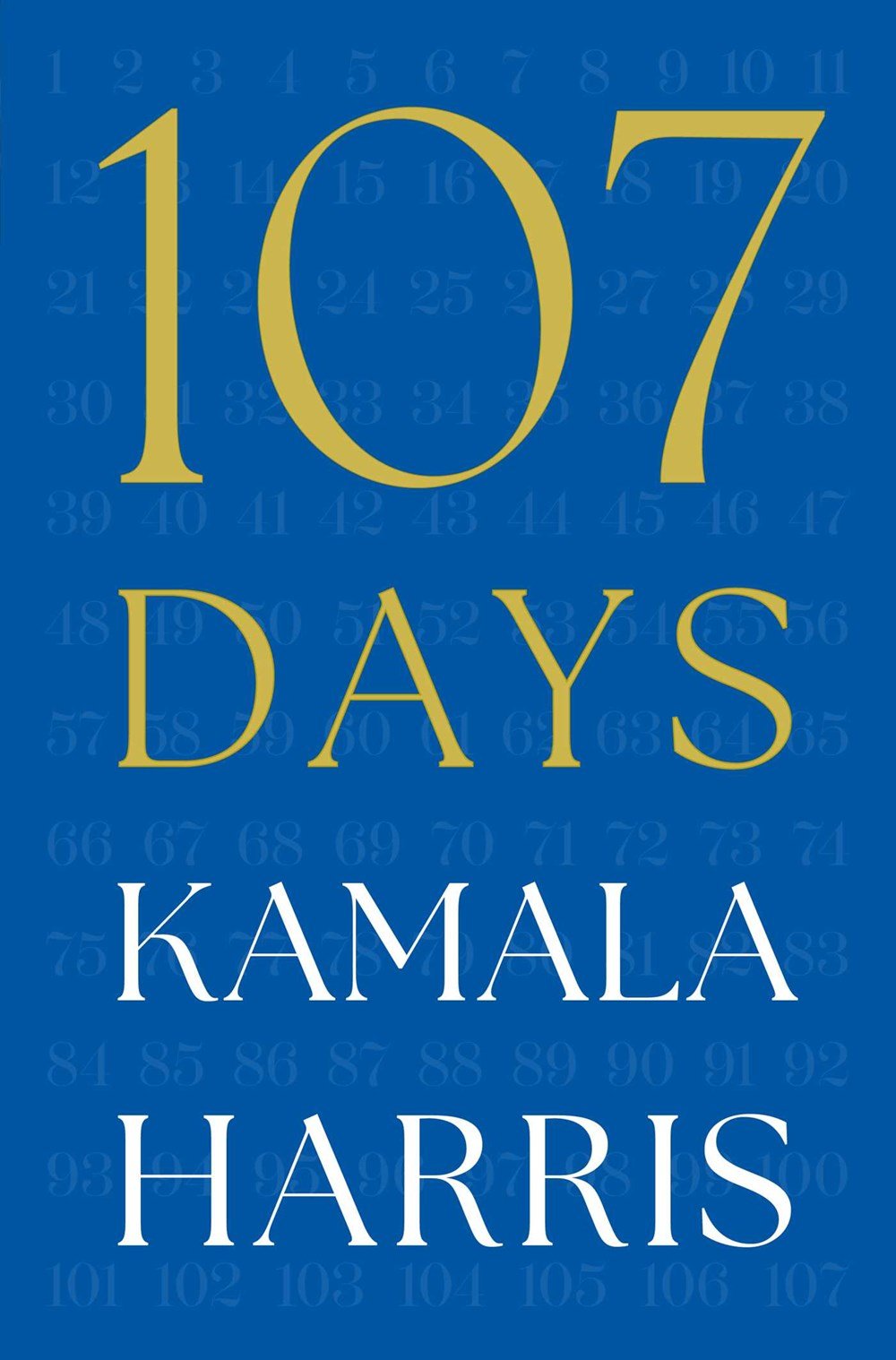
107 Days
In her book, 107 Days, former U.S. vice president Kamala Harris takes the reader through her abbreviated presidential campaign, beginning with the moment when then-president Joe Biden called her secure line and shared his plans to drop out of his re-election run. While there has perhaps been more energy given to her events and appearances promoting the book than the contents of the micro-memoir, it is rather telling that so many of her book tour stops feel like an extension of her previous campaign and an early look at what the 2028 election cycle may hold. Published less than a year after her loss to Donald Trump in the 2024 election, 107 Days is an extraordinary feat in its turnaround time. However, in its haste to hit the shelves, there may not be enough distance in the former VP’s assessment of her campaign to truly offer the clear vision of hindsight.
Timing is a central character in the story Harris tells about her 2024 campaign. The book is framed as a countdown towards election day, with short chapters that read as journal entries marching towards the now-known results of her short push to the presidency. Much of the book is unsurprising in its narrative—Harris is primarily concerned with setting the record straight and telling “her side” of what happened. It is at once defensive and detailed, and often as corny as it feels calculated. She shares how a range of key Democrats across the country responded to her entry into the running. My personal favorite? Her shady recall of California governor Gavin Newsom’s response, “Hiking. Will call back. (He never did).” (p. 19) She revels in the “Kamala is brat” declaration from Charli XCX and dedicates a significant amount of time detailing the many popular culture and political icons that contributed their cultural capital to the campaign. The reader is inundated with a frantic attempt to deliver a cohesive message to voters, to rally across generations to build something sustainable in a short time. It is a worthy endeavor, but one that felt constantly hampered by a party attempting to re-form a campaign sized for Biden to Harris’s form. Harris repeatedly spends an incredible amount of time looking to appease Biden and his team, delicately moving into campaign HQ even as she acknowledged the short time frame to make things shake. Others, like David Plouffe, were not afraid of saying the quiet parts out loud: “People hate Joe Biden.” Harris writes, “It was hard for me to hear that.” (p. 31) Her misplaced loyalty to the former president (despite his own advocates within the White House sabotaging her at multiple turns) is rendered a key misstep for her, looking back. She writes, “Was it grace, or was it recklessness? In retrospect, I think it was recklessness. The stakes were simply too high. This wasn’t a choice that should have been left to an individual’s ego, an individual’s ambition. It [Biden’s decision to step aside] should have been more than a personal decision.” (p. 46)
While there has perhaps been more energy given to her events and appearances promoting the book than the contents of the micro-memoir, it is rather telling that so many of her book tour stops feel like an extension of her previous campaign and an early look at what the 2028 election cycle may hold.
While some aspects of those 107 days seem fairly obvious, if not quite frustrating, there are details of the book that will stay with me for some time. On election night, champagne and cupcakes sat in a kitchen, waiting for the go-ahead once the final numbers rolled in. As victory moved further and further away, one of Harris’s staff “painstakingly peeled icing that read ‘Madame President’ off the top of each cupcake. Having converted them to innocuous comfort food, she sent them out, along with more wine, in case people needed it.” (p. 282-3). Reading this, I imagined a sinkful of scraped icing as staffers and supporters distractedly eat smeared desserts in the next room over. The most painful chapter is a short one: “January 6, Certification Day.” In less than three pages, Harris takes us across time from the infamous January 6, 2021, when an insurrection challenged the legitimacy of the election, and by extension, Harris’s vice presidency, requiring agents to relocate her to a secure location. She then jumps forward to four years later, where she is required to read the numbers aloud certifying Trump’s victory over her own campaign. She is only the third VP to face this unlucky task. The others? Nixon for Kennedy and Gore for Bush. Historic company indeed.
It is impossible to read the book without considering what being the first woman president of the United States could have meant. Following Harris’s successful clean-up interview after Biden’s disastrous debate with Trump, pundit John King notes, “She is a great asset to this team, and they have kept her under wraps.” (p.12) Harris does not linger too long on how she found herself underutilized while in office, only to be underestimated as a viable candidate at the beginning of the election cycle. However, she does illustrate some of the ways that gender shaped her campaign experience, understanding the hyperfocus on what she wears and how she moves, and acknowledging that there is no right way to “be” for her, as she is simultaneously racialized and gendered by political pundits and policymakers. In reading her observations throughout the campaign, it is also possible to see how she attends to what others may miss, adjusting as only someone socialized in this world as a woman may see—the inadequate portions ordered for staff (which she immediately remedies herself), the social soothing needed to assure the Bidens she does not plan to harm their legacy. She is a presidential hopeful that somehow still needs to make dinner happen: “Since I’m the cook in the family, I needed to make big batches of food and freeze them for [her husband Doug], so he’d have something decent to eat when I was gone.” (p. 39) Moments that seem fairly mundane speak to the extra labor required of women, where the pressure to spend time with her nieces can occur even as she works on strategy and speeches aimed at assuming the highest office in the nation. Even as she steps out on the campaign trail, she is forced to grapple with the idea of “real men” supporting powerful women as a talking point, becoming most distinct as a rallying cry within the Black community, as some polling predicted a solid bloc of Black men would vote for Trump. With all of this, it becomes easy to see that Trump’s rhetoric and the dinosaur Democrats’ approach do not fully explain why Kamala Harris failed to pull off a successful campaign. That racism and sexism undoubtedly shaped the possibility of the former VP’s bid for president is an understatement; that her own decisions along the way felt impacted by her own double consciousness remains one of the bigger insights of the book.
Harris is perhaps most brave when admitting her naivete, whether in the choice to avoid distancing herself from Biden or the decision to go on Fox News in the hopes of civil, reasonable conversation (one of several media gaffes). The shoulda, woulda, couldas bound up in the book include direct re-dos of how she wishes she answered certain questions, provided as if she is making up an exam she failed the first time. There is also, of course, election day. She writes in this chapter, “Why were we feeling so confident in a race that had never shifted out of toss-up territory?… We had plans for all kinds of contingencies—that Trump might win Pennsylvania and claim premature victory, that we might win narrowly and Trump’s supporters would react with violent rejection of the result, that the count might drag on for days. We’d planned for everything, it seemed, except the actual result.” (p. 280-1) Throughout the book, Harris runs down a range of missteps by the campaign, by the party, by the very strategists tasked with knowing how to navigate the current media ecosystem. It seems unclear what the airing of these errors might serve for Harris or Democrats in general going forward, seeming to consistently illustrate the lack of political agility, media acumen, and haphazard risk assessment within the party.
Upon reading the book, I wondered if anyone within Harris’s camp or the Democratic party had learned tangible lessons on the haphazard nature of the 2024 election cycle, or whether 107 Days represented a potential loop rather than a look back. What would be remembered and taken forward?
I read 107 Days front to back and then revisited it from the Afterword to the first chapter (when Harris receives Biden’s call), and found it fascinating to get a second perspective, where the final thoughts feel as though they were written yesterday, and each page before feels like someone is hitting the rewind button. Time is a fickle thing, and memory perhaps even trickier in the long run. Upon reading the book, I wondered if anyone within Harris’s camp or the Democratic party had learned tangible lessons on the haphazard nature of the 2024 election cycle, or whether 107 Days represented a potential loop rather than a look back. What would be remembered and taken forward? Given that vivid detail provided, I wondered if Harris kept a journal of each of these days and remain curious about her methodology in determining what to strategically share in the case that she decides to run it back in 2028. Near the conclusion of the book, in its afterword, there is a glimpse into her mindset going forward. She writes, “I wanted a seat at the table. I wanted to make change from inside the system. Today I’m no longer sure about that. Because the system is failing us. At every level—executive, judicial, legislative, corporate, institutional, media—every single guardrail that is supposed to protect our democracy is buckling. I thought those guardrails would be stronger. I was wrong…In this critical moment, working within the system, by itself, is not proving to be enough.” (p. 299) It is unclear exactly when Harris wrote this afterword. We know it follows the California fires and the inauguration, but somehow, it has caught the constant dumpster fire of the everyday news cycle. The idea of “changing the system from the inside” feels like the standard optimistic refrain of those in the military, law enforcement, and, of course, politics. It may induce an understandable eye roll, but it also speaks to how even a believer in “the system” has much to learn about sustained progress and movement building, both past and present. In the final pages of the book, Harris is reflecting on how much damage has already been done. “Perhaps so much damage,” she writes, “that we will have to re-create our government. And that doesn’t mean nostalgically reproducing what has been before, but something leaner, swifter, and much more efficient.” (p. 297) 107 Days is a maddening book to read in this moment, but perhaps an important one for encapsulating American politics today and understanding how we got here (more recently), and perhaps where we might be going. Time will tell.